
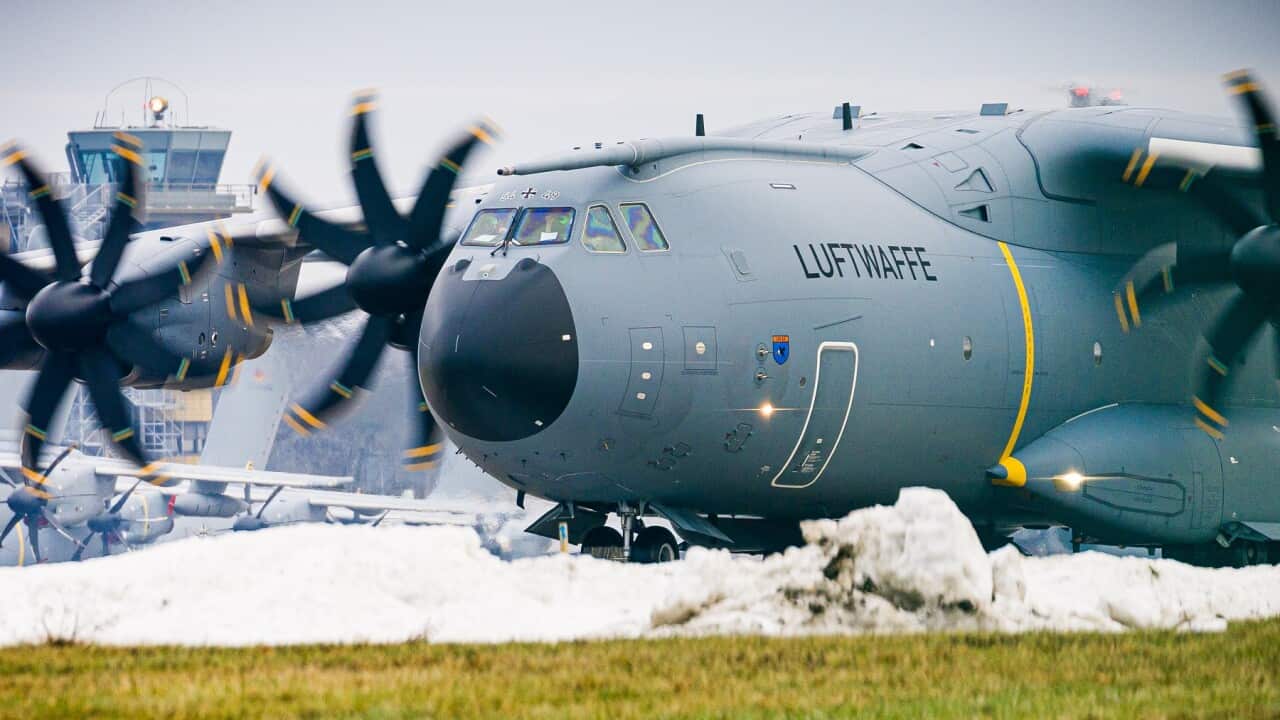

Greenland is rapidly becoming a geopolitical flashpoint. European troops are arriving on the island, Denmark is pushing for a stronger NATO presence, and the Trump administration insisting it still wants the United States to acquire Greenland.
Listen to Australian and world news and follow trending topics with SBS News Podcasts.
TRANSCRIPT:
A Danish Royal Air Force plane has touched down in Nuuk, delivering military personnel as Denmark steps up security and begins fresh exercises in Greenland, alongside NATO deployments.
President Emmanuel Macron says French troops are already on the ground, with more arriving by land, sea and air.
He says the US ambitions for Greenland are not just Denmark’s problem, but Europe’s and NATO’s as well.
“In Greenland, an autonomous territory of the Kingdom of Denmark, Europeans have a particular responsibility, because this territory belongs to the European Union and is also that of one of our NATO allies. France has decided to join the exercise that was scheduled and launched by Denmark in a sovereign and independent manner, as part of 'Arctic Endurance'. A first team of French soldiers is already on site and will be reinforced in the coming days by land, air and sea means.”
While officials describe the deployments as routine training, the signal is unmistakable: that NATO can maintain Arctic security without the US, a key NATO member.
Greenland’s Prime Minister, Jens-Frederik Nielsen, says sovereignty is not negotiable.
“As I have said. Greenland does not want to be owned by the USA. Greenland does not want to be governed and controlled by the USA. Greenland does not want to be part of the USA.”
European Commission President Ursula von der Leyen says the alliance will provide strong backing, emphasising that Arctic security is central to NATO and the EU.
“What is clear is that Greenland can count on us politically, economically, and financially. And when it comes to its security, the discussions on Arctic security are first and foremost a core issue of NATO. But I also want to emphasise that it is the Arctic and Arctic security, both topics, are core topics for the European Union and matter enormously for us."
Talks between Denmark, Greenland and the US in Washington this week delivered no breakthrough, with the Trump administration still arguing it needs Greenland for security and saying it will acquire the territory “one way or another”.
Maria Martisiute, from the European Policy Centre, says Europe is now facing the early stages of a deep political and military crisis, though she still hopes diplomacy can contain it.
"I think we are at the very early stage of rather deep political military crisis in Europe. And hopefully diplomatic efforts will be helpful, military deployments too, but there is a question mark about that. Because in Europe there is a greater realisation, even though political leaders will not like to admit it, that America has abandoned NATO, because, you know, while NATO is guarding against Russia opening a second front in Europe, the US is already opening it."
European partners say a larger NATO presence is being planned through 2026, with member nations offering troops and other backing.
Meanwhile, Russia has rejected all Mr Trump's claims that its government, or China's, plans to take over Greenland.
Maria Zakharova is a spokeswoman for the Russian Foreign Ministry.
"Neither Russia nor China have announced any such plans to occupy Greenland. There is no factual information that could support such accusations. ... We stand in solidarity with China's position on the unacceptability of references to certain activity of Russia and China around Greenland as a reason for the current escalation. Before they accuse others in emerging rifts between them, NATO and EU bureaucrats should first acknowledge their own responsibility for deep and quick erosion of global security and global legal framework.”
In Nuuk, a place where military personnel are rarely seen, Greenlanders are watching all of this unfold with growing concern.
Small business owner Mads Petersen says people want to live without fear, and he hopes the current build-up does not become the norm.
"Having some military presence is going to be a new thing here. I don't hope it is the new normal to say so because we would like to be free and walk out with no fears of people going to poke us or something. So it is going to be a, I think, an ambivalent feeling to have military personnel going around our seas and inside the cities and maybe at the airport and so on."