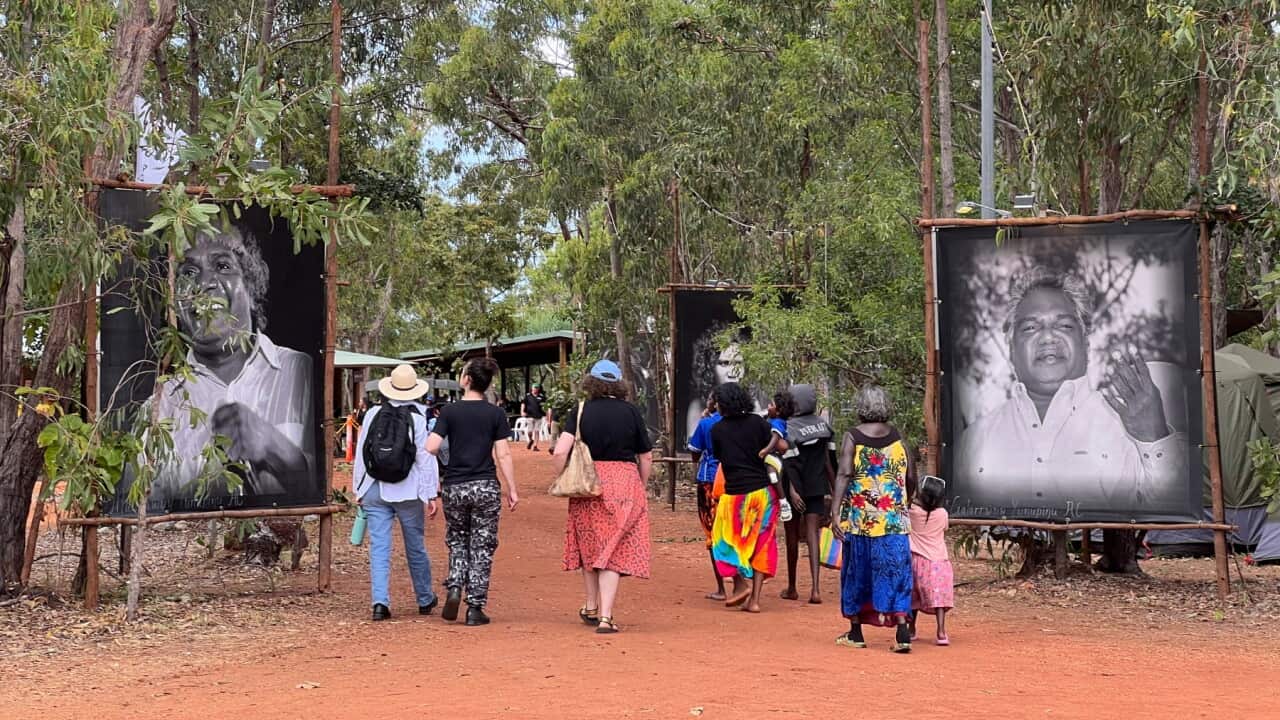


A powerful exhibition featuring photographs and stories of Aboriginal and Torres Strait Islander people with disability has been called a milestone for inclusion and representation. First exhibited at the United Nations in Geneva more than a decade ago, it's now being shown again on home soil in its most accessible format.
Listen to Australian and world news and follow trending topics with SBS News Podcasts.
TRANSCRIPT
Looking at his own portrait, hung at the Australian Museum in Sydney, proud Nurungga, Nakanoo, Latji Latji and Elder, Uncle John Baxter, hopes this exhibition - called 'Unfinished Business' - is a conversation starter and a catalyst for change.
“We don't want to be left in the background. We don't want to be left as a second thought or an inconvenience in this ever-changing world. We want to be there in the forefront with you standing by you, not standing behind you.”
Uncle John Baxter was deeply involved in the exhibition's creation from the planning stage.
His installation 'Not Fit For Purpose' also telling an important story.
“Sometimes when we receive this equipment, they're not fit for purpose. We think that they may be, or somebody else has thought on our behalf that, oh yes, uncle needs a wheelchair, so we'll give them a wheelchair. They may not realize that Uncle lives in a remote community. There are no footpaths. There are no sealed roads. You're going down dirt tracks. Uncle wants to be a part of his culture.”
Accessibility is woven into the exhibition's design, including elements such as tactile panels, audio descriptions, Auslan interpretation and large print materials.
This is Trevor Ahearn, the major projects lead in the First Nations department at the Australian Museum.
“We also wanted to create a design language that sort of made access prominent, a prominent theme, not just for people with access needs, but for people who able bodied people, people who don't have access needs to come in and be aware of what it takes to make a thing accessible.”
According to the Australian Bureau of Statistics, about one quarter of Aboriginal and Torres Strait Islander people report having a disability.
This exhibition also highlighting the intersection of ableism and racism.
This is Gayle Kennedy, a Wongaiibon Clan member.
“If you really want to know us, look at our eyes, see the power in them, see the strength. And not only as Aboriginal people, but as people with disabilities, because as far as I'm concerned, we are the most marginalized people in any society worldwide.”
A vessel for truth telling - each of the 30 participants told their story on their own terms.
“I think that you could see that in all of these photographs. We choose how we are photographed and what you see up there. It's accessible, it's brilliant, it's in your face, and it's much needed and long overdue.”