

The Federal Government has launched a landmark $218 million national plan to end violence against First Nations women and children. It marks the first long-term strategy designed and led entirely by Indigenous communities. While the policy targets specialised healing and emergency services in remote areas, community leaders warn that real change also requires confronting the systemic racism and high rates of violence perpetrated by non-Indigenous men.
Listen to Australian and world news and follow trending topics with SBS News Podcasts.
TRANSCRIPT
The Federal government is announcing more than $200 million dollars of funding for its first stand-alone plan to end family, domestic, and sexual violence against First Nations women and children.
The 'Our Ways – Strong Ways – Our Voices' plan is a 10-year strategy co-designed by Indigenous communities and all levels of government.
Social Services Minister Tanya Plibersek says Aboriginal women and communities have been advocating for this for decades.
Minister Plibersek says the reason the plan has taken so long is because the government worked closely and carefully with the steering committee to get it right.
“In 2022 before the 2022 election, we made a commitment as a government to deliver a standalone First Nations plan for family, domestic and sexual violence coming out of the national plan on violence against women and their children. There was a stand, there was a- an action plan for Aboriginal, Torres, Strait Islander communities, and that came with $282 million of funding for immediate actions. What this plan represents is the next stage of that work that takes a longer term approach, that also engages the States and Territories.”
This is coming almost 18 months after the landmark Senate inquiry into missing and murdered First Nations women and children.
Working with the National Plan, this initiative is committing $218.3 million dollars over four years to fund up to 40 Aboriginal Community-Controlled Organisations to provide specialist, community-led services.
Indigenous women are seven times more likely to be killed by a partner and 27 times more likely to be hospitalised for family violence than non-Indigenous women.
In remote areas, the hospitalisation rate jumps to 41 times more likely.
Assistant Minister Ged Kearney is calling the National plan a game changer.
“This is a seminal report. This is a game changer. We know that Aboriginal and Torres Strait Islander women and children are over represented in all the statistics with respect to domestic, family and sexual violence, and the way forward that has been mapped in this report puts First Nations people at the absolute centre of all the solutions. This will be community led response supported by the government: Federal and State.”
The federal government is expanding its domestic violence strategy beyond immediate financial relief to address the profound isolation of Australia’s remote communities.
Tanya Plibersek says that while the 'Leaving Violence Payment' helps thousands, money alone cannot overcome the extreme isolation facing remote victims in crisis.
She says that in regional areas, the logistical burden can be immense, with front line responders facing six-to-eight-hour drives just to reach a single victim.
She says the government must pivot toward a localised model that integrates community expertise with emergency intervention.
“We've done immediate response. This is about our long term future. How do we deliver new services on the ground, particularly through Aboriginal community controlled organisations? And that work will be funded from the first of July onwards. It means new services, new healing services, for people who are affected by family and domestic violence as they're growing up, men's behaviour change, emergency responses that help women leave, including from very remote locations. Aunty Muriel was talking about Torres Strait Islands as a really good example of how hard it is to keep someone safe in a small and very remote community.”
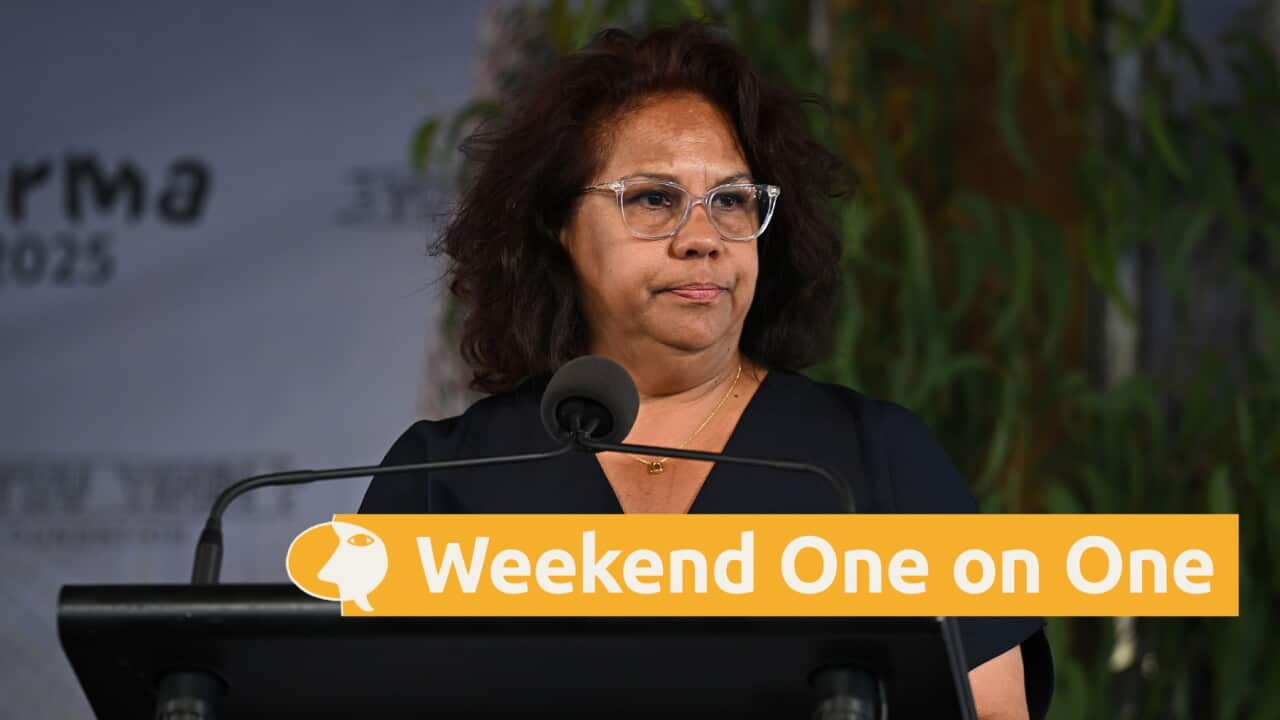
The plan is being led by Associate Professor Muriel Bamblett, CEO of the Victorian Aboriginal Child and Community Agency, who says she is proud to be part of the process.
Drawing on her experience in Brisbane with Musgrave Park women and those in prison, she says she has seen violence impact her community for generations.
Having worked with numerous organisations to drive reform, she believes this is the first plan written by Aboriginal people for Aboriginal people.
“The systems have to change, the court processes, the policing, the way justice is implemented - the way that housing and homelessness, child protection systems, all of those need to change. There's a lot of money that goes to mainstream organisations where there's no accountability. So we really do need to have Aboriginal people at the forefront. I work in child welfare. 72% of Aboriginal children come into care because of family violence. Now that's too many children coming into care because we can't address family violence. And family violence is learned. It's it comes out of a drug culture. It comes out of a culture that an alcohol culture that was never in Aboriginal communities.”
Dr Bamblett says that while the issue is complex, there is a growing movement for internal healing.
She says her research includes speaking with men from communities who want to be part of the solution, even as they acknowledge they are part of the problem.
However, she is also pointing to a startling reality regarding the role of external racism in violence against Aboriginal women.
“One of the really interesting data is 85% in one of our regions, 85% of the violence perpetrated on Aboriginal women are by non Aboriginal men. We have to ask the question: What - Why do non Aboriginal men treat our women as less than and so I think we need to really address the issue of racism and how that impacts on our women and our communities.”
Indigenous Affairs Minister Malarndirri McCarthy says this plan exists only because of the tireless, ongoing advocacy of First Nations women.