
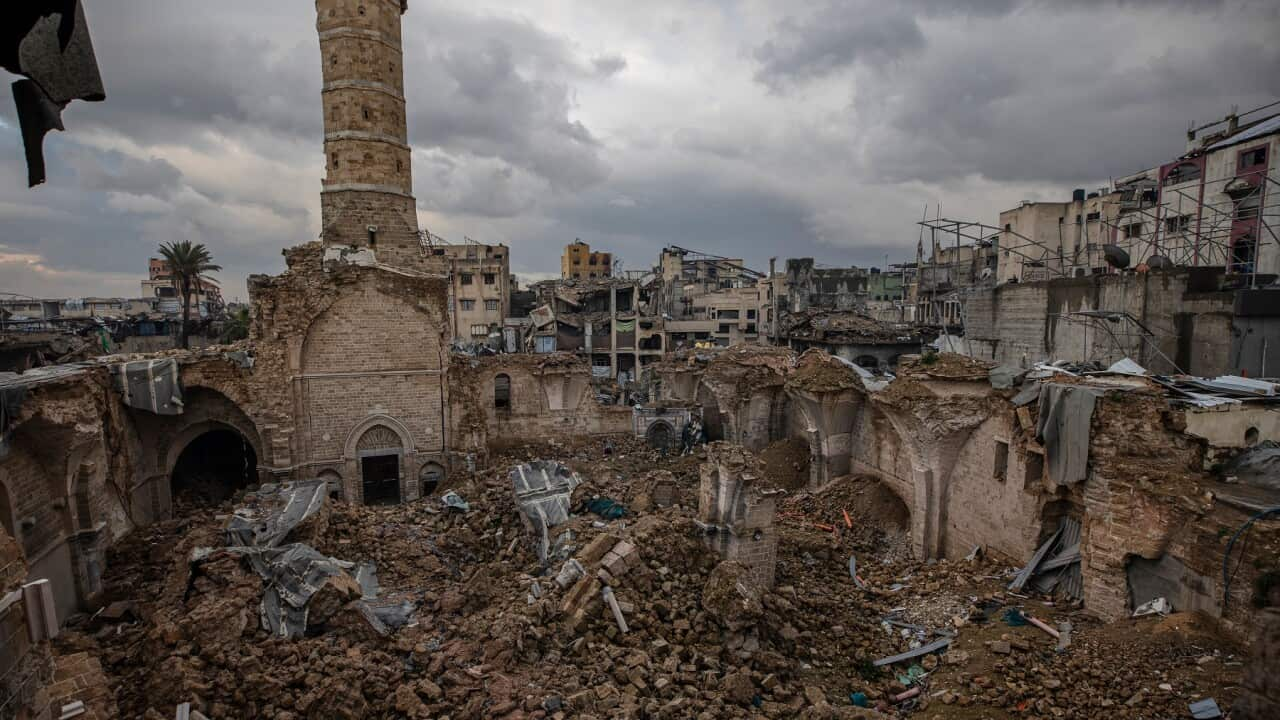

.The Gaza Strip is home to some extraordinary remnants of human history, dating from the Bronze Age through to the Ottoman and British empires.Many historic sites suffered from neglect before the war - but the United Nations cultural agency, UNESCO, says it has verified damage to at least 150 historic heritage sites since the start of the Israel-Hamas conflict. Palestinians in the Gaza Strip are reckoning with how to save their historical monuments.
Listen to Australian and world news and follow trending topics with SBS News Podcasts.
TRANSCRIPT
In this section of Gaza City, the facilities of a football club - including its fields - were left in ruins after the Israeli offensive in Gaza, launched in response to the deadly Hamas-led October 7 raid.
Gaza's health ministry says more than 72,000 Palestinians were killed in the offensive, while the United Nations Satellite Centre has estimated that 83 percent of all structures in Gaza City were either destroyed or had some damage.
So spectators like Adel Felfel sit on the rubble of destroyed houses to watch the game.
"There are almost no fields left in Gaza. Perhaps only two or three fields remain across the entire area. In all of Gaza, only the Palestine Field and another field in the Al-Darraj (neighbourhood of Gaza City) are still available; just two fields remain."
That level of destruction extends to hundreds of archaeological sites too.
These sites began to be uncovered following the 1993 Oslo accords, when two years after the signing, the newly created Gaza antiquities service opened its first archaeological dig, unearthing remnants of the ancient Greek port of Anthedon and a Roman necropolis.
But excavations stalled after Hamas seized power in 2007 and Israel imposed a blockade, only resuming years later with support from the British Council and French NGO Premiere Urgence Internationale.
Archaeologist Fadel al-A'utul says some of these historic places were not properly protected, including Tell es-Sakan, known as the Hill of Ashes, a 10 hectare site that contained a fortified settlement built centuries before the pharaohs ruled in Egypt.
"The importance of the place is from the ramparts that we discovered here where we are standing... Tel Es-Sakan site is one of the most important in Palestine, 3500 years old, which means 1,000 years before the pyramids."
Hamas later levelled the site for a construction project.
Once the most recent conflict between Hamas and Israel began, there were more sites damaged or destroyed.
Al Jazeera reported that the Al Qarara Museum - with its collection of roughly 3,000 artefacts dating back to the Canaanites - was given advanced warning by Israeli forces to empty its contents and evacuate to the south of Gaza.
It was ultimately destroyed in an air strike.
Gone too is the Rashad El Shawa Cultural Centre in Gaza City, which was the site of Oslo peace process discussions between Yasser Arafat and Bill Clinton in the 1990s.
Krista Pikkat is the director of Culture and Emergencies at UNESCO, the United Nations cultural agency.
She says they have done their best to estimate the extent of the damage across the Strip.
"Fourteen religious sites, 115 buildings of historic or artistic interest, three depositories, one museum, nine monuments and eight archaeological sites."
With major military operations largely halted, some organisations are trying to save what they can.
Jehad Yasin is an assistant deputy minister at the Palestinian Ministry of Tourism and Antiquities, based in the West Bank.
He says Palestinian officials and UNESCO are preparing a three-phase recovery plan with initial costs of $133 million for historical sites - but it could prove even more expensive, and a challenge in light of the cost of materials and ongoing access challenges.
Work continues regardless at the badly damaged Pasha Palace.
The Palace housed centuries-old artefacts, many of which have disappeared and may have been looted.
Among the missing items are an Ottoman-era manuscript of parts of the Quran, jewelry from the medieval Mamluk era, and a coffin dating back to Roman times from which only fragments have been found.
Hamuda Al-Dahdar is an architect and heritage expert at the Centre for Cultural Preservation, which is based in the West Bank city of Bethlehem and is now working inside Gaza to try to rescue sites destroyed in the war.
He says these items are just some of many to be lost or destroyed.
"Before the war, the Pasha Palace Museum and its storage facilities housed over 17,000 artifacts. More than 70 percent of the museum's area was destroyed, and only about 20 artifacts have been recovered and salvaged. The fate of the rest remains unknown."
The Great Omari Mosque is another site of destruction.
It's said by local tradition to be where the biblical Samson brought down a temple on his Philistine captors, and which housed a Byzantine church before the seventh century Caliph Omar brought Islam to the Mediterranean and reconsecrated it as a mosque.
The 1954 Hague Convention is meant to protect such sites from war.
But the mosque now lies in ruins, after Israeli forces struck the site to destroy what they said - without evidence - was a tunnel under its grounds used by Hamas fighters.
In an enclave where most residents are refugees from cities and villages in what is now Israel - and most districts were hastily built in recent decades to house them - the Omari Mosque was Gazans' main link to their own cultural heritage and the rich architectural historical legacy of the wider Middle East.
Ismail Al-Mishal says the loss of these kinds of cultural landmarks accordingly cause a particular ache, even among families who lost loved ones, homes, and livelihoods.
"During Ramadan, we used to come here to perform the Taraweeh prayers. We enjoyed beautiful evenings praying, for its restoration, asking God Almighty to rebuild it so that it would return to its former glory as a historical and archaeological landmark of Gaza and of all of Palestine."