
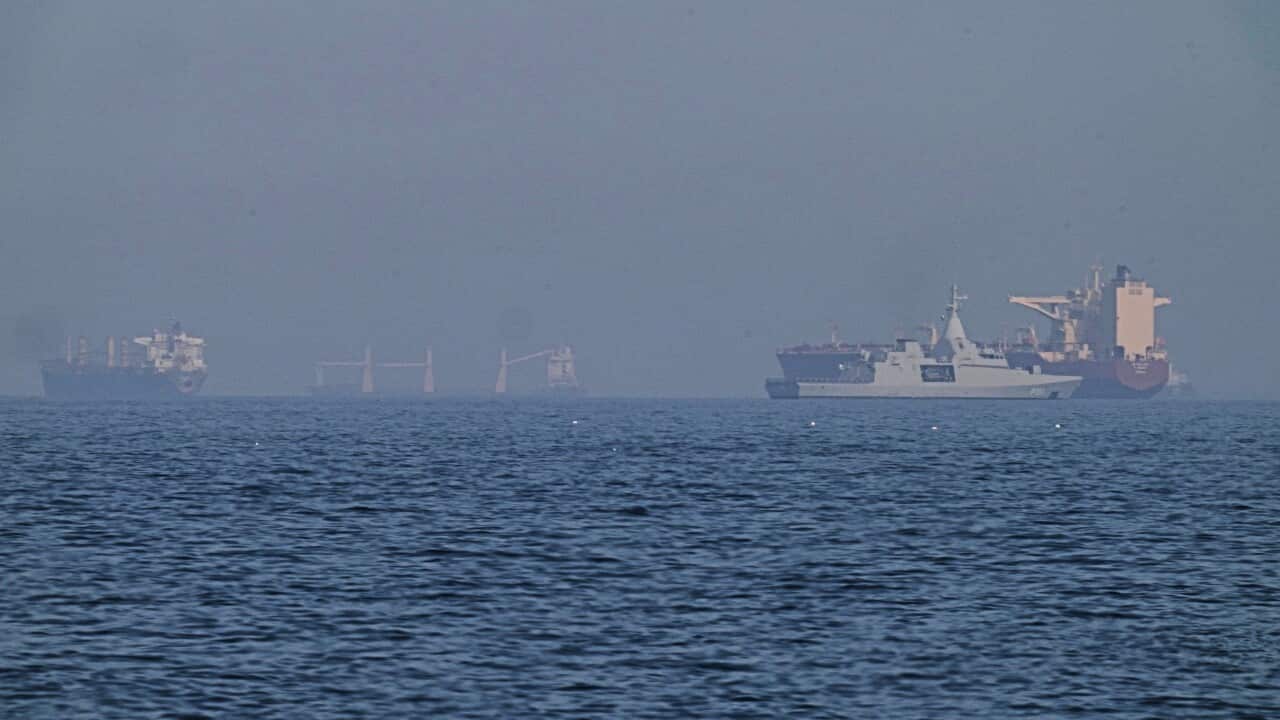

The United States has announced it plans to guide ships stranded in the Strait of Hormuz. President Donald Trump has revealed few details about the plan he is calling Project Freedom, saying it is a humanitarian gesture. It comes as he considers a 14-point proposal to end the war put forward by Iran.
Listen to Australian and world news, and follow trending topics with SBS News Podcasts.
TRANSCRIPT
United States President Donald Trump used a social media post to announce a plan for the US military to begin guiding ships safely out of the Strait of Hormuz.
Calling it Project Freedom, he provided little details for how it would work, but says it is a "humanitarian gesture" to help stranded ships that are running low on food and supplies.
Maritime intelligence firm AXSMarine says there are more than 900 commercial vessels in the Gulf.
The Strait of Hormuz has been a flashpoint in the war, with about a fifth of the world’s trade in oil and natural gas typically passing through the waterway.
That has now ground to a halt, triggering a surge in oil prices - which are now about 50 per cent above pre-war levels.
US Treasury Secretary Scott Bessent says the US blockade - in place since April 13 - is having an impact by starving Iran of the oil revenue it needs.
"And I can tell you that we are suffocating the regime, and they are not able to pay their soldiers. This is a real economic blockade, and it is in all parts of government, all hands on deck."
US Admiral Brad Cooper says US Central Command has received instructions on the mission - and it will include guided-missile destroyers, over 100 land and sea-based aircraft, multi-domain unmanned platforms, and 15,000 service members.
Meanwhile, Iran has submitted a 14-point counterproposal to the United States calling for a permanent end to hostilities and a full withdrawal of US forces from the region.
The plan, delivered through Pakistani intermediaries, responds to a nine-point US proposal.
While the US plan calls for a two-month ceasefire, Iran is pushing for a 30-day timeline to resolve key issues.
Iranian Foreign Ministry spokesman Esmail Baghaei says the 14-point plan is focused on ending hostilities across multiple fronts, including Lebanon, and establishing a new governing mechanism for the Strait of Hormuz.
"Our plan is focused exclusively on ending the war. The points mentioned about details in the nuclear field are absolutely not included in this plan. This plan is based on first drafting an understanding to end the war, and then discussing how to implement it over a 30-day period. It is very natural that, within the framework of a 14-point understanding, you cannot discuss and reach a conclusion on the details related to implementing the understanding. You need some time."
Since a ceasefire came into effect on April 8, there has been one round of peace talks in the more than two-month war.
The Pakistan talks failed to result in a breakthrough.
Mr Trump says he doubts the terms of the new proposal from Iran will be agreeable to him.
In a post on social media, he says he believes Iran has "not yet paid a big enough price" over actions taken the last 47 years.
He also threatened new military action, but did not specify what the trigger in that event would be.
There have been cascading impacts from the blockage of the Strait of Hormuz, with the United Nations warning of a food security crisis arising from the impacts on global agrifood systems.
UN Secretary-General António Guterres has established a taskforce to facilitate the safe passage of fertilisers and related raw materials for humanitarian purposes.
The mechanism is yet to be operational, although UN official Jorge Moreira da Silva - says it would only take seven days to get up and running, once combatants allow supplies to transit through the Strait of Hormuz.
A spokesperson for the UN Refugee Agency, UNHCR, Carlotta Wolf, says that can't come soon enough.
"Increasing food prices, for example, prices of very basic goods on the ground are also, because of inflation and because of the fertiliser issues, are also rising, meaning that people who are already in fragile contexts, in emergencies are able to buy less of their basic needs."
With the war passing the 60-day mark on Friday, there are renewed questions about the legality of the US military operation.
Once the 60-day deadline is reached, the War Powers Act necessitates the president moves to finish a war - unless he gets authorisation from Congress.
There is an option for a 30-day extension can be sought, but that has yet to be requested by the president.
Mr Trump says he considers the War Powers Act unconstitutional, while other Trump administration officials argue the ceasefire effectively stops the 60-day clock.
That interpretation has been questioned by some legal experts, who say a ceasefire is a not a permanent end to the conflict and something more substantial is required under the Act.
Middle East scholar Joshua Landis at the University of Oklahoma says it is unclear at this point how this conflict will end.
"Iran is going to have a hard time. Iranian ministers have said that they've lost a million jobs because thousands of their industries were hit. So, Iran is under tremendous economic pressure at home. With this embargo, they can't ship any oil out. So, Iran is under tremendous pressure, but so is the international community, so is the world. The international community is telling Trump to fix this and to stop this war, but he seems determined that he can wait out Iran and that he will win."