
Aditya Goel always dreamed of having a big family, and he talks about having children regularly with his partner of two and half years.
But at the age of 32, around the average age of first-time fathers in Australia, he wonders whether having even one child is possible for him.
Aditya doesn't speak of any fertility issues and says he and his partner are financially successful — he's a tax consultant and she's an engineer.
But the Melbourne-based couple feel a child is beyond what they can afford given rising costs of groceries, childcare and rent.
Plus they want to buy their own home one day.
News that makes sense
Your trusted source for staying up-to-date with the world around you. Get free daily news updates and analysis, straight to your inbox.

"We are in a position which is a lot more privileged than the average Australian. But even in a household like ours, the cost is a big factor … I wonder how somebody who's probably not earning as much, I don't even know how they comprehend this," Aditya told The Feed.
"In an ideal world, we would probably have four kids, but when we think of the cost to raise kids, we go, maybe it's just not realistic."
Cost 'a way bigger factor'
Glynis (surname withheld) understands this predicament well.
The 28-year-old is looking forward to starting a family with her long-term partner over the next five years or so. The pair have stable, professional jobs and own a one-bedroom apartment in Canberra, but aren't sure if they can afford to upsize in an area they want to live in.
"If we want to have kids, we would like at least a second room, preferably a third. But if we want to live in an area that's got the schools that we want our kids to go to and to be close to our parents, we need to be earning way more than we currently do.
"The idea of staying in a one-bedroom apartment and raising a family … is so not an ideal situation. Cost is becoming a way bigger factor in having kids than I thought it would've been even 10 years ago.
"And that's not even factoring in child-related costs."
Glynis wonders how she'll afford nappies, the extra food and childcare — and whether the federal government's Parental Leave Pay of 26 weeks (as of 1 July) will stretch far enough.
She says conversations with others her age reflect similar concerns.
"I've had multiple conversations with friends, and [the] cost of living is just pumping up and up and kids are getting just pushed back."
The cost of raising a child
There are various figures published around how much it costs to raise kids, which are all calculated differently.
A 2018 study from the Australian Institute of Family Studies found that parents could expect to spend around $170 a week raising a child — around $8,840 per year.
Studies from AMP and the National Centre for Social and Economic Modelling (NATSEM) have published three reports on the cost of raising children. Back in 2002, they calculated that raising two children from birth until they left home would cost a typical family $448,000. In 2007, this cost had jumped to $537,000; in 2012, $812,000 — if they left home at 18, that would work out at more than $45,000 per year.
Since those studies, living costs have skyrocketed, inflation has soared to its highest level since 2023, and the Reserve Bank of Australia has hiked rates three times this year, with more increases expected.
So in 2026, the actual amount parents are spending to raise children is likely much higher than what previous research suggests.
Aditya says he's astonished by the estimations of what it costs to raise a child.
"Four kids could very well be one person's salary," he said.
Costs going up, babies going down
Financial pressures are changing people's fertility choices.
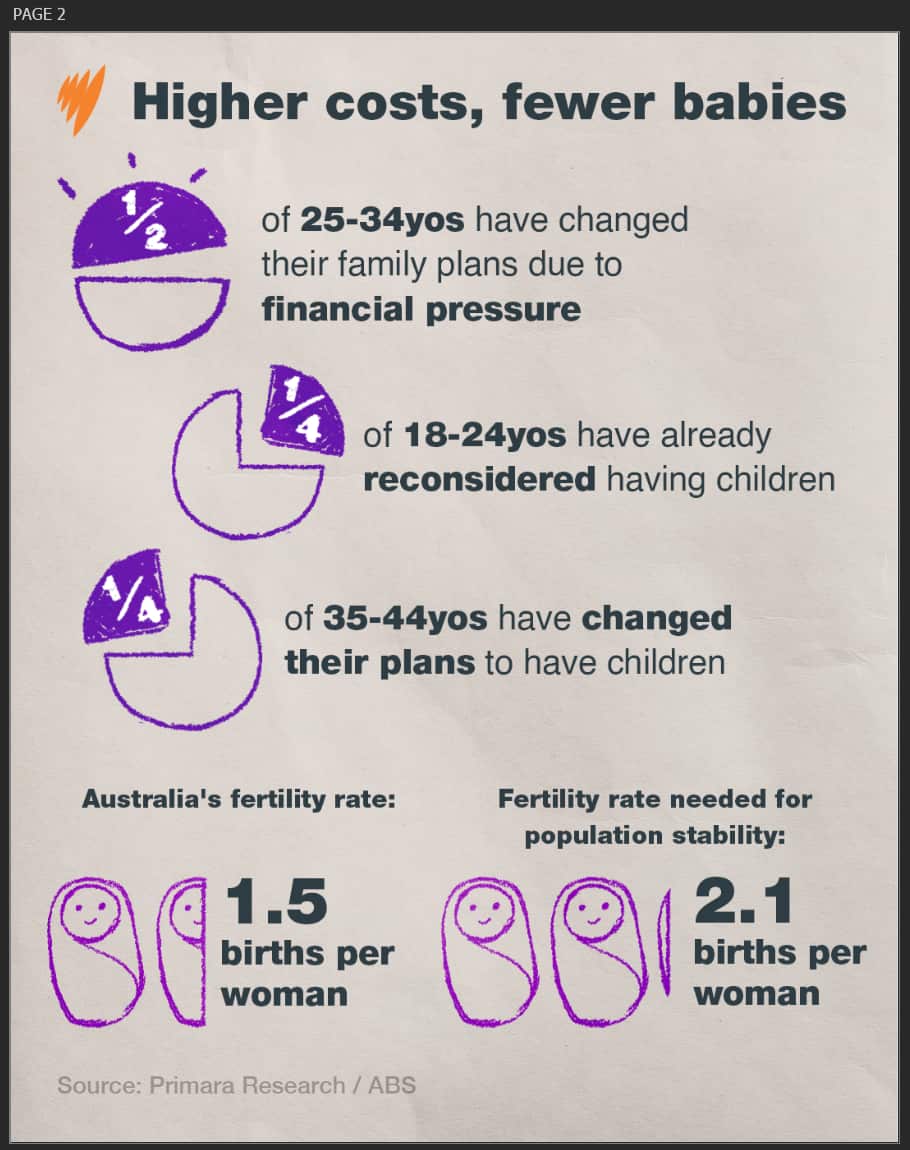
Nearly half (46 per cent) of Australians aged 25-34 have changed their family plans because of financial pressure, with 15 per cent ruling out children altogether, according to research published in March by Primara Research.
And financial anxiety is shaping life decisions early, the survey shows. Nearly one in four (24 per cent) of Australians aged 18-24 have already reconsidered having children, while 24 per cent of 35-44 year olds have changed their plans, with 14 per cent deciding against more children.
The 2025 Household, Income and Labour Dynamics in Australia (HILDA) Survey shows a similar story — with more Australians choosing to have no children or fewer children than they were 20 years ago.
"More people are now deciding that they don't want children," said Inga Lass, senior research fellow at the Melbourne Institute of Applied Economic and Social Research and member of the HILDA research team.
"The general cost of having children is the factor that people now consider most important. It was surprising how clear this picture was."
Australia's fertility rate in 2024 (the most recent year for which the ABS has released data) was 1.5 births per woman, the lowest in the nation's history.
By comparison, this rate was 1.8 in 2004, 2.3 in 1974 and 3.2 in 1964.
History shows birth rates are closely linked to economic conditions. The largest declines over the last century occurred during the Great Depression in the 1930s, which severely impacted Australia's export-reliant economy, and throughout the 1970s, when the 1973 oil shock drove Australia's unemployment from 2 per cent to 6 per cent.
Declining birth rates age the population, which shrinks the taxpaying workforce and threatens economic growth, labour markets and welfare sustainability — especially pensions and healthcare.
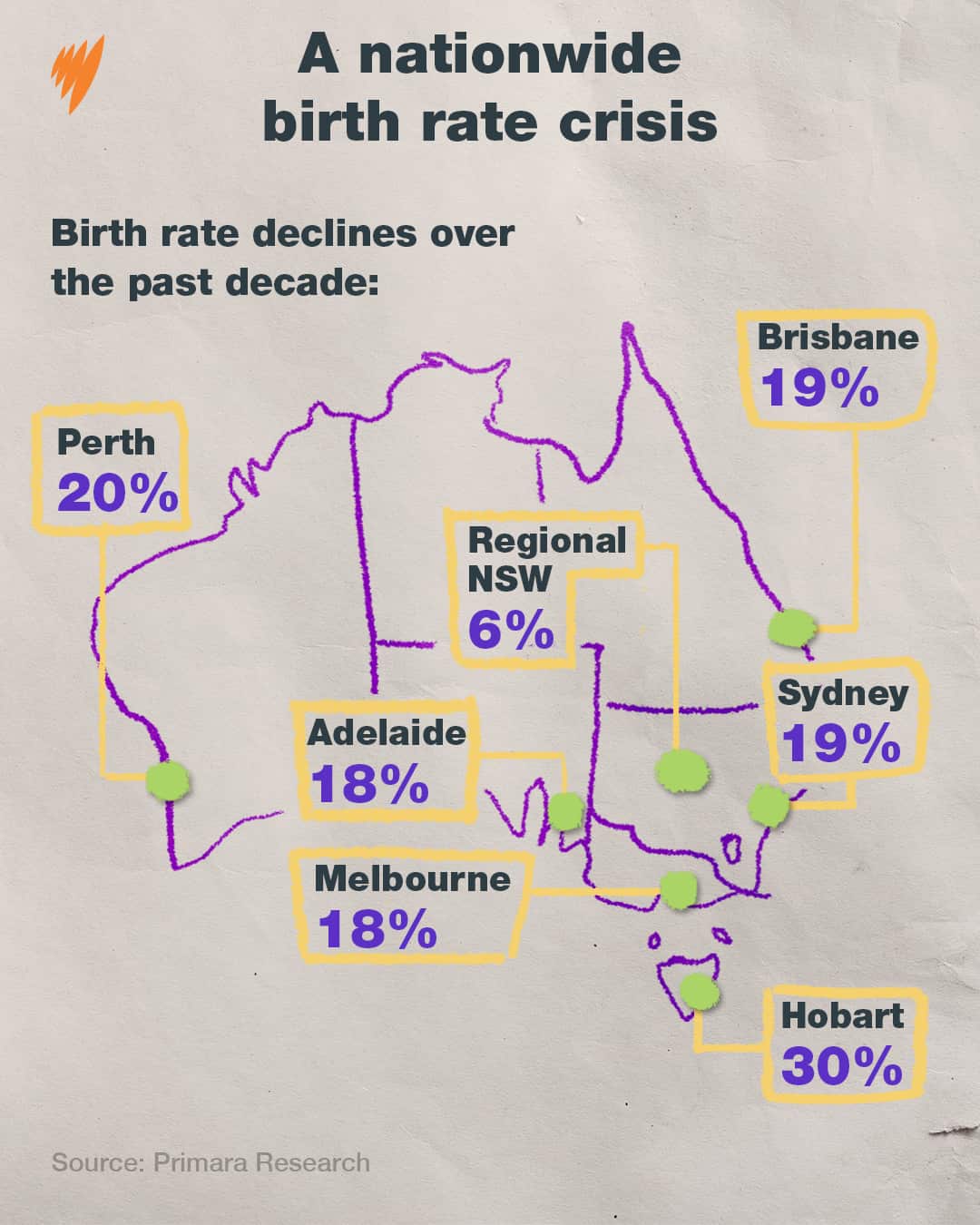
Primara Research data shows birth rates have fallen sharply across all major cities over the past decade, with the data revealing a clear link to housing unaffordability and rising living costs.
"Australia's birth rate crisis is no longer a demographic footnote; it is a direct consequence of a housing and cost-of-living emergency that is reshaping the nation's future in real time," the report said.
Wanting the best for your child
At 41, Priya Randhawa knows her window for having a child is narrowing. The Sydneysider, currently on a career break, has been married for five years and says babies are often on her mind.
She worries about various factors that could make parenthood difficult: being an older mother, AI-driven job insecurity, geopolitical instability impacting the global economy and — most critically — rising living costs.
"The entire financial instability surrounding all of us — that's a major, major question mark around whether we should consider starting a family. If money was not an issue or a concern, then I think starting a family would definitely be a much easier decision and not be put off for later."

Priya and her husband want to be sure that they can give their child a high quality of life without sacrificing their own.
"You'd want to put your child through the best possible avenues, whether it's schools, colleges or universities."
But she believes wages aren't rising fast enough to make this possible.
"Currently, it just seems that costs are rising at a phenomenal rate versus say the earning component and the rise in [wages] … We have to consider supplementing or having two incomes and two working individuals to make life comfortable."
Professor Michael Dockery at Curtin University's School of Economics and Finance says while fears around these costs are understandable, estimates around what a child needs can be overestimated.
“Rising expectations about what children have to have and how much that will cost is putting couples off having children, [but] a lot of those estimates are overblown. A lot of what is required to raise a happy and healthy child does not require that much additional expenditure," he told The Feed.
He says research shows that couples tend to "manage very well" financially after having children.
"They accumulate wealth at almost the same rate as couples who don't have children. If you have children, you're more likely to invest in property, and over that time, property's been a very good investment."
He adds that parents also tend to live in ways that are less income-intensive.
"When you have children, you might eat out less and spend more time taking your kid to the park, for example. You don't have the same rivalry of conspicuous expenditure."
Creating a new path
Lass at the Melbourne Institute of Applied Economic and Social Research says social expectations around what a typical family looks like have diminished.
"It has socially become much more acceptable to have no children or fewer children," she said. "There are so many other things that you can do with your life that compete. Plus today, women are highly educated and want to work."
However, this offers little solace to those who would love to start a family if they felt more financially secure.
Aditya is trying to accept he may never realise his dream of being a dad.
"I still do want kids. I've always wanted kids, I guess, but it seems more and more difficult to have them."
Glynis worries that the housing situation may push her plans for children back to the point where she may experience fertility issues.
"I think if we reached the point where we would be considering IVF, cost would be a huge factor in whether we went ahead," she said.
"If cost was the prohibitive factor of having a kid, I would be really upset … I've always wanted to have my own family, and the idea of not being able to do that just because everything is so expensive is really disheartening."

Through award winning storytelling, The Feed continues to break new ground with its compelling mix of current affairs, comedy, profiles and investigations. See Different. Know Better. Laugh Harder. Read more about The Feed

Have a story or comment? Contact Us







