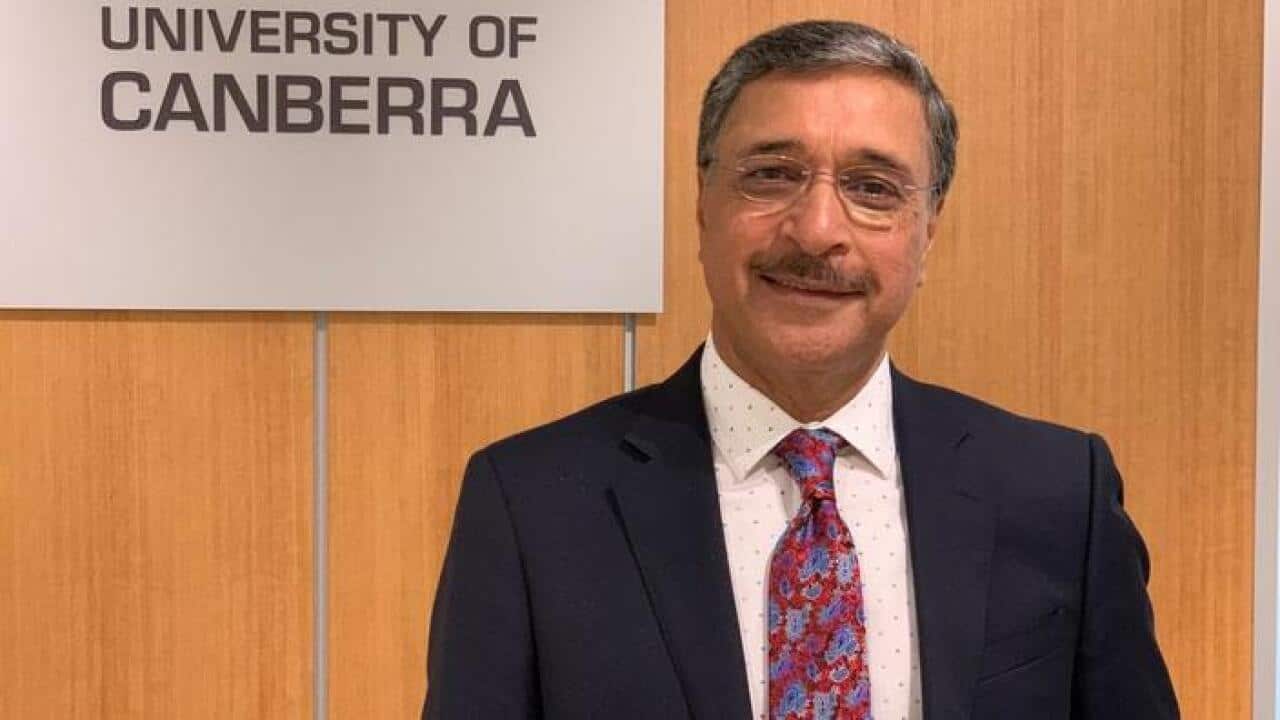

“The role of a university is to educate society, not to create wealth in the economy,” says Professor Deep Saini, Vice-Chancellor of the University of Canberra. To hear the full interview, click on the audio link above.
After an extensive academic career in Canada, Professor Deep Saini became Vice-Chancellor at the University of Canberra in 2016, making history as the first person of non-European background to earn that position in Australia.
In a wide-ranging interview with SBS Punjabi, Prof Deep Saini has spoken about the future of Australia as a choice destination for international students, their welfare and mental health, as well as about the role of universities in society.
He expressed a concern that more and more, the higher education sector is being regarded as “an export industry” by governments and universities alike.
“Education is fast moving into the business space in Australia. Even governments refer to it as the third largest export industry.”
“But universities provide a service, they’re not an industry. They are meant to provide education, and not focus on generating wealth for the national economy.”
He agreed that with a capping of government funding, many universities are now looking at international students to raise revenue. So are international students regarded as ‘cash cows’?
“Today the international students’ relationship with Australia has become increasingly transactional. It’s more the relationship between a buyer and a seller. In the long term, this may not be beneficial to Australia or it’s image as a higher education provider.”
Prof Saini drew upon his personal experience as an international student in Australia more than three decades ago. “When I came here to study, I didn’t pay any tuition fee. In fact, I earned a scholarship and soon after, went to Canada for my first job.”
“Although I stayed in Canada all this while, I had a deep sense of gratitude towards Australia for the gift it had given me. That’s why I came here, because I wanted to pay back the debt I owed this country.”
He is quick to point out that this is no longer the case for current students as universities acquire the role of a business house, and there is no “emotion in any transactional relationship.”
“Australia needs friends, not students only.”
Prof Saini went on to say that it would be unfortunate if English language requirements are reduced in order to accommodate more international students.
“If universities start admitting those students who may not even be able to achieve a good education, then the primary role of the universities will be subverted.”
“As a nation, Australia must think collectively whether it is morally correct to give someone admission into a university and not prepare them to enter the workforce. If the national policy – and that is unclear to me – is to give them a pathway to immigration through education, then the job market needs to align itself with the education sector.”
He added, “Universities can’t offer admission on the false pretext of providing a job or a guarantee of migration. That would amount to false advertising. I’m fairly confident that the larger universities don’t do this, but it’s hard to say what private education providers to, and that has always been an issue.”
Based on his own experience, first as an international student in Australia and now as a renowned academic, he had this advice for current international students: "If you've come overseas to study, then invest yourself fully in your studies only. Don't let immigration matters dominate your thoughts. Also, please don't make education an excuse for immigration - if it is only a pretext, then don't blame the system if it lets you down."
Listen to SBS Punjabi Monday to Friday at 9 pm. Follow us on Facebook and Twitter.