
This audio is voiced by AI and may occasionally mispronounce words.
Share your feedback and help us improve this feature. Read more about how we use AI at SBS here.
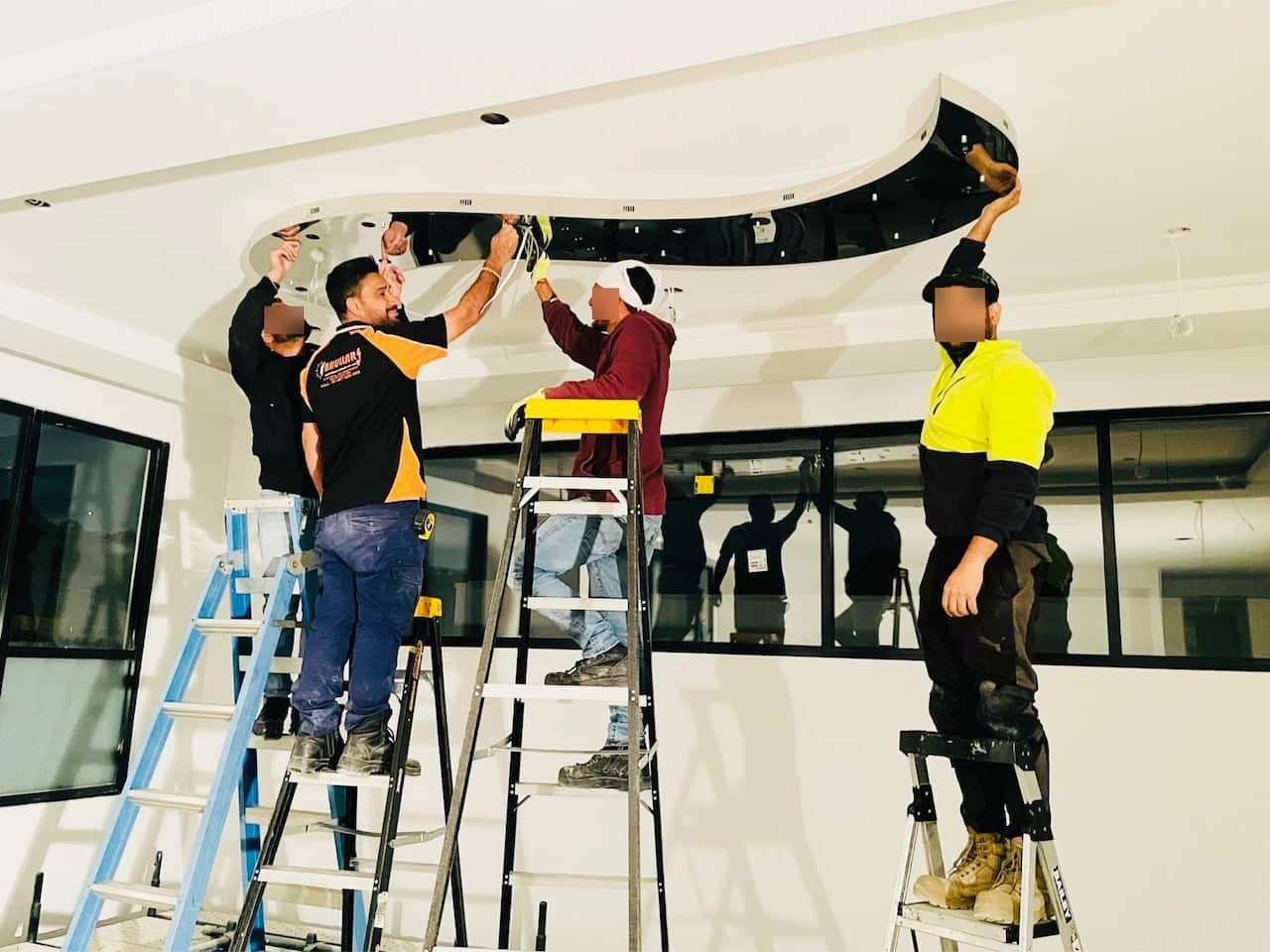
When Amandeep Singh Bhullar arrived in Adelaide in 2017 on a skilled work regional visa, he already understood something quite a few Australians are only now beginning to reassess: the value of a trade.
Originally from Bathinda in northern India, Bhullar came with experience as an electrician and a clear view that skilled, hands-on work can offer a reliable and high income.
Nearly a decade later, the electrician and solar business owner says that view has only been reinforced by his experience in the intervening years.
The 45-year-old estimates that experienced electricians doing higher-end domestic work can earn up to around $200,000 a year, with higher figures possible in commercial and specialist contracting.
His own business installing solar systems across South Australia generates monthly revenues he estimates to be between $40,000 and $50,000, though he emphasises that these are his earnings before deducting the cost of equipment, staff, other operating expenses and taxes.
News that makes sense
Your trusted source for staying up-to-date with the world around you. Get free daily news updates and analysis, straight to your inbox.
What is beyond dispute, however, is the demand for these types of jobs.
"The work is there," Bhullar tells SBS News.
And increasingly, so is the money.
Bhullar's story reflects a broader shift across Australia's economy, where demand for skilled workers, heightened during the mining boom, has been further boosted by housing, infrastructure, and energy transition projects.
In the labour market, the value of practical expertise has clearly been rising.
At the same time, parts of the white-collar labour market have shown signs of cooling, with reports of slower hiring in certain professional services and more competition for entry-level graduate roles.
Wage growth in parts of that sector has also softened compared with the rapid increases seen during the post-pandemic period.
Senior professionals in fields such as medicine, law and specialist technical roles continue to sit at the top of the income distribution, according to the latest data from the Australian Bureau of Statistics (ABS).
However, the gap between vocational and university-linked careers is narrowing in some areas, spurring renewed attention on how various types of skills are valued in the labour market.
The implications stretch beyond individual pay packages. As Australia seeks to deliver more housing, expand renewable energy infrastructure and address persistent skills shortages, there has been a gradual reordering of the nation's education and earnings hierarchy.
This shift is reshaping career choices, influencing government policy, and raising a broader question: which skills will be most valuable in Australia's future economy?
Shift showing in training pipelines
The shift in labour demand is starting to show up in Australia's training system, with the government trying to rebuild the pipeline of skilled workers needed to meet housing and infrastructure targets.
According to new government figures, more than 25,000 Australians have commenced apprenticeships over the past 10 months through the Key Apprenticeship Program, with construction and trade-related occupations accounting for a significant share of new enrolments.
Between July 2025 and April 2026, there were a total of 9,384 apprenticeship commencements in carpentry, representing more than a third of commencements under the program. Other occupations included plumbing (5,330 commencements) and electrical (4,832 commencements).
The uptake follows a broader rebound in trade training, with apprenticeship commencements in priority occupations rising almost 18 per cent in the September 2025 quarter compared with a year earlier, according to data from the National Centre for Vocational Education Research.
However, it comes against a backdrop of persistent structural shortages identified by Jobs and Skills Australia (JSA), a government-funded body that provides research and advice about vocational education and training, among other issues.
The JSA's data shows that there have been national shortages of all 18 construction and trades occupations at some point between 2021 and 2025, including core housing-linked roles such as electricians, plumbers, carpenters, bricklayers and roof tilers.
Housing Minister Clare O'Neil has pointed to expanding vocational training as central to delivering the government's housing agenda.
"If we're going to build more homes, we're going to need more tradies, and that's exactly what this program is doing with a $10,000 incentive payment for tradies getting on the tools," she said in a media release last week.
The government's policies and data suggest a broader change in priorities, with vocational education becoming a key component of Australia's economic strategy rather than an alternative education pathway.
The labour shortages driving wages higher
While shortages across Australia's entire jobs market have been easing since the post-pandemic labour crunch, the need for tradespeople remains notably high.
The latest data from JSA shows that there were national shortages in 29 per cent of occupations in 2025 — a slight improvement compared with 33 per cent in 2024 and a peak of 36 per cent in 2023.
However, in construction, nearly half of the trade occupations were assessed as being in shortage — particularly those that require years of vocational training and apprenticeship completion.
JSA's 2025 Occupation Shortage analysis shows Skill Level 3 occupations — a category that includes many trades and technicians — continue to record some of the lowest vacancy fill rates in the economy.
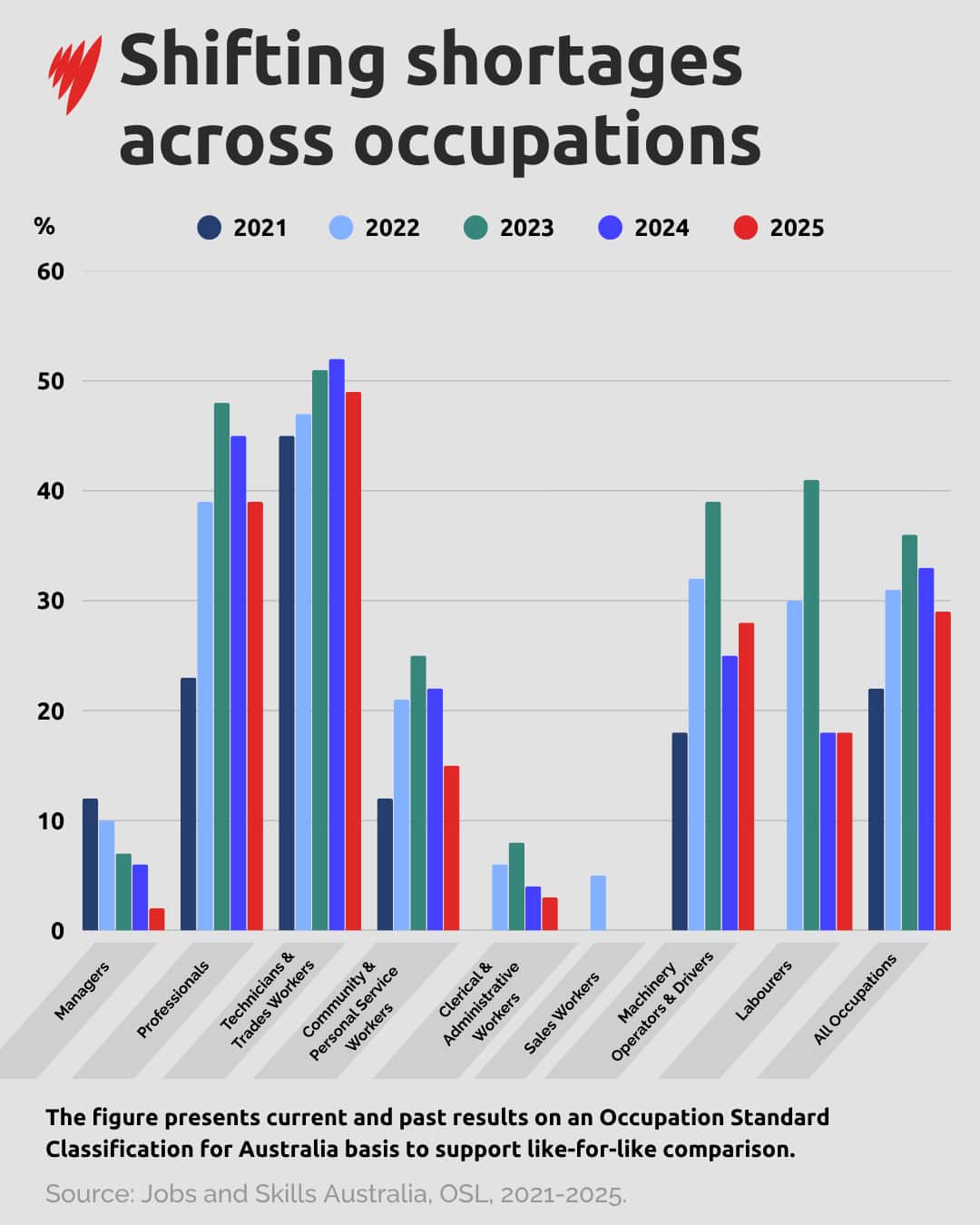
That shortage is worsening as demand for workers outpaces supply.
Skills and Training Minister Andrew Giles says progress is being made, but significant gaps remain.
"We're making progress, but there's still significant gaps in our labour market, particularly when it comes to some of the skilled trades," he tells SBS News.
Giles says meeting the government's housing ambitions will require a substantial increase in the construction workforce, which is why policymakers have focused on apprenticeships, fee-free TAFE places, advanced trade training and faster recognition of migrant skills.
"We recognise this is a challenge and the challenge to which there isn't a single silver bullet. It's about a really concerted effort that's got a huge role for [the] government," he says.
Why the wage gap is narrowing
The idea that a university degree will always lead to higher earnings is becoming harder to sustain.
"For a long time, many Australians saw the skilled trades as plan B," Giles says.
He argues that perception is out of step with the realities of Australia's labour market.
"What I'd really like to say is to no longer see a hierarchy between those two pathways, university or vocational," he says.
They're equal pathways; we need to treat them as equal pathways
The latest ABS Average Weekly Earnings data still shows many white-collar industries ahead on headline pay. Workers in professional, scientific and technical services earn an average of around $2,376 per week, while those in financial and insurance services average about $2,339. Construction workers average approximately $1,958 per week.
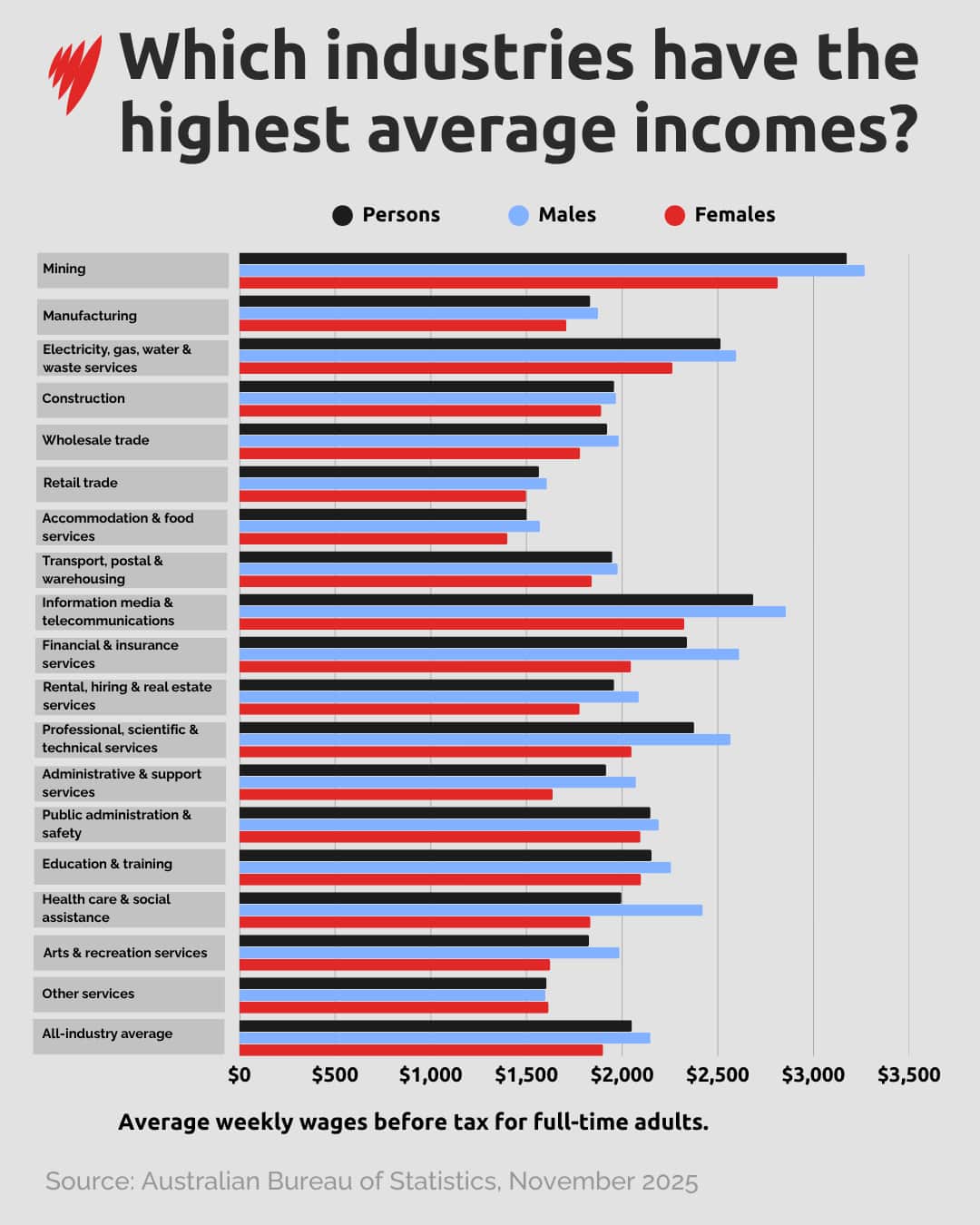
On paper, that still places many white-collar jobs ahead, but averages can obscure what is happening within industries.
Professional services include everyone from senior lawyers, consultants and executives to recent graduates at the beginning of their careers.
Construction includes apprentices and entry-level workers alongside experienced tradespeople, subcontractors and business owners whose earnings can be substantially higher.
The more important shift is not between industries, but between skills.
Where a certain capability is scarce, the wages for those who have that skill tend to rise — regardless of whether the job requires a university degree or a TAFE course.
Even at a broader level, wage growth across the economy has been relatively tightly clustered.
Shane Garrett, chief economist at Master Builders Australia, the peak body for the building and construction industry, notes there is little evidence of major divergence in wage growth across industries.
"Across the economy, hourly wages rose by 3.3 per cent over the year to March 2026," he tells SBS News.
Garrett says that pattern holds across sectors, with wage growth ranging from about 2.8 per cent to 4.3 per cent across 18 industry groups. Over the longer term, he says, the picture is similarly consistent.
But similar wage growth across industries does not mean workers are earning the same. It reflects broad industry trends rather than differences within occupations.
"People can see the fantastic wage outcomes in skilled trades, and that's driving a really keen level of interest in these pathways now," Giles says.
Those outcomes are reinforcing a broader shift in how education and income are understood.
JSA data shows that a growing number of vocational qualifications in engineering, mining and technical trades are delivering median incomes well into six figures, placing them alongside — and in some cases above — many traditional graduate career pathways.
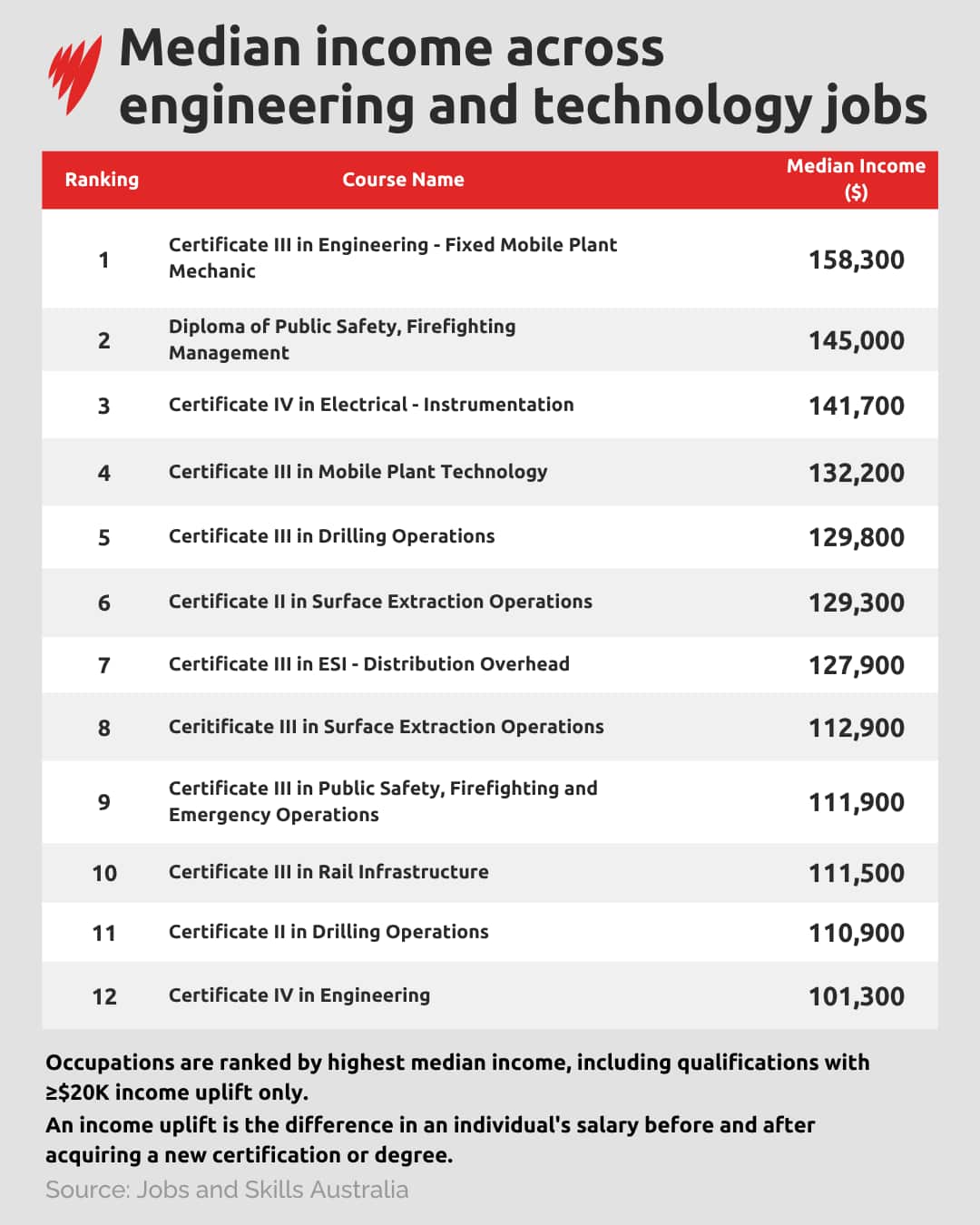
That does not mean the premium of a university education has disappeared. University qualifications continue to dominate many of the highest-paying professions, particularly in medicine, law and senior corporate roles.
A 2025 report by JSA estimated that more than 90 per cent of employment growth over the next decade will be in occupations requiring post-secondary qualifications. Of that projected growth, 54.3 per cent is expected to be in roles requiring a bachelor's degree or higher, and 40.1 per cent in roles where vocational education and training is the main pathway.
Why AI is changing the calculation for jobs and trades
Another force reshaping the labour market is artificial intelligence (AI).
The Organisation for Economic Co-operation and Development's work on AI and employment suggests the biggest impact is likely to be on specific tasks within jobs, rather than whole occupations — particularly roles that rely on routine administrative, analytical or content-based work.
Likewise, the JSA Generative AI Capacity Study suggests that an occupation's exposure to replacement by AI is uneven across the Australian workforce and depends on the type of tasks performed in that line of work.
Taken together, the evidence suggests AI is reshaping work more than it is replacing it — but the impact is not evenly distributed.
Many professional roles rely heavily on repeatable cognitive tasks, which are among the most exposed to automation and AI-assisted tools.
By contrast, trades depend on physical work, on-site problem-solving, and adapting to unpredictable environments — conditions that are harder to replicate digitally.
Electricians wiring systems, plumbers finding faults in older buildings, and construction managers coordinating live sites operate in environments where tools may change and evolve, but the underlying work remains grounded in physical execution.
Bhullar puts it simply: "AI has brought in new technology in our field, but it cannot replace us. Someone still has to install it, maintain it and fix it."
Migration and the shortage economy
With AI and the existing domestic labour force unlikely to address current shortages, economists say skilled migration will continue to play a central role, particularly in construction and the trades, where training channels alone are not fast enough to meet demand.
Garrett says the current system is not fully aligned with the needs of the construction sector.
It is fragmented, costly and suffers from slow skills recognition.
He says trades remain significantly under-represented in the migration intake, and that Australia is failing to make full use of skilled migrants already living in the country.
The challenge, he argues, is structural rather than cyclical.
"Domestic uplift is necessary but cannot fill the acute and severe worker shortage alone. Skilled migration is essential to any immigration policy," he says.
Giles says the government is already moving in that direction, with a stronger focus on construction-linked migration pathways.
"We are seeing record numbers of visas issued to people with construction-related skills," he says.
However, residential construction, infrastructure and energy projects are competing for the same limited workforce.
For workers like Bhullar, who arrived in Australia on the promise of that demand, ongoing shortages have translated into higher wages. But the widening gap between the skills the economy needs and the workers it can produce is also driving up costs, leaving employers to chase the very skills Australia is still struggling to produce.
For the latest from SBS News, download our app and subscribe to our newsletter.







