
'IN BRIEF'
- The appeal of multi-generational living is growing as housing costs climb — but younger and older Australians are divided.
- Sharing homes can help families manage costs. But it doesn’t address the root causes of the housing crisis.
Younger Australians are increasingly embracing the idea of multi-generational living as housing costs soar, but older Australians remain far less convinced, a new survey suggests.
Daniel Kaminsky, a 36-year-old mortgage broker, and his wife Monica bought an apartment in Sydney a few years before they got married in 2023.
"Everything seemed fine. We were just kind of chipping away at the mortgage slowly," he said.
But that soon changed, as the couple started planning for a family and noticed their budget might not stack up with the added expenses of having a baby.
"We could see that it was probably going to be a bit of a struggle. So we were having the conversation at the dinner table with everyone, my wife's family … and we were just kind of chatting about what the next steps are," he said.
News that makes sense
Your trusted source for staying up-to-date with the world around you. Get free daily news updates and analysis, straight to your inbox.
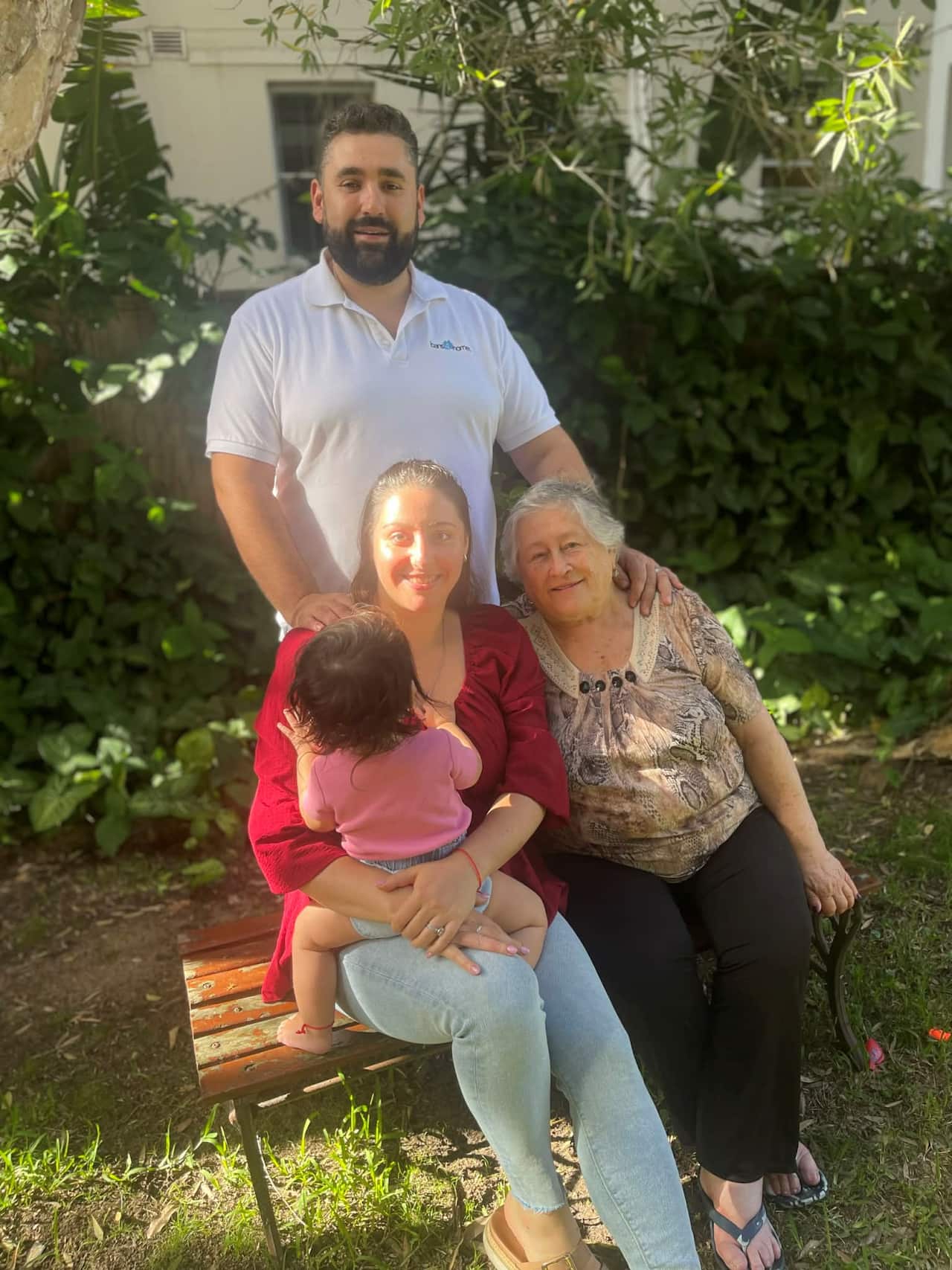
That's when Monica's grandmother, Maria, came up with an idea.
Maria put her hand up and said: 'You know what, why don't you guys move in with me? I've got a big apartment, I don't take up much room.'
"'We can work it out and then you guys can have the kid here and at least live here for 12 months. Build up your savings, rent your place out, and then move back when you guys are comfortable,'" Daniel recalled.
"My wife, funnily enough, as soon as we moved in two weeks later, we found out that she was pregnant."
He says the arrangement was initially intended as a short-term solution, but has since become essential.
"It's helped us to really budget at the end of the day, and essentially adopt a more old school mentality to the cost of living," he said.
"It's also allowed us to not sell our property."
By sharing expenses with Maria, 81, and having the added buffer of rental income, the family has been able to stabilise their finances.
"[Being] able to have rental income coming in … allows us to essentially have a bit more money in the bank, which has helped us with any potential rises in cost of living," he said.
It has also helped to share the caregiving responsibilities.
"In the first few months [of having a baby], when it was just so inconsistent, we were both waking up. It was really helpful to have Maria around because we would be able to give the baby to Maria, and just maybe have a hot meal once in a while."
Living under a shared roof
New research from financial services firm AMP has found that 55 per cent of the 2,000 Australians surveyed are open to the idea of multi-generational living — an arrangement where parents, adult children and sometimes grandparents or other extended family members share a home to pool resources and reduce costs.
The increase in support is being driven strongly by younger Australians, many of whom are struggling to enter the property market amid rising prices and higher interest rates.
"As housing pressures intensify and Australia becomes increasingly multicultural, younger Australians are rethinking what the 'Australian dream' looks like," says AMP's director of retirement Ben Hillier.
"They're seeing fewer and fewer of their peers enter the housing market, and so simply we talk about the 'bank of mum and dad', but I think the 'house of mum and dad' is going to play a stronger and stronger role in making sure that young Australians have somewhere to live that's affordable [and] secure."
Among the survey recipients aged 20 to 39, 68 per cent support the idea of living with family, compared to just 39 per cent of those aged 65 and over.
Women and single people are also more likely to support adopting multi-generational living arrangements, with 58 per cent of women and 61 per cent of singles backing the model.
Experts say this reflects the reality that single-income households are often less able to absorb rising costs.
Wealth divide reshaping expectations
The growing openness to shared living arrangements comes against the backdrop of a widening generational wealth gap.
Older Australians — particularly baby boomers — have benefited from decades of rising house prices, while first home buyers face significantly higher barriers to entry.
The AMP research shows 38 per cent of Australians aged 20 to 39 expect to rely on an inheritance to get into the property market.
But Hillier said longer life expectancies are pushing back the generational wealth transfer.
"Inheritances are increasingly being passed on to beneficiaries who are in their 50s, 60s and sometimes in their 70s. This is breaking some of the traditions we previously might have relied on at using the 'house of mum and dad', where it simply becomes yours when mum and dad pass away,” he said.
"Now that inheritance is being received really at a time that's not as helpful as perhaps it would be if inherited when we're in our 30s and 40s, when our children are young and we're struggling with housing cost pressures … and so intergenerational living can help to bridge that gap."
He says the trend also speaks to the broader issue of financial confidence, especially when it comes to retirement. AMP's 2025 Retirement Confidence Report found that about half of Australians are confident about life after work, highlighting that financial stability isn't just tied to superannuation balances.
"Housing ownership is one of the key determinants to comfort and confidence in retirement, and to be honest … I actually think home ownership is the number one determinant of how comfortable and confident you are in retirement, even more so than your superannuation balance," Hillier said.
Not a long-term solution, experts warn
Despite its growing popularity, property experts caution that multi-generational living is not a structural fix to Australia's housing challenges.
"Unfortunately, I think for some people it's the only solution in the current context where new housing supply is very necessary, but it takes a long time and it's very difficult to deliver," said housing market commentator Eliza Owen.
She said while the model can provide short-term relief, it doesn't address the underlying issues.
"The key problem we have is that home prices and, more recently, rents have really been outpacing the rate of growth in wages, and so that means that particularly lower income [people] or singles get left behind," she said.
“They don't have as much buying capacity, they don’t have as much borrowing capacity."
Owen says long-term fixes to both supply and demand are needed to alleviate affordability pressures.
"You can keep supplying new housing, which is very necessary, but you do need to put some parameters around demand to make sure, for example, it all doesn't just get concentrated among a few wealthy buyers," she said.
Owen said long-term solutions would also include planning reform, including not just focusing on building high-density housing but exploring other options, such as expanding city fringes for people who want standalone homes.
"Ideally, you would have a housing system that allows people to live how they want, and maybe that is in a multi-generational household," she said.
"But maybe it's independent of family, and living by oneself. Maybe it's in a share house, maybe it's owning your own home … you want to create a situation of autonomy so people can live how they want to."
Changing social norms
Multi-generational living isn't a new concept, with many cultures around the world living this way for hundreds and even thousands of years.
Demographers say the shift to multi-generational living reflects broader changes in Australian society, including cultural diversity and evolving attitudes towards family life.
"It's removed any social stigma of young adults living with their parents later," demographer Mark McCrindle told SBS News.
"[That's] to the point now where we have almost one in three 20- to 24-year-olds, even those that are working and therefore non-dependent, still living with their parents, so that's been a big increase."
He also says that the changes in life experiences are also affecting how Australians choose to live.
"Young people are marrying and coupling up a lot later. They're starting their families not in their 20-something years now, but in their 30-something years — and they're staying in education later before they start their earnings years," he said.
"All of which means that living with parents makes a lot more sense than it used to."
While McCrindle says there are real social advantages to living in a multi-generational household, such as shared responsibilities, stronger family support networks and keeping the generations connected, there are also challenges.
"We're seeing parents in their middle years be challenged, sandwiched, if you like, between the care of their young adults … and that's coming right at the time that one's own parents are getting elderly," he said.
"So here we have the gen Xer, perhaps in their 50s or 60s, managing still the parenting role and then looking after older parents themselves, so it can be an emotional stress. It can be a financial stress. You've got the householder covering bills for more people."
Balancing opportunity and tension
For families considering multi-generational living, experts say communication and planning are key.
"As long as in that household each group is pulling their weight and making the household function, and not treating it perhaps like they were as kids, or as a free or low-cost rental arrangement," McCrindle said.
Hillier says open conversations about finances, expectations and responsibilities can help prevent conflict.
"Contrary to popular opinion, [baby boomers] actually think the rising generation have it tougher, or at least as tough as they had it themselves when they were young," he said.
"But equally, they're not confident themselves, and I think that the younger generation are seeing that confidence as their parents enter retirement without the confidence that they need."
For Daniel and his family, the experience has been largely positive — but he acknowledges it's not a perfect solution.
"It works for now," he said.
The couple hopes to expand their family, which could potentially signal another move.
"At the end of the day, we're not really planning on moving. Maybe out of the area we were thinking about building a granny flat where my wife's parents are, to allow, if we need to, for the extra space if we have another baby," he says.
For the latest from SBS News, download our app and subscribe to our newsletter.







