In brief:
- The Australian government imposes a tax on petrol, called the fuel excise, currently set at 52c per litre.
- Australia's fuel excuse is quite low compared to other countries, where tax makes up most of the price of petrol.
Global oil prices are soaring amid supply pressures and pushing the costs of regular unleaded petrol in Australia to around $2.38 per litre on average, according to NRMA Insurance.
The Strait of Hormuz — the narrow, strategic waterway carrying about a fifth of the world's oil and gas — has been effectively shut down since conflict in the Middle East broke out on 28 February.
While petrol prices are "largely out of our control" as a nation, the factors that the government can regulate — taxes and duties — have remained relatively flat.
The government also has other indirect levers to influence prices, such as cracking down on anti-competitive behaviour and policies that can increase fuel supply.
These tax components, made up of the fuel excise and GST, amount to 52 cents per litre in Australia, with the remaining cost determined by petrol retailers.
News that makes sense
Your trusted source for staying up-to-date with the world around you. Get free daily news updates and analysis, straight to your inbox.
Motorists will be feeling the brunt of the increased costs, but experts have told SBS News that Australians are "relatively well off" compared to many countries when it comes to fuel.
This is largely thanks to the fuel excise being significantly lower than in many other countries.
So, what is the point of taxing fuel, and how does the government determine when to change the excise?
What is the fuel excise?
The Australian government imposes a tax on petrol, called the fuel excise, currently set at 52c per litre.
Fuel is also subject to GST, which carries a standard duty of 10 per cent.
It is then up to the oil companies to set their profit margins, considering the wholesale costs of fuel and factoring in taxes.
The cost of fuel is otherwise unregulated, but Australia's consumer watchdog does monitor the industry for price gouging and uncompetitive practices.
NRMA spokesperson Peter Khoury explained that the excise tax creates revenue for the government to spend on roads and infrastructure.
It doesn't cover the total costs of maintenance and upgrades, but it makes a positive difference in the budget.
"The fuel excise and GST are a tax on a tax. And the only other commodities where that happens are alcohol and cigarettes," he told SBS News' podcast Cost of Living Secrets, referring to the fact that GST is applied on top of the fuel excise.
"Prices of fuel go up and down based on when the excise changes and when oil companies shift their profit margins."
When does the excise change?
Looking at current national averages estimated by NRMA, a litre of petrol minus the fuel excise is around $1.70, and much of this cost comes directly from rising oil prices overseas.
Brent crude oil has been costing around US$100 ($143) per barrel this week, according to international markets, a spike since the conflict in the Middle East started.
"We see that the biggest contributing factor is global oil prices," Khoury said.
"If we're going to get real relief at the bowser, it must come from falls in oil prices. We cut the excise, and we will still pay record prices."
The government has reduced the fuel excise in the past to ease cost-of-living pressures.
During the COVID-19 pandemic, a sustained period of inflated prices, the government halved the excise for six months.
Associate professor Ben Phillips from ANU's Centre for Policy Research told SBS News that's unlikely to happen again in the immediate future, as the excise typically shifts by mere cents at a time.
"There's bill shock when it comes to petrol prices," he said, describing the current prices as a temporary lift, compared to the COVID-19 era economic upheaval.
"When you look at how much extra you might pay because of this tax, it's a minimal amount."
Compared to other member states of the Organisation for Economic Co-operation and Development (OECD), Australia has some of the cheapest petrol prices and related taxes.
"Our taxation for roads via excise is really very, very low and petrol prices are very low when looking to other similar economies," he said.
"So in a sense, we've got a pretty good here in Australia for road users."
How does Australia compare?
Australia's fuel excise is currently sitting at around 52 cents per litre.
It's half of what people pay in Japan, which charges 26 cents per litre in fuel excise and duties.
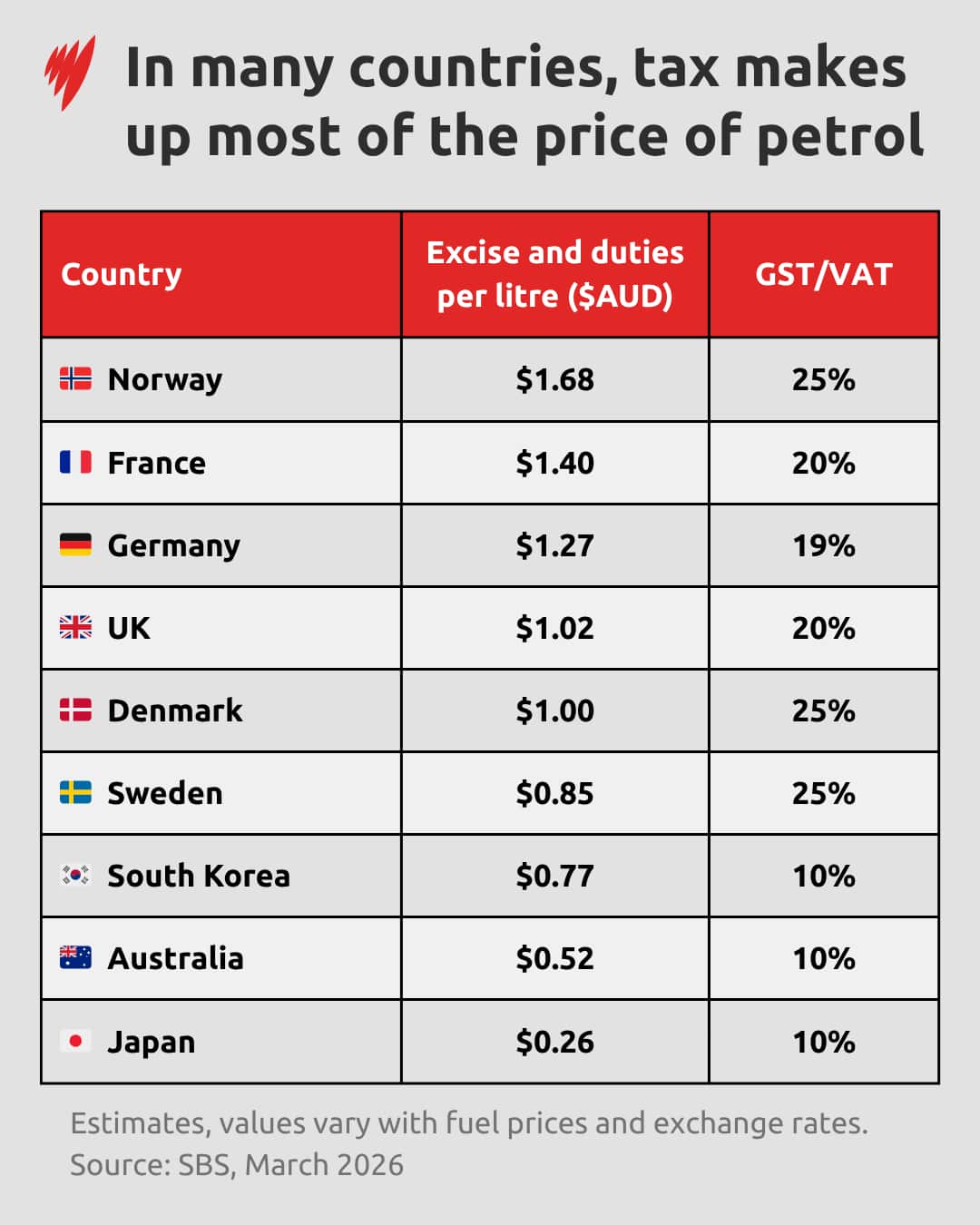
At the other end of the list, European countries have some of the highest taxes on fuel, where excises and duties make up most of the price of petrol.
Norway has a tax of $1.68 per litre, and in France that number is $1.40 per litre, a substantial difference from Australia.
Phillips said that Europeans regularly pay upwards of $3 per litre of petrol on any given day, with that number even higher now with ongoing conflicts.
"Whenever you travel to Europe, you will notice that petrol over there is much more expensive," he said.
This increased cost means more revenue for European governments to invest in making their cities less car-dependent.
"They're making a bigger contribution to their roads and also they're setting up their economies over the long run by doing that to have alternative transport forms that are better for the environment, so less emissions and less pollution," he said.
This can also reduce traffic and road maintenance costs, he said.
"Raising the excise here like in Europe probably wouldn't be politically popular as we are very car-dependent as a nation. But if we want to reduce pollution and traffic issues, that's probably where we should be heading."
For the latest from SBS News, download our app and subscribe to our newsletter.







