
Donald Trump had a busy February.
On 11 February, the United States president signed an executive order directing the military and the Pentagon — already emitting carbon dioxide at volumes comparable to the Philippines — to source their energy from coal.
For that, the CEO of the country's largest coal company awarded him a bronze trophy, declaring him the "undisputed champion of beautiful clean coal".
A day later, Trump and Environmental Protection Agency (EPA) administrator Lee Zeldin repealed the foundational 2009 greenhouse gas endangerment finding, stripping the EPA of its authority to regulate carbon dioxide and methane emissions.
Then, on 14 February, he established the National Energy Dominance Council, a federal body designed to fast-track oil, gas and coal projects at minimal cost and without environmental impact assessment — fulfilling his election promise to "drill, baby, drill".
News that makes sense
Your trusted source for staying up-to-date with the world around you. Get free daily news updates and analysis, straight to your inbox.
Two weeks later, the US was firing missiles at Iran.
The retaliatory Iranian blockade of the Strait of Hormuz and attacks on Gulf state infrastructure have created an energy crisis the likes of which the world has never seen.
Oil and gas disruptions are expected to continue for months, even years.

At the same time, the world is warming at its fastest rate in geological history, driven by the burning of those same fossil fuels.
The transition away from them has not been happening fast enough to avoid the kind of warming that exacerbates extreme weather events, such as the recent catastrophic wildfires in Europe and North America or the "exceptionally unusual" El Niño event presently brewing.
For many countries, the cost of switching away from fossil fuels has outweighed the urgency of the climate crisis, slowing the transition to renewable energy.
But that appears to be changing. Trump's decision to engage Iran in a protracted military conflict has prompted a global rethink of traditional energy sources — inadvertently strengthening the case for investment in renewables at a time when market conditions are increasingly favourable.
Some experts suggest it could be the inflection point needed to bend climate projections in a more survivable direction — but it has also prompted a major doubling down in some areas, which could have the opposite effect.
Economic drivers trump environmental urgency
Since the war broke out at the end of February, at least 29 countries have enacted structural policy decisions to decarbonise their economies, the International Energy Agency (IEA) reports.
Australia is among them, having announced an expansion of public EV charging stations, funding to electrify the Australia Post fleet and a zero-emission heavy freight transport project.
Overseas, the European Union has fast-tracked a mandate requiring solar panels to be installed on all new buildings by the end of the year; France and Germany have redirected billions from fossil fuel subsidies into heat-pump grants; India has commissioned 500 new biogas plants (which convert organic waste into renewable energy and nutrient-rich fertiliser); while New Delhi and Mumbai have switched all new public buses to electric.Even in the US, a major high-voltage transmission project has been fast-tracked to deliver Canadian hydropower to New York and New England.
Experts say such emergency policy measures are being driven by economic needs in the wake of the crisis, the third this decade to rocket global fuel prices, following the COVID-19 pandemic and Russia's full-scale invasion of Ukraine.
The current situation, however, is accelerating fossil fuel "demand destruction" on a larger scale, independent climate analyst Ketan Joshi says.
"Those previous crises did not occur when there was a cheap, readily available alternative to both oil consumption and gas consumption," Joshi tells SBS News.
The policy response also signals the growing importance of domestic power generation, according to Roc Shi, professor of energy, environmental economics and sustainability at the University of Technology Sydney.
He believes the present crisis "will impact any future assessment scenario for governments".
"The crisis makes people realise that relying on the global supply of oil and energy actually [makes them] vulnerable to the new reality. That will undermine and damage the comparative advantages of fossil fuels," Shi says.
A global 'turning point'
That economic rationale is already driving major renewable projects worldwide, especially in parts of Asia that have historically depended on oil and gas imports for energy production.
In South Korea, there is a huge push to ensure commercial truck and shipping infrastructure will soon run on hydrogen.
In Vietnam, the country's largest conglomerate Vingroup recently announced a major hybrid renewable and battery storage project, replacing its previous proposal to build the country's largest liquefied natural gas (LNG) import terminal and power plant.
In China, now the world's biggest producer of green energy, the rapid uptake of renewables has been fuelled in part by energy security concerns, along with the economic growth potential of green technology and manufacturing. In the first six months of this year, more than 40 per cent of its electricity came from renewables, according to China’s National Energy Administration.
Sofia Gonzales-Zuñiga, a senior climate policy analyst with Climate Analytics, tells SBS News the crisis has been a wake-up call for many countries. Those that have been sluggish to act on environmental grounds are now seeing the economic appeal.
"Things are changing very fast now," she says.
You have mature technology that is price-competitive and that can be easily scalable.
Over the past decade, renewable energy installation costs have fallen dramatically, opening up market opportunities in regions that previously saw the transition as cost-prohibitive.
According to research from Our World in Data, solar photovoltaic costs fell by 90 per cent over the decade to 2024, onshore wind costs dropped by 70 per cent, and battery costs by more than 90 per cent.
As costs have dropped, capacity has grown. And with an energy crisis once again inflating fuel prices, conditions are ripe for long-term change, Gonzales-Zuñiga says.
"The expectation is that this could be that turning point where afterwards there's no return to fossil fuels."
The 'solar revolution'
Pakistan's response to the 2022 energy crisis offers a domestic example.
Following Russia's invasion of Ukraine, international sanctions halted the supply of Russian oil to Europe. In response, contractors re-routed shipments, chasing enlarged profits in Europe, which sent global fuel prices soaring.
At the time, Pakistan was generating 25 per cent of its power from LNG imported via Qatar. The country suffered devastating rolling blackouts as a result of the price hikes and quickly began seeking alternatives.
Haneea Isaad, a Pakistan-based energy finance specialist at the Institute for Energy Economics and Financial Analysis (IEEFA), says solar energy was the obvious choice.
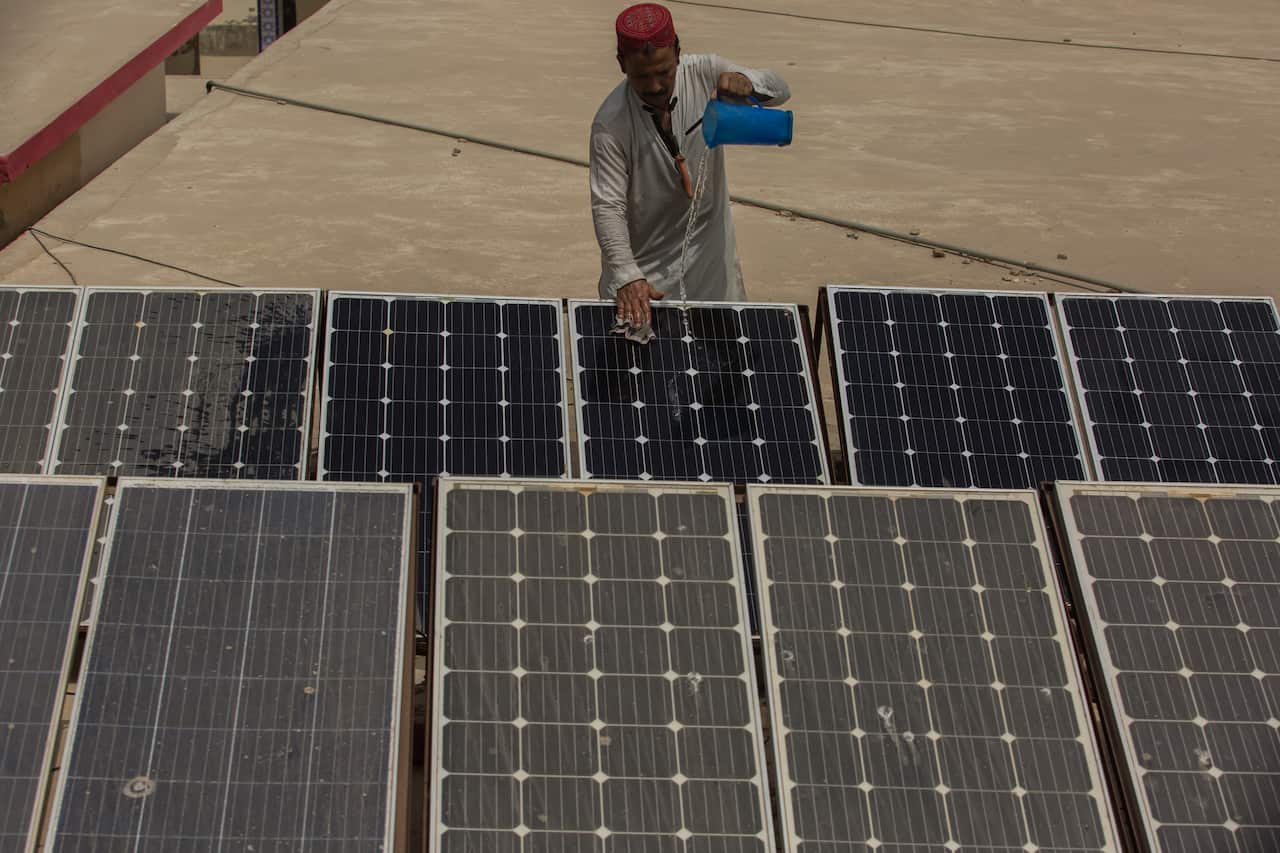
China was producing a "massive surplus" of solar panels for relatively low cost at the time, she explains. In addition, the newly elected government in Pakistan slashed taxes and import charges on them, while implementing "generous" energy buyback schemes.
"Anybody who could really afford to put up a rooftop solar system went for it," Isaad says.
Pakistan quickly became the world's largest importer of solar panels. Over the next two years, almost 30 gigawatts of solar energy was installed; rural areas were electrified for the first time and demand for coal, oil and LNG dropped.
Joshua Runciman, lead Australian gas analyst at IEEFA, describes it as a "human-led solar revolution".
"It potentially serves as an example of the way that individuals — not energy planners, not wonks in ivory towers — but individuals might actually respond to [the current crisis]," he says.
Thanks to Pakistan's solar revolution, when gas stopped flowing through the Strait of Hormuz in March — essentially cutting off all LNG supplies from Qatar — the country was better positioned to respond than it was in 2022.
Waqas Moosa, head of solar energy company Hedron Solar in Pakistan, says other countries can learn from Pakistan.
"Malaysia, Philippines, India, Bangladesh, they suffered," he says, referring to the fallout of the crisis ignited by Trump's war on Iran.
The sun does not pass through the Strait of Hormuz or any other strait or chokepoint which is going to come in the future.
With solar panel sales rising dramatically over the last few years — which Moosa notes coincided with prices falling — he expects to see similar revolutions around the world as countries enter "the renewable era".
"The Stone Age did not end because stone finished, the Iron Age did not end because iron finished, and the fossil fuel age is not going to end because we ran out of fossil fuel," he says.
"Maybe 30, 40 years down the road, when the kids study history, they'll probably look at this decade, the 2020s, where the transition from fossil fuels towards renewables happened."
Billions and billions of dollars
Even as rapid change is underway in some parts of the world, the status quo prevails in others.
Research from Climate Analytics shows that nearly one-third of the global population lives in a country that is highly economically dependent on fossil fuel exports.
So while many importing nations have hastened their transition to renewables since Trump authorised the first strikes on Iran in February, some exporting nations have sought to capitalise on increased global demand for fuel.
US exports of LNG have surged to an all-time high while Canada has enacted emergency legislation to fast-track new mining and export projects, simultaneously reneging on its global climate pledges.
Other countries without established renewable resources have also increased their use of coal for power generation, including Japan, Bangladesh, Thailand and the Philippines.
Even China, increasingly touted as a green energy leader, has walked back coal-reduction commitments, choosing instead to focus on building its renewable-led power sector, underpinned by coal.
Indeed, the country remains the world's biggest carbon emitter. Its domestic coal-fired power generation is expected to rise by 1.5 to 3 per cent this year, reversing last year's first-in-a-decade decline.
Globally, coal use is predicted to increase 1.4 per cent.
Across the world, politicians have used the crisis to argue for slowing or reversing the energy transition on economic or energy security grounds, something Joshi says is "very convincing".
In Australia, Opposition leader Angus Taylor has said "we must dig and we must drill" in response to the current global shock. The Liberal Party and One Nation have both promised to abandon net zero frameworks entirely, arguing they hamper energy security.
Such favourable political backing gives fossil fuel companies greater licence to continue generating already vastly inflated profits.
Analytics firm Wood Mackenzie estimates the global oil and gas industry is on track for a nearly $700 billion cash windfall this year. When oil peaked at US$126 a barrel in April, the world's top 100 oil companies were making a combined US$30 million ($43 million) in profit every hour.
"This money just becomes a war chest," Joshi says.
"They can use it for political lobbying, for communications, to build new fossil fuel infrastructure. I think we can say confidently that it makes them more capable in enacting their agenda."
'The last push for fossil fuels'
The tug-of-war between renewables and fossil fuels is affecting global emissions in real-time, too.
While the IEA predicted at the beginning of the year that emissions would finally begin to drop, the onset of war in Iran saw carbon emissions spike sharply. It represents a departure from other recent energy crises, which have typically triggered a temporary drop in emissions.
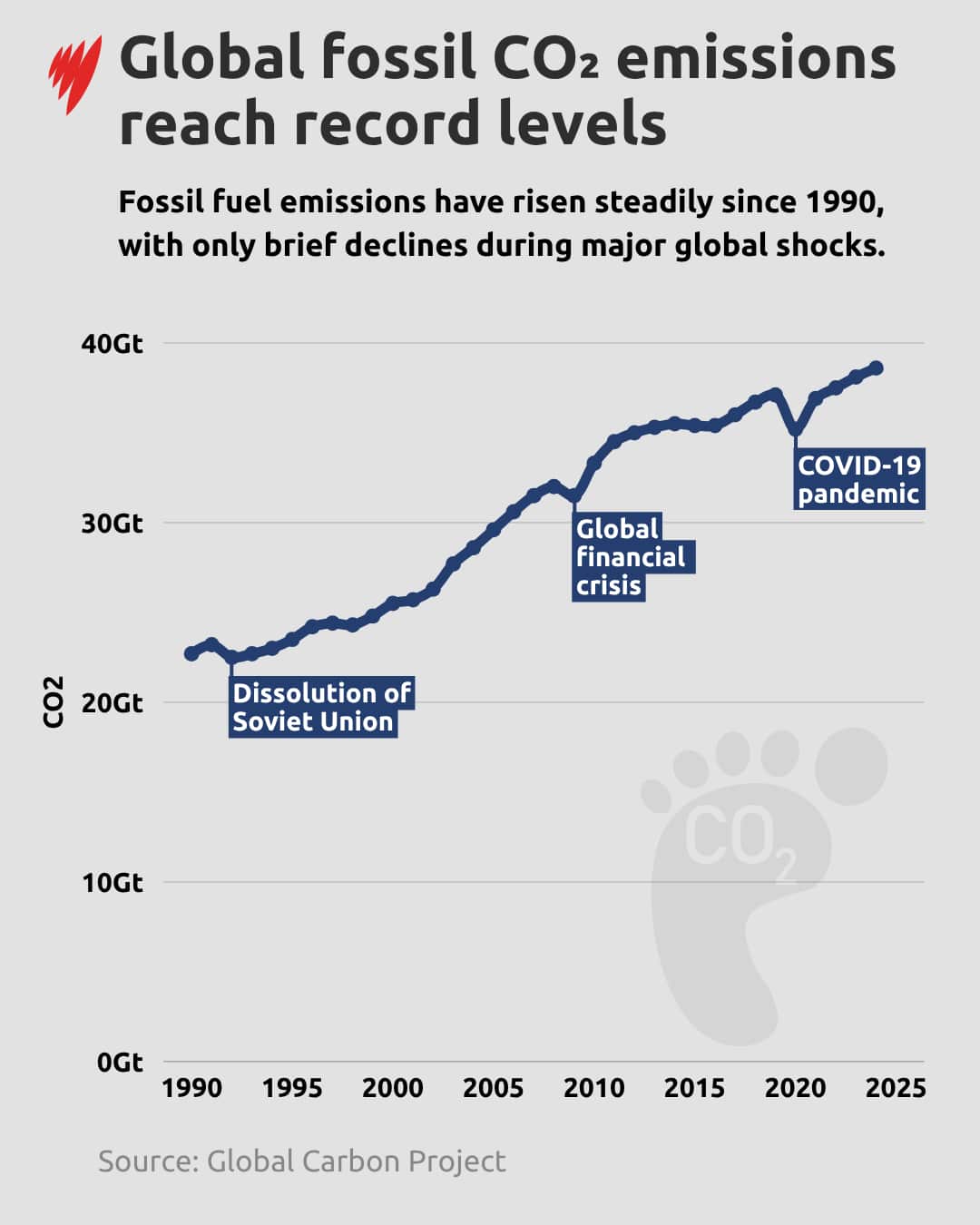
The IEA now expects emissions to rise to a new record once again this year.
Gonzales-Zuñiga says a "lot is changing in the background"; however, political resistance and entrenched interests continue to offset meaningful climate action.
"There's this last push for fossil fuels, like, the last dying push," she says.
I think we are exactly at that threshold where it just needs to go in the other direction.
If the world could rally to implement the Global Stocktake goals agreed to at COP28 — tripling renewable capacity, doubling energy efficiency, and cutting methane — by 2030, it would reduce projected warming by 0.9 degrees this century.
"If this crisis were to tip the scales in that direction, this could be like a reference point for how far we could go," Gonzales-Zuñiga says.
With economic factors, not environmental ones, driving the rollout of renewable energy so far, it's not yet clear whether uptake will moderate long-term projections beyond the war.
Joshi says the simultaneous push for renewables and the doubling down on fossil fuels seem to be having a "counter-balancing" effect, with no clear overall direction.
"If I had to guess, electrification in Asia and a general nervousness around fossil fuel use will result in a material reduction in fossil fuels, but not necessarily enough to make that curve plummet downwards — you know, like it should have 10 years ago."
He adds that a renewables transition powered by concern over energy security is also unsustainable, as once that issue is resolved, "the impetus to switch away from fossil fuels just drops".
"It probably does have some side benefits for climate, but in general, it is just not a great way of enacting this change."
If you could design a perfect world, you would opt for a much better way of doing things.
With the war in Iran now in its sixth month and fuel prices again climbing, some experts are sceptical about whether the crisis will amount to lasting change.
And yet, undeniably, it has also hastened the fast-tracking of renewable projects in some regions which otherwise may not have happened — including in the US.
In Texas, America's most oil-rich, deep-red state, pure economics have seen solar, wind, and battery installations roll out faster than in any other, save for California.
Solar now powers more Texan homes than coal, and installation records continue to be shattered.
The picture in Donald Trump's United States, much like the rest of the world, remains complex. Still, despite the best efforts of the "undisputed champion of beautiful clean coal", not everyone has been persuaded to stick with the black stuff.
For the latest from SBS News, download our app and subscribe to our newsletter.







