In brief
- Donald Trump has rejected reports that he is seeking to end the war in the Middle East.
- The US president has repeated claims that Iran wants to make a deal, a position that Iran has strongly denied.
United States President Donald Trump denied being "desperate" to make a deal with Iran, as he mixed threats with diplomacy in a seeming push to wrap up the war in the Middle East.
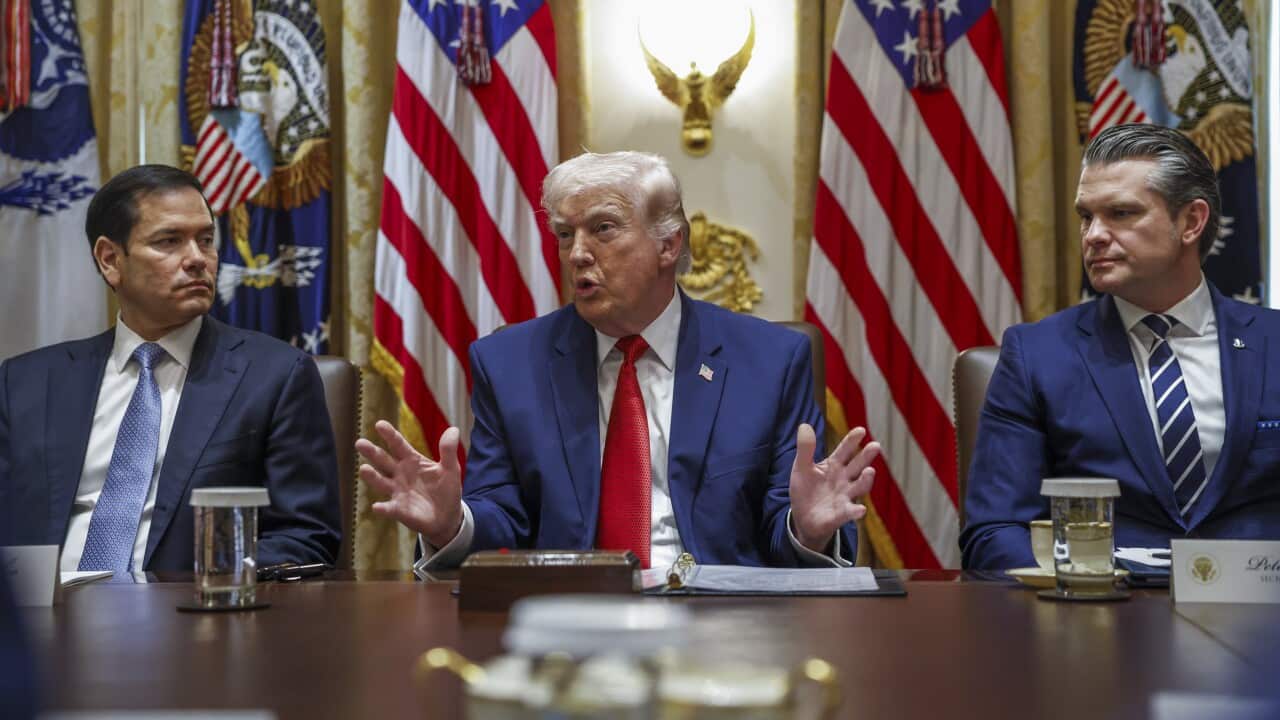
Holding his first cabinet meeting since the joint US-Israeli operation on 28 February that started the latest round of hostilities, Trump insisted that Iran was being "beat to sh-t" and was "begging" for a deal, despite the Islamic Republic's refutation of these claims.
However, Trump rejected reports that he was looking for an exit ramp, as oil prices soared and political pressure mounted on him to avoid the kind of drawn-out Middle East war he once spurned.
"I read a story today that I'm desperate to make a deal," Trump told reporters on Thursday. "I'm the opposite of desperate. I don't care."
Trump has been saying for days that Iran wants to make a deal, amid growing signs he is seeking a quick end to the conflict. Iran, however, has continued to say there are no direct negotiations.
News that makes sense
Your trusted source for staying up-to-date with the world around you. Get free daily news updates and analysis, straight to your inbox.
He also lashed the North Atlantic Treaty Organization (NATO) and other allies, singling out Australia, for rejecting his appeals to help secure the Strait of Hormuz, saying he was "a little surprised by Australia".
During the 90-minute televised meeting at the White House, Trump veered between repeated threats to "obliterate" Iran and claims it was on the verge of capitulating.
"They want to make a deal. The reason they want to make a deal is they have been just beat to sh-t," Trump said.
"They now have the chance, that is Iran, to permanently abandon their nuclear ambitions and to join a new path forward. We'll see if they want to do it. If they don't, we're their worst nightmare. In the meantime, we'll just keep blowing them away."
Citing the original timeframe of four to six weeks that he gave shortly after the US-Israeli offensive began on 28 February, Trump said "we're extremely, really, a lot ahead of schedule."
The US leader said Iran had allowed 10 oil tankers to pass through the strategic Strait of Hormuz as a "present" to show it was serious about negotiations to end the war.
The president, who is sending thousands of troops to the Middle East, driving expectations of a ground invasion, also said taking control of Iran's oil was an option, as the US effectively did with Venezuela after toppling Nicolas Maduro, who appeared in a US court on Thursday.
Speculation has mounted that the US will seek to take control of Kharg Island, Iran's oil "lifeline", where 90 per cent of the country's oil tankers are loaded.
A note seen by Reuters on Tuesday to the United Nations from Iran said "non-hostile vessels" could transit the strait if they coordinated with Iranian authorities.
The Iranian embassy in Spain said on Thursday that Iran would be receptive to any requests from Spain relating to the Strait of Hormuz, because Spain respected international law — the first such concession offered to an European Union state.
Spain has a relatively small merchant fleet but was among the first countries to condemn the US-Israeli attacks on Iran, denouncing the war as reckless and illegal — remarks which drew the ire of Trump, who threatened to impose a trade embargo on Spain.
A Thai oil tanker has passed through the strait following diplomatic coordination with Iran, and Malaysia said its vessels were also being allowed to transit in a sign that restrictions were loosening for some countries.
US proposal 'one-sided and unfair', Iran says
Trump's comments will once again fuel the speculation that has swirled since the start of the war about the 79-year-old's goals and timeline for the war.
The US-Iran talks have been shrouded in uncertainty since Trump first announced them on Monday and postponed a threat to attack Iran's power plants.
Trump's deadline for Iran to unblock the Strait of Hormuz or see its energy network hit is due to expire on Friday, but with just a day to go he said he wasn't sure if he'd extend it.
"In Trump time, a day, you know what it is? That's an eternity," the president said.
But Trump's global envoy Steve Witkoff confirmed for the first time that the US had sent a 15-point "action list" via mediator Pakistan and said there were "strong signs" Iran might make a deal.
The US proposal for ending nearly four weeks of fighting is "one-sided and unfair", a senior Iranian official told Reuters on Thursday, saying it was "was reviewed in detail on Wednesday night by senior Iranian officials and the representative of Iran's Supreme Leader".
It lacked the minimum requirements for success and served only US and Israeli interests, the official said, while stressing that diplomacy had not ended despite the lack for now of a realistic plan for peace talks.
Trump described the Iranians as "great negotiators" but added that he was not sure he was "willing to make a deal with them to end the war".
US, Israel, Iran continue to trade blows
Meanwhile, the US, Israel and Iran continue to exchange fire.
In Iran, strikes hit a residential zone in the southern city of Bandar Abbas and a village on the outskirts of the southern city of Shiraz, where two teenage brothers were killed, Iran's Tasnim news agency said. A university building in Isfahan was reported to have been hit.
US and Israeli officials said an Israeli airstrike had killed the Iranian Islamic Revolutionary Guard Corps' Navy commander Admiral Alireza Tangsiri.
On Thursday, Iran launched multiple waves of missiles at Israel, striking Tel Aviv, Haifa and other areas, including a Palestinian town in central Israel.
At least one ballistic missile hit Tel Aviv, according to the military, while others carried cluster munitions that dispersed smaller explosives, damaging homes and cars. Israel’s ambulance service said a man was killed in Nahariya after Hezbollah fired a rocket barrage at the northern city.
Israel announced this week plans to take control of large swathes of southern Lebanon, territory amounting to one-tenth of the country — a move that experts say will have severe humanitarian consequences.
Hezbollah has said it would fight to prevent Israeli troops from occupying southern Lebanon, calling it an "existential threat".
Trump singles out Australia, lashes NATO
During Thursday's cabinet meeting, Trump spent much of his time lambasting NATO and other allies for rejecting his appeals to help secure the Strait of Hormuz, through which around a fifth of global crude oil and liquefied natural gas normally passes.
He blasted the British aircraft carriers London eventually offered as "toys" compared to their US equivalents.
"I've done a great favour for the world. The world has not been reciprocal," Trump said. "I believe that's going to cost them dearly."
He also singled out Australia. "Australia was not great. I was a little surprised by Australia," he said, as reported by the ABC and other news outlets.
It followed remarks he made over a week ago, in which he also lashed out against Australia in a tirade aimed at NATO and other countries for not meeting his call for aiding the US in the Strait of Hormuz.
Trump's top officials also chimed in.
Top US diplomat Marco Rubio appeared to quote rappers Public Enemy as he said that "every day, the Department of War lets the drummer get wicked over every portion of Iran".
US defence secretary Pete Hegseth hailed Trump for "doing the work of the free world".
"We pray for a deal, and we welcome a deal," Hegseth said. "But in the meantime ... the Department of War will continue negotiating with bombs."
For the latest from SBS News, download our app and subscribe to our newsletter.







