
The EU has formally designated Iran’s Islamic Revolutionary Guard Corps a terrorist organisation, aligning it with groups such as Islamic State and al-Qaida. Tensions between Tehran and Washington are escalating amid one of the deadliest protest crackdowns in Iran’s recent history.
Listen to Australian and world news and follow trending topics with SBS News Podcasts.
TRANSCRIPT
The European Union has formally designated Iran’s Islamic Revolutionary Guard Corps a terrorist organisation.
In Brussels, the E-U’s foreign policy chief Kaja Kallas said ministers agreed to blacklist the Guard, impose fresh sanctions and expand export controls, arguing that the tyranny in Iran cannot be allowed to continue.
“Today ministers agreed to designate Iran’s Revolutionary Guard as a terrorist organisation. This will put them on the same footing with Daesh, Hamas, Hezbollah, al-Qaida. Those who operate through terror must be treated as terrorists. Ministers also imposed sanctions on those responsible for the brutal crackdown of protests, including the Minister of Interior. Repression cannot go unanswered.”
Ms Kallas explains the scope of this decision, preferring diplomacy to threats of attacking Iran, such as those made by the United States.
“This decision means that if we list them as a terrorist organisation, that many member states have criminalised any activity or interaction with the terrorist organisation. So that puts more pressure on this. When it comes to attacks, then I think the region does not need a new war.”
The Iranian Foreign Ministry condemned the decision, saying the move was illegal, political and contrary to international law as well as a violation of the country’s internal affairs.
It also said:
“Iran reserves the right to take appropriate measures within the framework of international law to defend its sovereignty, national security, and the interests of the Iranian nation, and holds the European Union and its member states responsible for the consequences of this action.”
The decision follows weeks of nationwide protests driven by economic hardship and political repression.
The US based Human Rights Activists News Agency says it has confirmed at least 6,373 people killed in the crackdown, including more than 200 linked to government forces.
Other medical networks gathering information inside Iran believe the toll could be far higher.
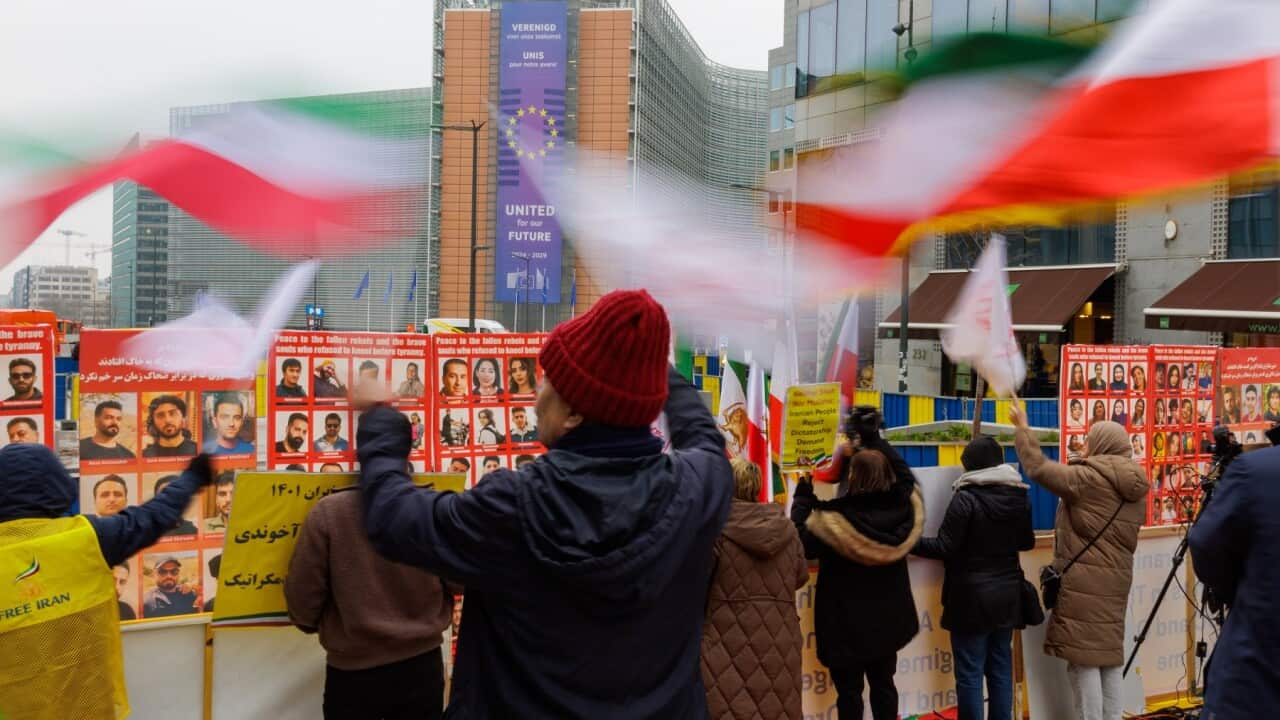
Outside the European Council in Brussels, Iranian demonstrators welcomed the EU’s decision, calling it a turning point after years of lobbying.
Protest organiser Ali Baghery says the move sends a clear message to Tehran.
“In fact it’s a very strong signal from the European Union in supporting the Iranian people and stopping the appeasement policy.”
Legal professional Nikou Aboutalebi says protesters are seeking solidarity rather than military action.
“We don’t ask for any intervention inside Iran. We don’t ask to start a war with Iran, for America to bomb us. We don’t ask for all of that. We just ask support us like that. We just say we do not negotiate with terrorists and it ends there. The rest is up to the people of Iran inside Iran. It’s their voice and we need to hear them.”
As Europe tightens economic and political pressure, attention is now turning to Washington, where the White House has signalled a more muscular approach.
At a cabinet meeting with US President Donald Trump in attendance, Secretary of War Pete Hegseth warned Iran must abandon its nuclear ambitions, and that the Pentagon stands ready if ordered to act.
“Well, Mr. President, you had to, like so many other Cabinet members have referenced, rebuild the perception of America. And at the Department of War, that meant reestablishing deterrence… Same thing with Iran right now, ensuring that they have all the options to make a deal. They should not pursue nuclear capabilities. We will be prepared to deliver whatever this president expects of the War Department.”
The military posture has raised concern across the region, with Middle Eastern leaders calling for restraint and warning against a wider conflict.
Saudi Arabia and the United Arab Emirates have both said they will not allow their airspace or territory to be used for any attack on Iran.
Iranian officials have long been warning that any strike on Iran would be met swiftly and reminding the U-S that its bases across the Middle East remain within missile range.
With all this sabre-rattling, UN Secretary-General Antonio Guterres had this advice not just for Iran and the United States, but for all nations.
“We are living in a world where actions - especially reckless ones - are provoking dangerous reactions. And unlike in physics, these erections are not symmetrical or predictable. They are being multiplied by geopolitical divisions and magnified by an epidemic of impunity. The law of power is prevailing over the power of law. International law is trampled. ... Global problems will not be solved by one power calling the shots, nor will they be solved by two powers carving the world into rival spheres of influence.”