

On Thursday, the four-booster Ariane 64 is scheduled to lift off from French Guiana on its maiden flight. This powerful version of the Ariane 6 rocket will carry 32 satellites for Amazon Leo’s broadband constellation. At a time when the United States is seen as a potentially unreliable partner, this is a key milestone in Europe’s effort to secure independent access to space.
Listen to Australian and world news and follow trending topics with SBS News Podcasts.
TRANSCRIPT
In a tightly-controlled manufacturing hangar west of Paris, workers put the finishing touches on an enormous silver-coloured engine.
This week, a similar machine will help propel the most powerful version of Europe’s Ariane 6 rocket yet, flying for the first time with four boosters.
On Thursday, the Ariane 64 rocket — named after its 4 boosters — is scheduled to make its maiden launch from the European spaceport in Kourou, French Guiana, aiming to deploy 32 satellites for Amazon Leo’s broadband constellation.
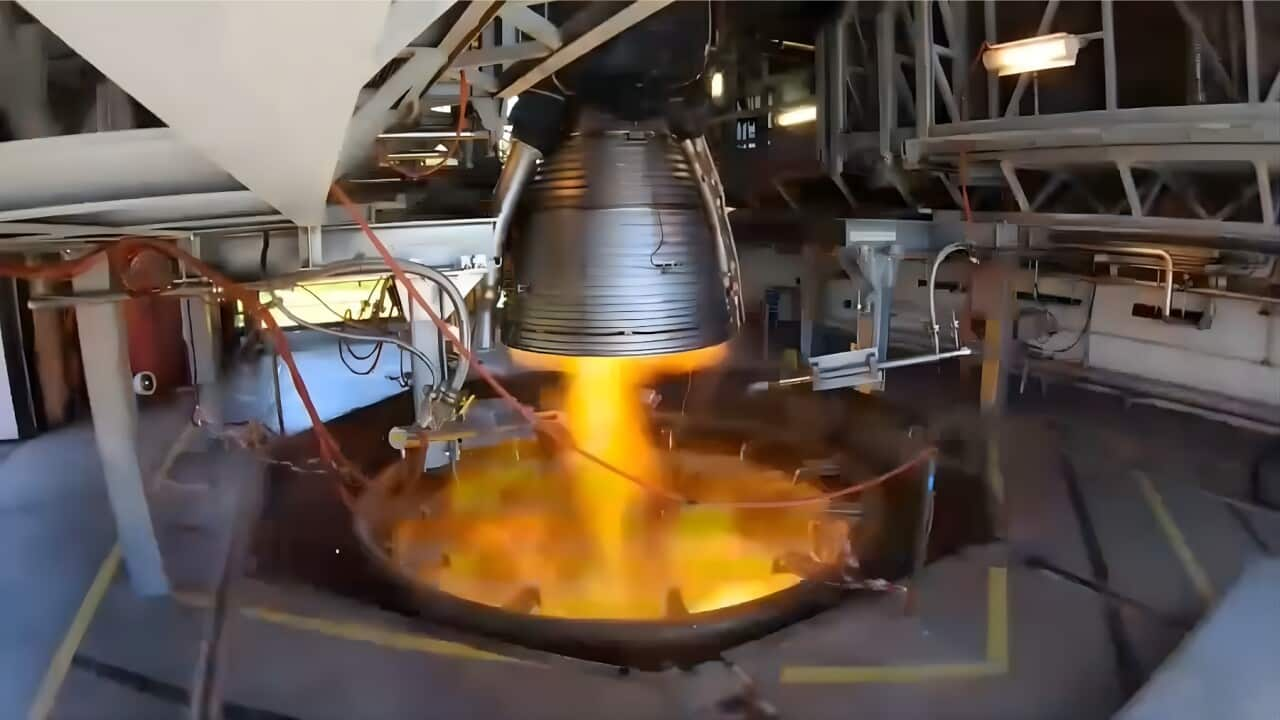
At Ariane Group’s plant in Vernon, engineers design, integrate and test engines for the European heavy-lift launcher.
At another site west of Paris, in Les Mureaux, the rocket’s main stage components were carefully built and assembled.
Emmanuel Viallon, the head of the site at Vernon says the project has been designed to halve the costs of a launch:
“So the main stake for Ariane 6 was to divide the cost by a factor of a little bit less by two. This was not done only at engine-level but at all launcher level, but each of the components was supposed to bring a significant value on that aspect.”
For employees working across the Ariane program, the countdown will be shared — and personal — as Ariane 64 roars skyward for the first time.
The launcher, its engines and avionics are built across Europe, with 13 nations participating in the Ariane program.
Ahead of Thursday’s launch, all components have crossed the Atlantic to French Guiana for final assembly.
The rocket stands about 62 meters (203 feet) tall, roughly the height of a 20-story building.
Emmanuel Vallion says at its heart is the 3-metre tall main engine assembly
“The Vulcain 2.1 engine behind me is the first to ignite when the rocket is launched. For a few seconds, we verify that it is operating properly. Once we are fully confident that it will perform as expected during the eight minutes that follow, the solid rocket boosters are ignited and the rocket lifts off. Its burn time is about eight minutes, during which it delivers roughly 140 metric tonnes of thrust.”
Once airborne, the mission will last about one hour and 50 minutes — nearly a full orbit around Earth — before the satellites are deployed in pairs from the top of the rocket.
Amazon Leo’s constellation is intended to compete with industry leader SpaceX’s thousands of Starlink satellites.
Engines produced in Vernon are tested on site under near-real launch conditions near the launch site.
Deep in the surrounding forest, reinforced structures hold the engines in place as they fire at full power, while test teams operate from underground control rooms.
Laurence - his full name is withheld for security reasons - says a large team is involved in the process.
“The entire process from the moment the engine arrives to when it departs, including the entire intermediate testing phase, ambient tests, cryogenic tests, and real firing tests, takes about 10 days to 3 weeks of activity. Consequently, we have a whole team with specialists, including measurement specialists, IT specialists, fluid mechanics specialists. The team consists of approximately 20 people who will handle this engine during these 2 to 3 weeks to ensure it is calibrated and ready to be sent to the assembly hall.”
Back in France, at the Les Mureaux facility, engineers have started preparing rocket components for upcoming missions.
Independent access to space remains the core objective of the program, according to Arnaud Demay, the Ariane 6 project manager.
It's a highly competitive sector dominated by Elon Musk's SpaceX and its reusable rocket model.
“ArianeGroup is currently working on key technology bricks, whether for engines or for a complete rocket, to enable the reuse of certain launcher components. Ideally, we would like to be able to reuse an entire stage, including the engines that powered its liftoff. To achieve this, we need engines that can be re-ignited. We already know how to re-ignite an engine in space, as demonstrated with the Vinci engine. But we also need thrust that is throttleable and adjustable, allowing us to perform a controlled landing. This is something we are actively developing and working on across our ArianeGroup sites throughout Europe.”
Competing with Space-X is challenging: while it offers comparable heavy-lift capability, the Ariane 64 faces significant challenges due to its lack of reusability, higher cost, and slower launch cadence compared to SpaceX's established fleet.









