
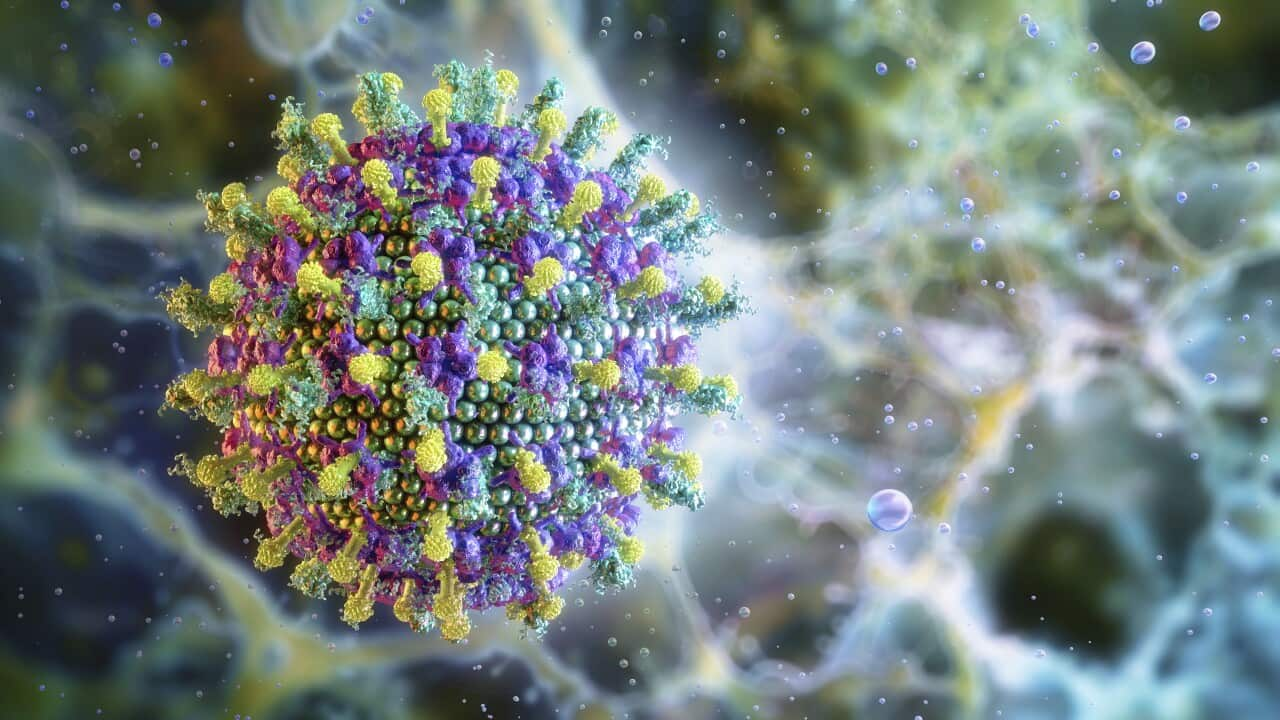

Two cases of the deadly Nipah virus have been confirmed in India's West Bengal state and at least 190 people have been quarantined. It's prompted multiple countries in Asia to step up airport screenings to prevent the spread of the infection, which at this stage has no vaccine or proven treatment. However, experts say while it's a dangerous virus with a high fatality rate, it doesn't spread easily from person-to-person.
Listen to Australian and world news and follow trending topics with SBS News Podcasts.
TRANSCRIPT
Two cases of the deadly Nipah virus have been confirmed in India's West Bengal state and at least 190 people have been quarantined.
It's prompted multiple countries in Asia to step up airport screenings to prevent the spread of the infection, which at this stage has no vaccine or proven treatment.
However, experts say while it's a dangerous virus with a high fatality rate, it doesn't spread easily from person-to-person.
Two cases of the deadly Nipah virus have been confirmed in the state of West Bengal in India since December.
It's sparked concern in parts of Asia, where multiple countries including Malaysia, Thailand and Nepal, have stepped up airport screenings to halt the spread of the virus.
Dr Subarna Goswami from the Darjeeling Tuberculosis Hospital says Indian authorities are working to trace, test and quarantine all who have come in contact with the confirmed cases.
“So far, only two patients have tested positive. The remaining contacts, approximately 190-200 of them, have been quarantined and those who showed symptoms have also been tested. They also tested negative apart from these two patients, no one else has tested positive yet.”
Nipah is a rare viral infection that spreads largely from infected animals, mainly fruit bats, to humans, and can cause fever and brain inflammation.
The World Health Organisation says it has a fatality rate of between 40 per cent and 75 per cent, depending on the local healthcare system's capacity for detection and management.
Dr Goswami says the confirmed cases in India is troubling, given there is no vaccine, or proven treatment options.
“The Nipah virus infection is very dangerous. There are three reasons for this. First, there is no cure for it, there is no specific treatment and no medicine works. Secondly, there is no vaccine or inoculation for it. And the third thing is that its morbidity rate, the fatality ratio, is very high.”
Infectious diseases consultant at Manipal Hospital in India's West, Dr Sayan Chakraborty, says the danger of the virus lies in its potential to spread to the brain.
“It starts like a normal viral fever. There is fever, headache, pain in the whole body. Along with it, there is pain in the throat and a cough. The cough transforms into Pneumonia-like conditions. There is difficulty in breathing. Then, gradually, the infection spreads to the brain which reduces the senses of the patient. Eventually, the patient goes into a coma.”
Professor in Medicine at the Norwich Medical School, Paul Hunter, says once the virus has impacted the brain, symptoms quickly become severe.
"The thing that probably kills most is called encephalitis, which is an infection and a swelling of the brain. And when you get encephalitis, you start feeling very unwell. You have high fever, you have very severe headaches, and you can have photophobia, where the light hurts your eyes."
Most people who survive encephalitis make a full recovery, but the W-H-O says approximately 20 per cent are left with residual neurological consequences such as seizure disorder and personality changes.
Nipah was first identified in Malaysia in 1999.
Since then, there have been small outbreaks almost every year, mostly in Bangladesh, and India has experienced sporadic outbreaks.
According to the Coalition for Epidemic Preparedness Innovations, a group that tracks emerging disease threats, as of December last year, 750 cases had been recorded since 1999, and 415 of the patients died.
While the virus can spread from person to person, Professor Hunter says it does not do so easily, which may explain why outbreaks have usually been small and fairly contained.
"As far as we can tell, the main risk of person-to-person transmission comes from fairly close contact, you know, typically when you're caring for somebody who's quite ill. But it must be said there aren't a lot of, there's not a huge amount of evidence on which to base a lot of these judgements."
When first identified in Malaysia, Nipah spread largely through direct contact with sick pigs.
Since then, it more commonly spreads from contact with what scientists say is its primary host: fruit bats.
The WHO says the consumption of fruit or fruit products containing urine or saliva from infected fruit bats has been the most likely source of infection.
Professor Hunter says with this in mind, there are some precautions that can help protect a person from contracting the virus.
"In terms of the initial infections, it's being careful about eating and drinking food that might be contaminated by fruit bats. For the traveller, if any of us go to these areas, the issue is, you know, being the sort of things that you're not supposed to do anyway, or you don't eat fruit without peeling it first. Don't drink unpasteurised or unheated drinks that have been heated to a temperature that would kill viruses."
While there are currently no approved vaccines or treatments for Nipah, a number of vaccine candidates are undergoing testing, including one developed by the Oxford University scientists involved in developing one of the COVID-19 vaccines.
Professor Hunter says while Nipah is a dangerous virus with a high fatality rate, it hasn't yet shown signs of becoming more transmissible among humans, making it's global spread at this stage unlikely.
However, he says its long incubation period does pose potential challenges to tracking its movement across borders - as it's also difficult to detect in the early stage.
"It's about one to two weeks, (the time for symptoms to show) maybe a little bit sooner in some, and sometimes a lot longer than that. I think the longest has been 45 days. And what this means is that it's actually very difficult to control at airports, if you've got a disease that's got a two-week incubation period, you know, for the first two weeks after somebody's carrying the infection, there's no way you can pick it up."