
High-level diplomatic talks aimed at ending the war in Ukraine are gaining momentum, with United States and European leaders hoping to secure a path to peace before Christmas. US President Donald Trump says negotiations on a draft peace plan have made significant progress. While Ukraine has welcomed the proposal, key issues remain unresolved, including the future of Russian-occupied territory and security guarantees to prevent renewed aggression.
Listen to Australian and world news, and follow trending topics with SBS News Podcasts.
TRANSCRIPT
High-stakes negotiations are continuing in the international effort to bring four years of fighting in Ukraine to an end.
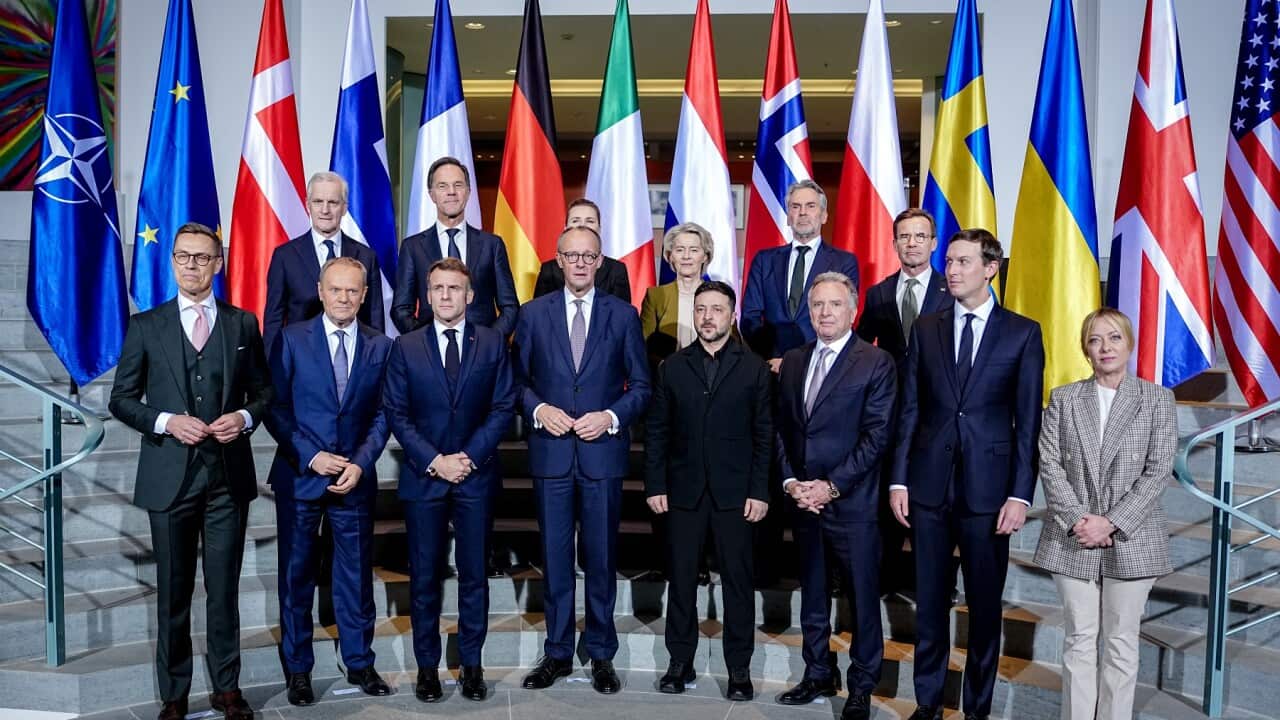
United States President Donald Trump says talks between US officials and European leaders in Berlin over a draft peace plan to end the Russia-Ukraine war went well and an agreement could be expected soon.
“We had very good conversation with the European leaders and things are seemingly going well. But we've been saying that for a long time, and we're getting closer. We're having tremendous support. At this moment, Russia wants to get it. And the problem is they'll want to get it ended and then all of a sudden they won’t and Ukraine will want to get it ended and all of a sudden they won't. So we have to get them on the same page. But I think that's working along. Very good talk.”
Ukrainian President Volodymyr Zelenskyy has praised the draft agreement but says Ukraine is still concerned over what would happen to the roughly 20 per cent of their territory that is currently occupied by Russian forces.
He says US envoys will present the plan to Russia's government before any further meetings in the US.
"The American partners also received the European reaction yesterday. And now, with all these reactions in hand, I think the American side will contact the Russian side, and after that there will be a meeting with Ukraine in the United States at the level of negotiating teams - I think in the coming days, possibly over the weekend, or perhaps a little later. We hope it will be as soon as possible."
The United Kingdom's Defence Secretary, John Healey, says British forces are preparing for a breakthrough in ceasefire negotiations after the Berlin talks.
“And today, as 2025 draws to a close, we are at a major moment in this war. The US led push for peace is advancing, and yesterday in Berlin, there were signals of a progress in the peace talks, which is further advanced than at any time during this war. And through the coalition of the willing, we are raising our readiness levels, and I continue to direct funding to prepare our UK troops and armed forces so that we are ready to deploy when peace comes.”
Meanwhile, European leaders and Mr Zelenskyy have met to launch an International Claims Commission to help ensure Ukraine is compensated for hundreds of billions of dollars in damage from Russian attacks and alleged war crimes.
The 35-country Council of Europe has formally approved plans to create the compensation body which will allow Ukraine to seek payment for loss or injury caused by Russia since the full-scale invasion began in February 2022.
The council says Russia must foot the bill, but there is no clear pathway for forcing Russia to pay.
The E High Representative for Foreign Affairs and Security Policy, Kaja Kallas, says there have been precedents.
"After Iraq's invasion of Kuwait, the United Nations Compensation Commission was able to use Iraqi oil revenues to pay reparations because a percentage of the oil sales went directly into the U-N compensation fund. Russia is no less liable for the damage in Ukraine than Iraq was for the damage in Kuwait. But Russia will never voluntarily pay for the damage it has done."
Another proposal is to use some of the tens of billions of dollars in frozen Russian assets held in Europe.
Some 80,000 claims have already been filed with the register of damages, which is based in The Hague.
Ukraine's President Zelenskyy says it’s important for this claims commission to set a precedent.
“Every Russian war crime must have consequences for those who committed them. We hope the tribunal for Russian aggression will truly begin its work. Not just for us, but for everyone who wants peace in Europe. This war and Russia's responsibility for it must become a clear example so that others learn not to choose aggression."
Both Ukraine and European leaders are also seeking security guarantees in any ceasefire deal that will discourage another act of aggression from the Russian military in future.
European Union nations that border Russia or are located near the Russian border have met in Finnish capital Helsinki to flesh out proposals to boost their defence and security.
The so-called EU "eastern flank" meeting includes leaders from Sweden, Estonia, Latvia, Lithuania, Poland and Romania, who are hoping to send a strong signal ahead of an EU summit in Brussels next week.
Finnish Prime Minister, Petteri Orpo, says it is up to Northern and Eastern European countries to keep flagship EU defence projects alive considering reluctance among large nations such as Germany and France.
“The build-up of European defence will not happen or continue unless we, as states on the EU's eastern border, make our voices heard and explain our realities. Finland, together with other Eastern-flank countries, has been active within the EU in raising these issues to the top of the European agenda.”
President Trump says he's confident that the Ukraine peace plan will include mechanisms to counter an effort from Russia to renew their invasion of Ukraine or to attack another of their neighbours.
"In terms of security guarantees, we're working with Europe on it. Europe would be a big part of that. And we're working on the security guarantees so the war doesn't start up again. We don't want to have a war start up again."