
Events in Venezuela have stirred emotion among the Latin American diaspora in Australia. In Sydney and Melbourne, Venezuelans are gathering in streets and community spaces as developments unfold.
Listen to Australian and world news and follow trending topics with SBS News Podcasts.
TRANSCRIPT:
In Sydney's central business district, two rallies unfolded within metres of each other...
"War criminal Donald Trump has bombed Venezuela. Join us for an emergency rally here at 6pm. Join us for an emergency rally, find out what is happening in Venezuela."
They involved the same community – but one divided in their response to the taking of Venezuelan President Nicolas Maduro by United States forces.
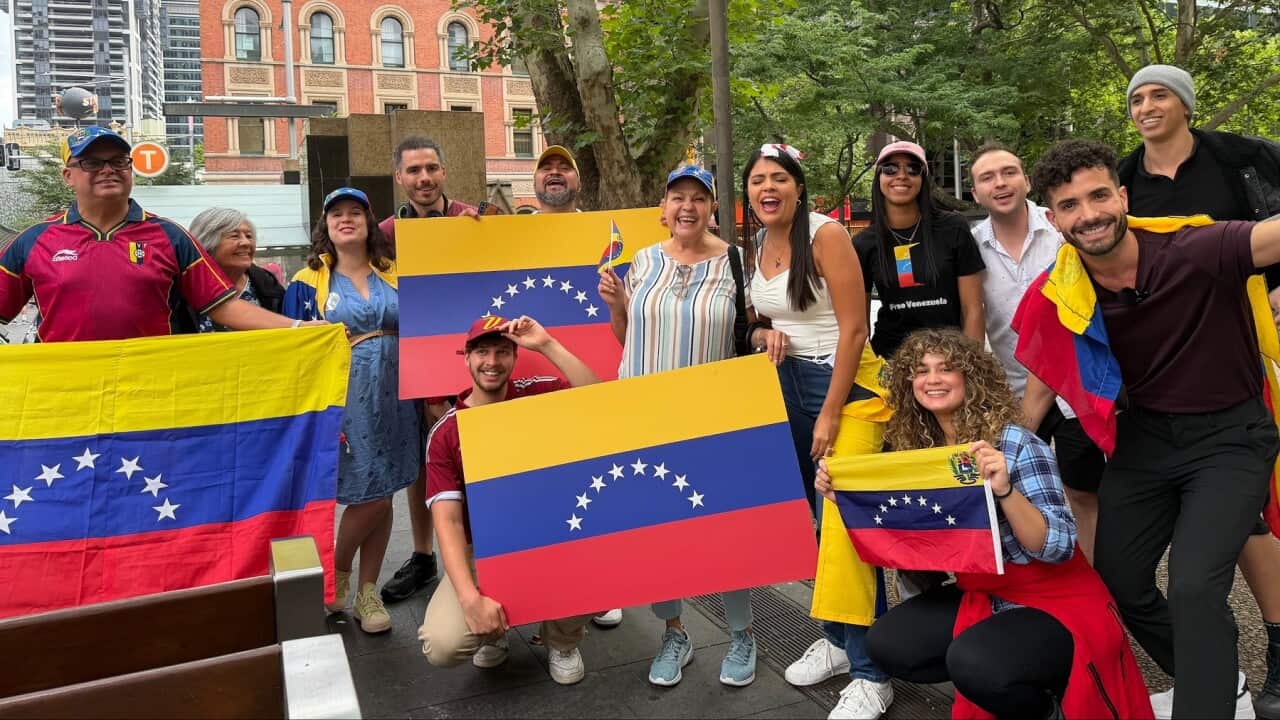
Outside Sydney Town Hall, Venezuelans and supporters gathered for a 'Hands Off Venezuela' rally.
Protest chants competed with a police helicopter circling above.
A short distance away, another crowd formed.
Police stood between the two groups, though there was no visible confrontation.
From one side came chants opposing foreign intervention.
From the other, cheers declaring "freedom".
A former Chilean political prisoner, Paula Sanchez, says she is protesting over what she views as a violation of Venezuela's sovereignty.
"It's not about the president of Venezuela. It's about what's happening in Latin America. That a country can come and take a president and take him away. It's about the sovereignty of a country that need to be left alone. The country can resolve their own issues. I think the issue of the reasons for this of saying that it's to do with drugs is not true. This is about oil and it's about taking the resources of the country."
But among the counter-protesters, several Venezuelans described deeply personal reasons for supporting US involvement.
One of them is Javier Eduardo Acosta Scandela.
He says the ongoing humanitarian situation in Venezuela forced his remaining family to flee.
"My family is not in Venezuela. I had to take them out because my mum almost twice she died because we didn't have any food. I was doctor, but I didn't have food to pay her how to eat. She almost died twice. My grandma, my family, I have many people that died because of the situation in Venezuela. Relatives. Many, many people this impact us in a way that you cannot imagine."
Others at the rally described the present situation as one they have waited years to see.
Brigitte Alejandra Villasmil Rivas says it has brought renewed hope.
"Oh gosh, we were so excited. We were coming out of our New Year's celebration, a brand new year, and we had no idea that this is going to be the start, but it's a ray of hope that we haven't had for 26 years. We've been fighting for more than two decades to try to overthrow this dictatorship. And last night, finally, we got some hope that this is the start of us being able to do that."
Some analysts say while the events were anticipated, the outcome remains uncertain.
This is Associate Professor of Crime, Justice and Legal Studies at Latrobe University, Raul Sanchez-Urribarri – whose research on Venezuela, his home country, has chronicled and analysed the decline of democracy.
"The military built up presence of the United States in the Caribbean suggested that something was going to happen, but we didn't really know exactly what. So, experts have already mapped a series of scenarios. One of them was precisely a targeted attack in Caracas that would lead to Maduro being removed. But this was one out of many possible scenarios that were thought of. It's one thing to imagine things, how they are going to happen, and a different thing to experience it or to actually see it and witness as it unfolds."
In Melbourne, separate to the city's own protests, one group has turned its focus to providing a space for Venezuelans to gather and talk.
The Venezuelan Association of Australia hosted a lunch at Papelon, a Venezuelan diner and community hub adorned with sunny, orange walls.
President Genesis Lindstrom says the aim is not to promote a single view, but to allow people to experience the strength of community in a time of crisis.
"The only thing we can do is gather at events like this, have spaces where we can gather with our adopted family in a way and process all of these complicated emotions together."
Association Vice President Elena Zurbo says the situation is often misrepresented.
"Only Venezuelans know what Venezuelans are going through. No-one understands our situation better than ourselves. Even for ourselves, it's complicated. So it really is hurtful when it's narrowed down to a fight between left and right, which is much more complex than that."
Associate Professor Sanchez-Urribarri says Venezuelans are now navigating a moment of uncertainty shaped by years of hardship.
"Venezuelans have suffered greatly for many years. This is a country that lost over 70 per cent of its economy, eight million people, a quarter of its population. I saw it myself with my own eyes when I visited Venezuela in 2023. It's shocking what Venezuelans have been going through. So, this is a moment of trepidation, of fear for the present, for the future. But at the same time, for many people, a bit of hope in the sense that it could well be that the opening has the potential for opening other scenarios for the country. And all those sentiments and all those concerns can coexist."
Australia's Department of Foreign Affairs and Trade has advised Australians in Venezuela to leave the country if it is safe to do so.
The department says it is making urgent enquiries with consular partners and stands ready to provide assistance.
The travel advice for Venezuela remains 'Do Not Travel'.
For Venezuelans in Australia, reactions remain divided.
But across cities, the focus is firmly on what comes next.