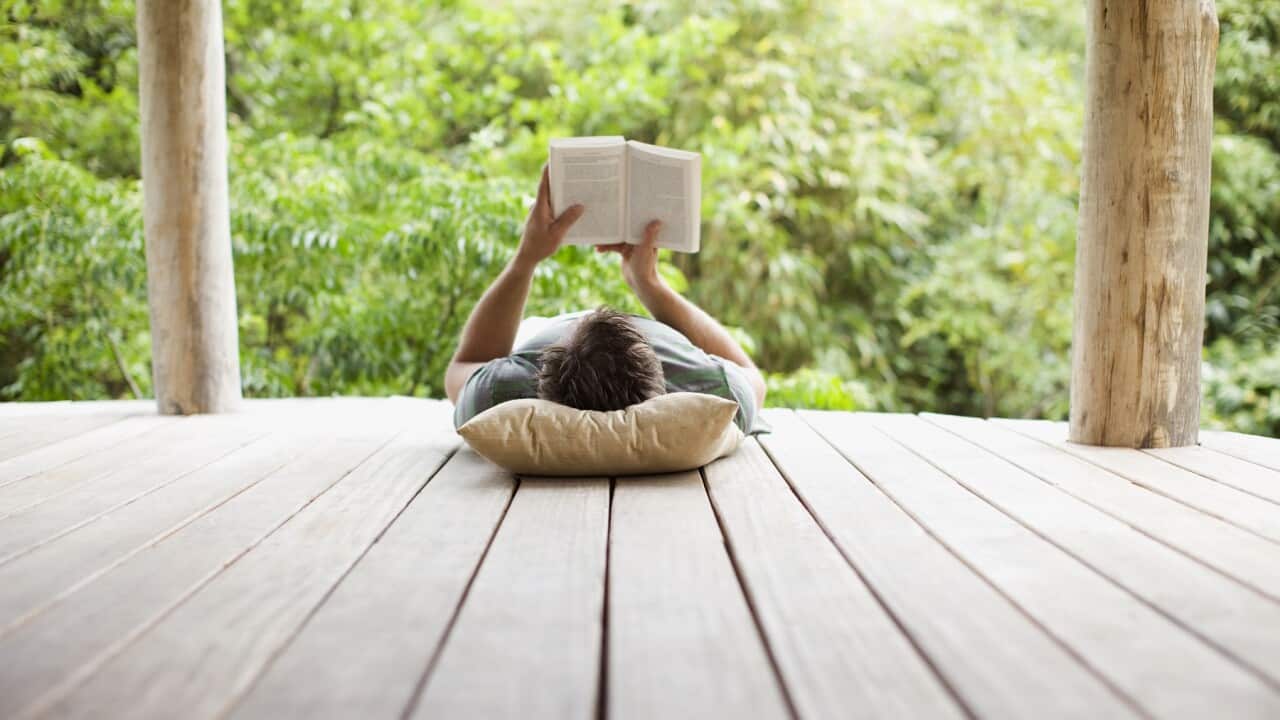

As the holiday season hits there's nothing like grabbing a good book, heading to a cool shady spot and reading a story that takes you into another world. But with so many digital distractions, how popular are books and what genres are catching readers' interest the most? Please note: This story contains sexual references.
Listen to Australian and world news and follow trending topics with SBS News Podcasts.
TRANSCRIPT:
Storytelling remains a big part of what it means to be human.
We make sense of the world from the stories we tell about our own lives and the stories we hear from others.
Storytelling also allows us to access worlds both believable and fantastical.
As for Australians, what kind of stories are grabbing our attention the most?
Topping our best-seller lists are romance novels, true and fictional crime, self-help and memoirs.
"Crime has been a popular genre for a few years actually, and mostly spurred on if we're looking at nonfiction crime by true crime obviously, but also crime generally speaking is really popular. Most overarching genres are. And then we see hybrid genres underneath those. So the other huge one is romance, which encompasses lots of sub genres such as, romantasy, romcom, all of those, even rural romance has been huge for a while, but those two are really mainstays I would say."
That's Katherine Day, senior lecturer at Melbourne University in the publishing program.
When it comes to romance novels there's not one particular preference.
The sub-genres can range from rural romance - with its rustic wood interiors, and a floral arrangement or two to romantasy which revels in elements of fantasy or science-fiction, think mythical creatures, dragons, and magic woven into a romantic narrative.
Romantasy has come into its own in recent years, partly due to reviews on social media particularly through TikTok's BookTok.
Australian BookTokker Tierney Page reviews romance fiction for her 800,000-plus followers.
Her reviews are unashamedly blunt, celebrating some of the more explicit elements of female sexual desire.
"So you want some completed romance series with spice? Don't worry, I've got you. Best up we've got Legacy of the Nine Realms by Amelia Hutchins. If you have not read this and you love Spicy Fantasy, you need to read this. You've got a chick who's a witch. Her aunt is a see you next Tuesday. She has a million sisters. She becomes super powerful. And then the MMC (main male character) knocks. He is, to this day, one of my favorite MMCs. He's such a prick, but he's really hot. Plus we don't really know who he is, but his chest rattles like this and he knots. Down there, he knots. And I'll tell you what, the spice will have you soggier than a tomato sandwich."
Dr Day says women make up the majority of romance readers, many in the 25 to 40 age bracket across all sub-genres.
"Even if you look at rural romance, I mentioned that earlier. That really picked up about a decade ago. There's also farm lit where it's quite specific in the characters it uses and the story lines and the plots which have to be set in a rural setting, mostly in Australia. And that has actually translated quite well in some cases to an international market too. So I think the fact that it's able to pivot a little bit and tap into different likes and dislikes of particular readers is why it's sustained, its popularity."
Mainly catering to heterosexual story lines, single parent tales are also having a moment.
The parent is usually divorced, widowed, or someone who suddenly gains custody of a young relative, putting their nurturing side on full display.
Think responsibility, vulnerability, the potential for a blended family.
BookTokker Tierney Page again in one of her posts.
"Books with some of the hottest single dads I have ever read. Single dads (is) just a trope that never gets old. It just gets better. He's a single dad, lost his wife to cancer. He's got these two beautiful little girls and it's just, oh, he sprays their mum's perfume on their pillows. Not only is this one of the spiciest books that I've ever read, it's beautiful. I can cry thinking about it."
Other sub-genres include: closed-door romance - that means no explicit sex; sport-related romance; steam-punk - a retro-futuristic sci-fi genre; paranormal and historical styles, among others.
Monash University's Better Reading report for 2025 states that there aren't dramatic differences between men and women's reading preferences but romance and science fiction are the notable exceptions.
Women prefer romance, at almost 50 per cent compared to 12.2 per cent for men.
Men prefer science fiction, at 41.6 per cent compared to women at 17.6 per cent.
Contemporary science fiction sub-genres include hard sci-fi and soft sci-fi, horror, cyberpunk, dystopian, apocalyptic and space travel.
Dr Day says a couple of other genres also stand out for male readers.
"Men also tend to like history, military books, which women are really not into when we look at the numbers of sales for those kinds of books."
Luke Bateman used to read in secret, telling SBS's Insight program in 2025 he used to lock himself in the toilet to read fantasy books.
Luke said books have always been a key part of his life, particularly during dark periods.
The former NRL player and The Bachelor star now reviews fantasy fiction from his farm tractor in a style that has amassed him millions of views on TikTok.
"This book was like reading one long poem. And we sort of got dropped into this really beautiful story that was super complex and it was gripping the entire time. And we got fed little bits of information the whole way through that just kept me on the hook and kept me so encapsulated. And it was a story about love and a story about loss and a story about how love stays with us even after it's gone."
So how much of an impact are BookTok content creators having on the reading and buying habits of consumers?
Dr Day says if a BookTokker reviews you positively and the revue goes viral, it can really boost an author's sales and marketing campaign.
"I think the most popular BookTokker in the US has millions, millions of followers. And what they essentially do is promote the books that they're currently reading or even that they just have on display in their bookshelves. I mean, the fact is that some BookTokkers don't even read the books, they just like the covers and that might be the whole meme or the BookTok segment about design. But they do expose the book to a wider range of readers who follow them for whatever reason. Some of them are really entertaining, some of them are just quite factual, but it's essentially a different kind of book review to the traditional review that would critique the book."
The Monash report shows while many people have good intentions when it comes to reading, with so many digital distractions there has been a decline in recreational reading.
Their survey of the reading habits of 1622 respondents across different ages reveals that more than half want to read more.
Sophie Groom is the CEO of Writing New South Wales.
"There was a very strong sentiment that Australians want to read more, which is really great. Over 50 per cent of survey respondents said that they want to read more and that was pretty common across people who already read a lot right through to people who hardly read it all. So we've got the right intention there. It's just about this attention economy where it's so difficult for people to find time to read and I think that that's where alternative formats can really help. So things like audiobooks, like digital books, e-books people can find a way of integrating reading into their lives differently."
But most people still prefer to read print formats - with Gen Z embracing this most traditional of formats.
"Yeah again it's pretty stable so it's around 70 to 75 per cent of readers prefer to read in print and around 20 to 25 per cent prefer to read in digital. And of course you know some of those cross backwards and forwards between the two. But where we are seeing the biggest growth is actually in audiobooks. Audiobooks are up, the numbers differ and it's a little bit hard to tell because of the fragmented market but probably up around 15 per cent which is really pretty significant."
Sophie Groom says while it's difficult to verify actual numbers, the available data suggests the upwards jump is mainly due to young men listening to more audiobooks.
"We're seeing a growth in the number of young men who are reading via audiobook. Most likely they are coming across from podcast into audiobooks which is really encouraging to see because traditionally young men have not been really avid readers so it's wonderful to see those people coming into the market."
The popularity of audiobooks is partly due to convenience, that is being able to walk your dog, exercise or do housework and a lot of other things at the same time.
It's also about the comfort that comes from being read to, hearing a voice - especially if it's the writer's own story.
"It's a real mix. Non-fiction is really popular in audiobooks so both learning books and also memoirs and a lot of those memoirs are read by the author and that's a really kind of special experience in audio, where you get to hear that person's story told in their own words. So that is a particularly strong genre in audio."
What's considered a best seller in the publishing world in Australia?
Sophie Groom says that's a hard figure to measure.
"That is very variable. If you sold 100,000 copies of a book in Australia you would be absolutely delighted. That would really be considered a household name best seller."
But she says debut authors would be doing well if they sold much less than that.
"Most people who are writing a debut novel would be really happy to have 4,000 to 5,000 copies of that book selling in the Australian market at the moment."
Another recent change in the Australian and international book market is the increase in self publishing, especially of e-books.
Technology has made it more affordable and accessible than ever to publish for a wider variety of people.
"I think it's sensational that people are writing the way that they want to write in the way they intend, and then producing their own self-published books. // So it's definitely lucrative for some who have the time and the energy and a little bit of nous to invest in their own marketing of those books."
In 2023 the Alliance of Independent Authors in the United Kingdom commissioned a global research survey of over 2000 self-published authors.
The survey revealed self-published authors were earning more than those going through traditional publishing houses.
Younger authors were more likely to go to self-publishing first.
Also niche authors - for example the LGBTIQ+ market were increasingly turning to self-publishing as a first option, bypassing traditional publishers all together.
But there are also issues with how digital platforms promote books, says Dr Day.
"I think that they feed into certain algorithms that are very directed. We've done a bit of research in our own program at the University of Melbourne to show how they marginalise certain authors as well in the metadata that they use at the back end, the account setting-up, the keywords even, to promote your title, they at some point can control that back end metadata. And so I think that that kind of intervention is quite dangerous actually and does set us up to read certain books, certain people to read certain books."
Artificial intelligence is also having an effect.
For mainstream publishing houses, restrictions in the use of AI are embedded in contracts.
But when it comes to self-publishing things aren't as clear.
Making things even murkier is a Productivity Commission proposal to permit tech companies to use copyrighted material to train A-I under fair use.
The proposal has been fiercely criticised by Australian authors who are already struggling with the impact of big companies using their work to train their AI models.
The work of many Australian authors already appears in pirated databases, and critics of the proposal argue that it would legitimise what they say is the theft of their work without compensation.
In September 2025 Lucy Hayward, CEO of the Australian Society of Authors, told a Senate Inquiry readers of books are also missing out with the influx of AI-generated books.
"So we know that in 2023, Amazon changed its upload policy to a maximum of three books a day. That is after the release of generative AI tools. If that tells you anything about the number of books being uploaded to the platform as we heard, no one's writing a book in a day. So we are worried about the flood of AI-generated content on global retailers. Discoverability for Australian authors is already hard enough - that's going to make it impossible. But also we're going to damage consumer confidence. If you are looking for a book and all you can find is low-quality AI-generated content, do you give up?"
There's special term for this kind of material - AI SLOP, which was also Macquarie Dictionary's Word of the Year for 2025.
Learning to discern what is and isn't AI SLOP is something readers are only just learning to deal with.
But Sophie Groom says what remains clear is that when it comes to original story-telling, the benefits for readers are clear.
"It's great for your brain. It's great for kids. It's one of the factors that really impact a child's success at school and finding a job after school, if they're an independent reader who wants to read for pleasure. But it's also great for adults and it's great for learning, for relaxation. And it's also a great way of building empathy and broadening a world view so I think it's just about getting some of those really positive messages out there about reading."