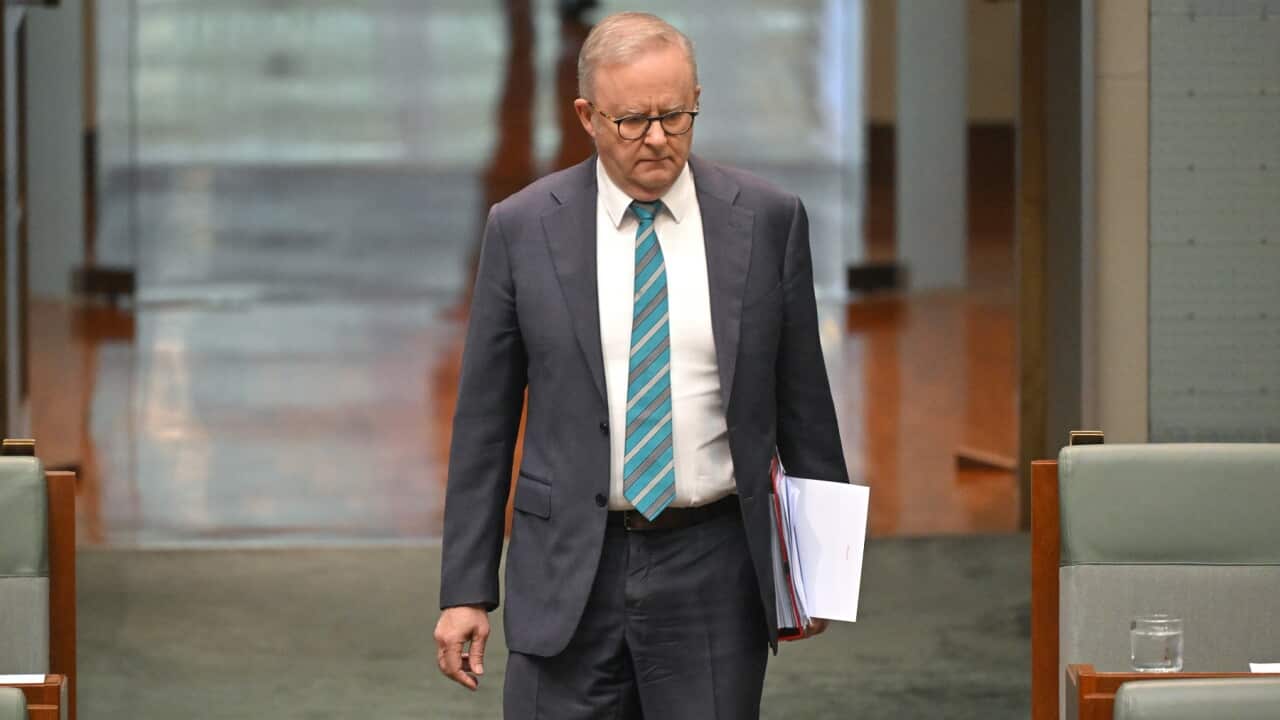
Starting next Wednesday, Australia will become the first country in the world to ban under-16s from having social media accounts, forcing major platforms to comply with the law or face fines of up to $50 million. The Albanese government says the move will protect young people from harmful algorithms and negative mental-health impacts. Many parents support the change, while critics warn that tech-savvy teens are likely to find workarounds to the measures.
Listen to Australian and world news, and follow trending topics with SBS News Podcasts.
TRANSCRIPT
Starting next Wednesday...
"Australia will become the first country in the world to ban under-16s from having social media accounts."
That's Communications Minister Annika Wells trumpeting the long-awaited social media restrictions for under-16s that she says will help protect them from further harm online.
"With one law we can protect Generation Alpha from being sucked into purgatory by predatory algorithms described by the man who created the feature as behavioural cocaine. And on 10th December there are going to be withdrawal symptoms. Teenagers will be upset, some will fight to get back on, some will manage to find their way around the tech and keep their accounts but I truly believe the short-term discomfort will work be worth the long-term benefits."
You might be wondering what platforms are covered under these restrictions and how exactly the government expects to enforce this.
So, Australia's eSafety Commissioner has identified 10 social media platforms that will now be age-restricted, with the list expected to be broadened in the future.
These are Facebook, Instagram, Snapchat, TikTok, Reddit,, X (formerly known as Twitter), YouTube, Threads, and live-streaming platforms Twitch and Kick.
From Wednesday, these platforms must remove accounts of users under the age of 16 and take what the government considers to be reasonable steps to prevent the children from creating accounts on their services.
If they fail to take these steps they will risk being fined up to $50 million.
Dr Tiffani Apps is a senior lecturer at the University of Wollongong and chief investigator at the ARC Centre of Excellence for the Digital Child.
"These social media spaces have not been designed for children in mind, and we have seen over recent years a number of harms that alarm parents and communities and alarm children as well. I would say that it's an interesting response because it restricts children from accessing the platforms, so restricting children rather than requiring the platforms to create spaces that are safe for children."
Dr Apps says each platform will implement the steps differently.
"We will see changes come in pretty swiftly, and we've begun to see them over the last couple of weeks. For those platforms that are included, it will look different across those platforms. They're owned by different people and they're managing the restrictions in different ways."
Meta, the owner of Facebook, Instagram and Threads, has started removing half a million accounts belonging to teens under 16.
Youtube, on the other hand for instance will be a little different as it doesn't require users to have an account to access content.
Under-16s will not be allowed to have active YouTube accounts or subscribe to YouTube channels but children will still be able to watch videos on the website in a logged-out state or under parental supervision.
Public support for the Albanese government's changes to the Online Safety Act was one factor in the Labor government's successful re-election campaign heading into the federal election this May.
"This is about letting kids be kids. It's also about empowering parents to be able to have those discussions with their children."
A number of parents in Sydney say they're excited for the pioneering move.
VOXIE 1: "There’s so many mental health implications, and to take that off my hands and leave it to the government to decide. Give my kids a break from after school and they can rest and hang out with the family. I think it’s a great initiative, a great thing."VOXIE 2: "I think it’s fantastic. As a mum of two teenage girls , I’m really pleased with the initiative of the Australian government and I think it's wonderful that they’re a world leader in this."
Some are a little more sceptical of how it will work.
"Children are clever. They can work systems much more cleverly than adults actually realise. So it’s going to have a big impact, hopefully for the better, but it's going to take a bit of time to get that rolled in and implemented in the best way possible."
The government says platforms must deactivate existing accounts of those under 16, ensure no new accounts are activated, implement workarounds and correct errors.
But many experts are warning the age verification tools that platforms are using to prevent kids from signing up are far from perfect.
Chair of Electronic Frontiers Australia, John Pane, says kids could use software or even an older family member to skirt around many of these methods.
"Kids are looking at using VPNs obviously to get around the ban. Kids could also use individuals to sit in for them, an older brother or a sister, to take a photograph and have it go through biometric estimation of their age. They can use software to modify their own photograph to make them look older. There are so many ways to get around this. It has more holes in it than swiss cheese."
15-year-old Noah Jones is one of those teens determined to get around the ban.
"I'm just going to make a new account on Instagram and it'll either ask for me to scan my face or an id and I don't see what's stopping me from getting my older brother's ID or my mum's ID."
The government says there won't be penalties for parents or young people who find ways to continue using social media, with the onus entirely on platforms to prevent access.
These potential flaws have piled more pressure on the Albanese government to get this social media age restriction right and adapt to the countless number of work-arounds and new social media platforms that are expected to pop up in response.
As Communications Minister Annika Wells says, the world will be watching to see how this first-of-its-kind policy will play out.
"This law is world leading and countries around the world are taking our lead. Denmark, Greece, Romania, France, New Zealand, Malaysia, the European Commission have all signaled intent introduce a minimal age for social media."
And for the millions of children under 16 who won't find ways around these restrictions, Dr Tiffani Apps says this could be a tough adjustment for kids.
"This could be potentially a really big change for young people who are connected online with each other. Some of the that kids have been telling us is they're worried about things that might happen in the physical spaces that they're in when they don't have that space to connect. It really is a great social experiment at the expense of our kids. There are lots of government bodies and organisations who have been sharing resources and tips to support young people and I really encourage families and teachers to connect in with those trusted bodies and resources."