Warning: The following content contains the names of an Indigenous people who have passed.
For over 25 years, Yolŋu have welcomed people from across Australia and around the world to Gulkula, to exchange knowledge and celebrate culture.
The idea for the Garma festival was conceived by Yolŋu leaders the late Dr Yunupingu AC and his brother Dr M. Yunupingu, an educator and the frontman of the celebrated rock band Yothu Yindi.
The two men wanted to create a platform to preserve and celebrate Yolŋu culture, while also serving as a forum for cultural exchange and understanding. This purpose is reflected in the name of the festival itself: the word 'Garma' is a Yolŋu matha term for ‘two-way learning process.’
Since the first festival in 1999, Garma has grown in significance, becoming one of Australia's leading forums for political and cultural dialogue.
But who are the Yolŋu, what is some of their history, and why is Garma held where it is?
Who are Yolŋu?
Yolŋu means ‘people’ in the language of Yolŋu matha. Yolŋu are the Aboriginal people of north-east Arnhem Land region (which is known as ‘Miwatj’ – translating to "morning side" or "land of the first sunrise").
The Yolŋu are made up of some 26 ‘bäpurru’ (clans) differentiated by the land, languages, and dialects they speak, but generally sharing overall similarities in the ritual life and cultural lifestyles (each clan's members own areas of land and waters).
Clans include the Gälpu, Rirratjiŋu, Gumatj, Wangurri, Ḏäṯiwuy, Ŋaymil, Dhalwaŋu, Djapu, Dhudi-Djapu, Madarrpa, Maŋgalili, Munyuku, Marrakulu, Djarrwark, Golumala, Djambarrpuyŋu, Gupapuyŋu, Warramiri and Marrangu.
Yolŋu people identify themselves first by their family group, then by their clan and language, and finally by their family’s country.
The Yolŋu land owning groups are divided into two moieties, Yirritja and Dhuwa. People belong to the moiety of their father, and marry someone of their mother’s moiety.
Today, the Yolŋu live mostly in the settlement of Yirrkala or in the 25 or more outstations or homeland communities scattered throughout a 200-kilometre region.
What is Yolŋu matha?
Yolŋu matha is the group of languages spoken in north-east Arnhem Land. Yolŋu is the word for ‘people’ and matha means ‘tongue’ or ‘language.’
There are over 40 Yolŋu languages and most Yolŋu peoples speak multiple languages.
Centuries of trade (some 300-500 years before 1770) occurred between the Yolŋu and trepang (sea cucumber) fishers from Makassar (Sulawesi) in Indonesia. It led to the adoption of many Malay words into Yolŋu Matha, referred to as ‘common loanwords’.
About 10 kilometers south-east of Yirrkala, at a placed called Garanhan (also called Macassan Beach) lies Wurrwurrwuy, where 47 rare Yolŋu 'stone pictures' lie.
They record the history of trade between the Yolŋu and Macassans.
The stone pictures depict Macassan praus (a double-hulled canoe), houses, trepang fireplaces and drying houses, sharpening stones for iron knives and other images relating to the Macassan trepang industry.
Why is Garma held at Gulkula?
Gulkula is a highly sacred Gumatj ceremonial site on the Dhupuma escarpment overlooking the Gulf of Carpentaria. It’s located about 40 kilometres from Nhulunbuy on the Gove Peninsula.
Gulkula is a focal point of Yolŋu culture and one of the most sacred places in Yolŋu cosmology.
According to tradition, it is the site where the sacred ancestral figure Ganbulabula first created the yidaki (didgeridoo) while searching for honey and brought it to the Gumatj people.
Ganbulapula, a master of the ceremonies brought the yiḏaki into existence and named all the places and trees and animals in the area.
Iconic Yolŋu artist and leader Mungurrawuy Yunupingu (1907–1979) described Gulkula as “an all-encompassing philosophical, physical, cosmological, theoretical place”.
What is a buŋgul?
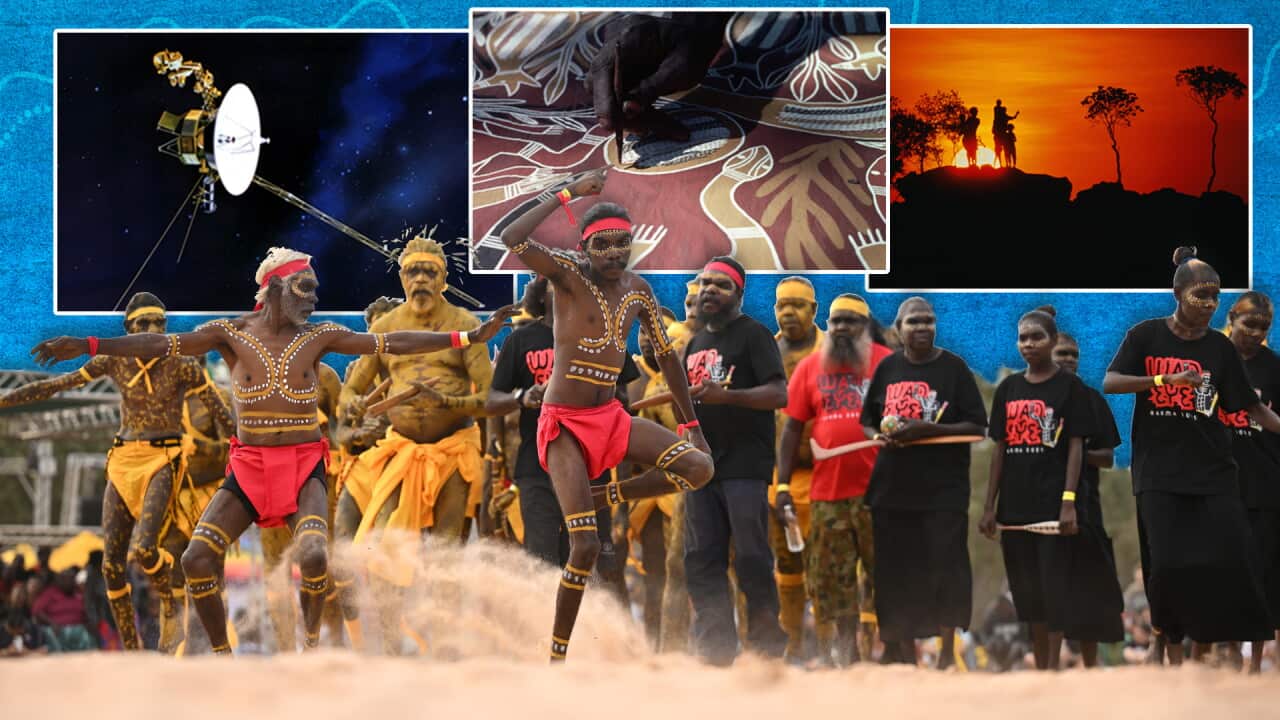
A buŋgul is a ceremony, a meeting place of dance, manikay (song) and ritual.
Yolŋu clans have been performing buŋgul for thousands of years. This is a ceremonial tradition as old as any in the world.
At Garma, Yolŋu conclude the evening buŋgul inviting balanda (non-Indigenous) to dance with them - together as one.
Dances mimic animals, natural and environmental elements, ancestral stories and cultural interactions, such as the arrival of the Macassans.
Yolŋu - the first ‘Australians'
The Yolŋu were one of the first people to be described as "Australians".
In 1803, English navigator Matthew Flinders, on his circumnavigation of the continent, made the first detailed charting of the Arnhem Land coast in his ship The Investigator.
At Caledon Bay in February 1803, when describing an encounter with Yolŋu people, he uses the term "Australians" in his journal.
Then again in October 1803, as he headed home to England in The Cumberland, Flinders stopped for a shore visit in a bay on the Wessel Islands.
He interacted with a a small group of Yolŋu men whom he called "the Australians".
It is believed to be the first time that anyone had applied that name to the people of the continent that he had mapped and named.
The first recorded European contacts with East Arnhem Land were an exploratory voyage by Dutch man Willem van Colster in 1623 that sailed into the Gulf of Carpentaria.
Cape Arnhem (Wanuwuy) is named after the ship of this voyage, The Arnhem.
In 2013, unpublished documents from Matthew Flinders’ 1803 circumnavigation were unearthed – which contained Yolŋu words.
The words were documented in notes from Robert Brown, a botanist with Flinders, and are the earliest known record of Yolŋu language.
Yolŋu culture - to infinity and beyond
Did you know that the music of the Yolŋu people of north-east Arnhem Land has a unique place in human history?
It is travelling through interstellar space aboard both the Voyager 1 and Voyager 2 spacecrafts.
Back in 1977, NASA selected two Yolŋu songs for the Voyager Golden Record, a gold-plated phonograph record designed to represent the cultural and natural diversity of Earth to any extra-terrestrial life that might one day encounter the spacecraft.
The record was assembled by a committee led by astronomer Carl Sagan.
Today, Voyager 1 is the most distant human-made object, more than 24 billion kilometres from Earth, carrying those Yolŋu songs into interstellar space.