
Key Points
- Supply chain disruptions to fuel and petrochemicals is driving up construction costs.
- Peak industry bodies are calling for regulations to be streamlined to reduce pressure for builders.
Peak building and housing bodies are calling on the government to slash red tape in housing and construction, as rising fuel costs undermine the sectors and drive prices up.
War in the Middle East has led to skyrocketing fuel prices, creating worksite woes for one of Australia's most diesel-reliant industries — construction.
The ongoing conflict has also led to increased costs for plastics, cabling and piping, key construction products, which are rising by up to 40 per cent at the register.
Jocelyn Martin, the managing director of the Housing Industry Association (HIA), said conditions are "tough but manageable".
Builders are paying an extra $5,000 in expenses on a standard four-bedroom home in a new development, she estimated, with many on fixed-price contracts.
News that makes sense
Your trusted source for staying up-to-date with the world around you. Get free daily news updates and analysis, straight to your inbox.
"For the volume builders, that per-home amount can make a difference," she told SBS News.
"They've obviously got employees and premises and so forth to support. And so that obviously is a concern for them."
Martin, along with others, is calling on the government to streamline the National Construction Code, a document that sets industry standards, to help reduce pressure on builders.
Reform will be discussed at HIA's national housing conference on Thursday, with a focus on ways to address the "significant headwinds" in meeting the federal government’s commitment to deliver 1.2 million homes by 2029.
She described it as a "once in a generation opportunity" to address Australia's housing crisis.
The federal government has also hinted at reforming the code, which critics say is far more long and complex than it needs to be.
In August, Labor announced it was pausing any changes to the National Construction Code while it looks to reduce delays in approvals and speed up residential construction.
A spokesperson for Housing Minister Clare O'Neil told SBS News any changes remain on hold.
"We're consulting right across the building sector to understand how we can make the code easier and more effective," they said.
What products are increasing in cost?
The construction industry was already facing crushing costs before the current conflict in the Middle East, which broke out at the end of February.
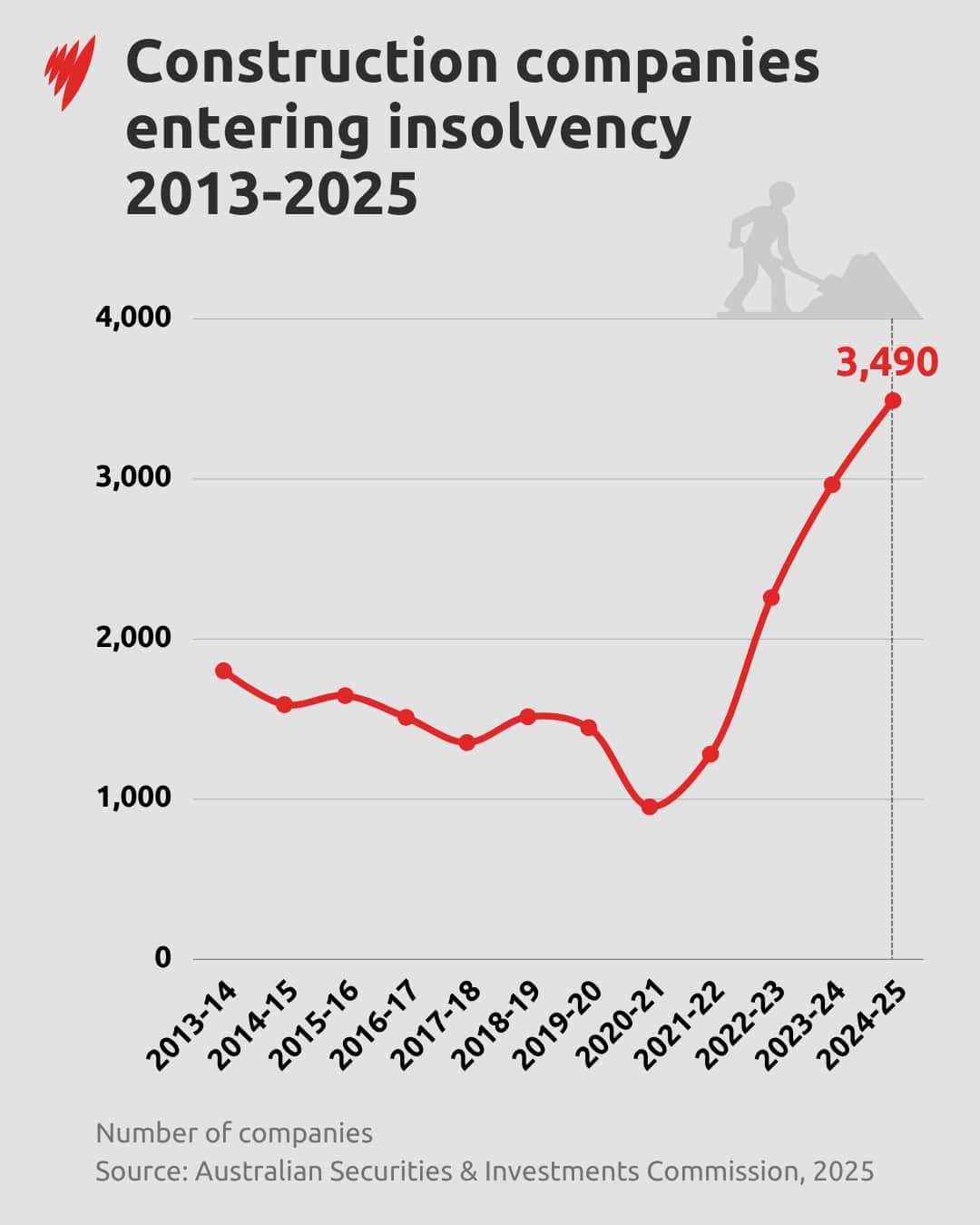
Data from ASIC shows that more companies entered insolvency last year than before or during the COVID-19 pandemic. In 2025, 3,490 construction companies went insolvent, almost double the figure for 2013.
Master Builders Australia estimates that construction costs have increased by around 1 to 5 per cent so far this year, placing further constraints on builders.
The body's CEO, Denita Wawn, told SBS News that, due to fixed-price contract arrangements, most builders are being forced to absorb these cost increases.
"Builders are reporting surcharges for fuel, concrete and skip bins for example, with increases of between 20 to 30 per cent to plastic piping products," she said.
"PVC and cabling are of particular concern; however, plastic suppliers this week have assured that they are now producing the same supply as they were before the conflict, but at the increased price."
The rise in costs stems from supply chain delays and cancellations, as Australia imports large amounts of oil and petrochemicals – used in plastics – from the Middle East.
Supply chain dependency
Wawn said the industry is "quickly pivoting" to mitigate the risk of shortages of "vital products" through alternative supply options, but a logistics expert says it’s a difficult task.
David Leany, a lecturer at the Australian National University, specialises in international supply chain management.
He explained that Australia and the world are highly dependent on imports from the Middle East for construction, accounting for around 20 per cent of global fuel and 30 per cent of petrochemical plastics.
"Construction is probably the most diesel-dependent sector, about 80 per cent of construction's energy actually comes from diesel," he said.
"And there are also costs associated with freight and cargo, the availability and the costs associated with some petrochemicals, plastics in particular, and then some of the other flow-on effects about the availability of key products."
In a report last week, economist Saul Eslake echoed concerns that civil construction is the most diesel-exposed sector in the Australian economy.
The average price of diesel across Australia's five largest cities is $3.20 per litre, according to the ACC's latest weekly fuel report.
This was a slight drop from March, attributed to the now-instated cut to the fuel excise, but it remains higher than pre-war prices.
While fuel can be redirected through alternative pipelines to avoid conflict, plastics are left in the lurch.
"You can't get the plastics out because they don't fit the pipeline. Whereas the world's adjusting to some of the fuel constraints, there's not the same level of adjustment that's possible with the plastics," he said.
"That means shortages, which means it really pushes prices up pretty much the corresponding amount. With that 30 per cent shortage, you can at least get the 30 per cent increase in the price."
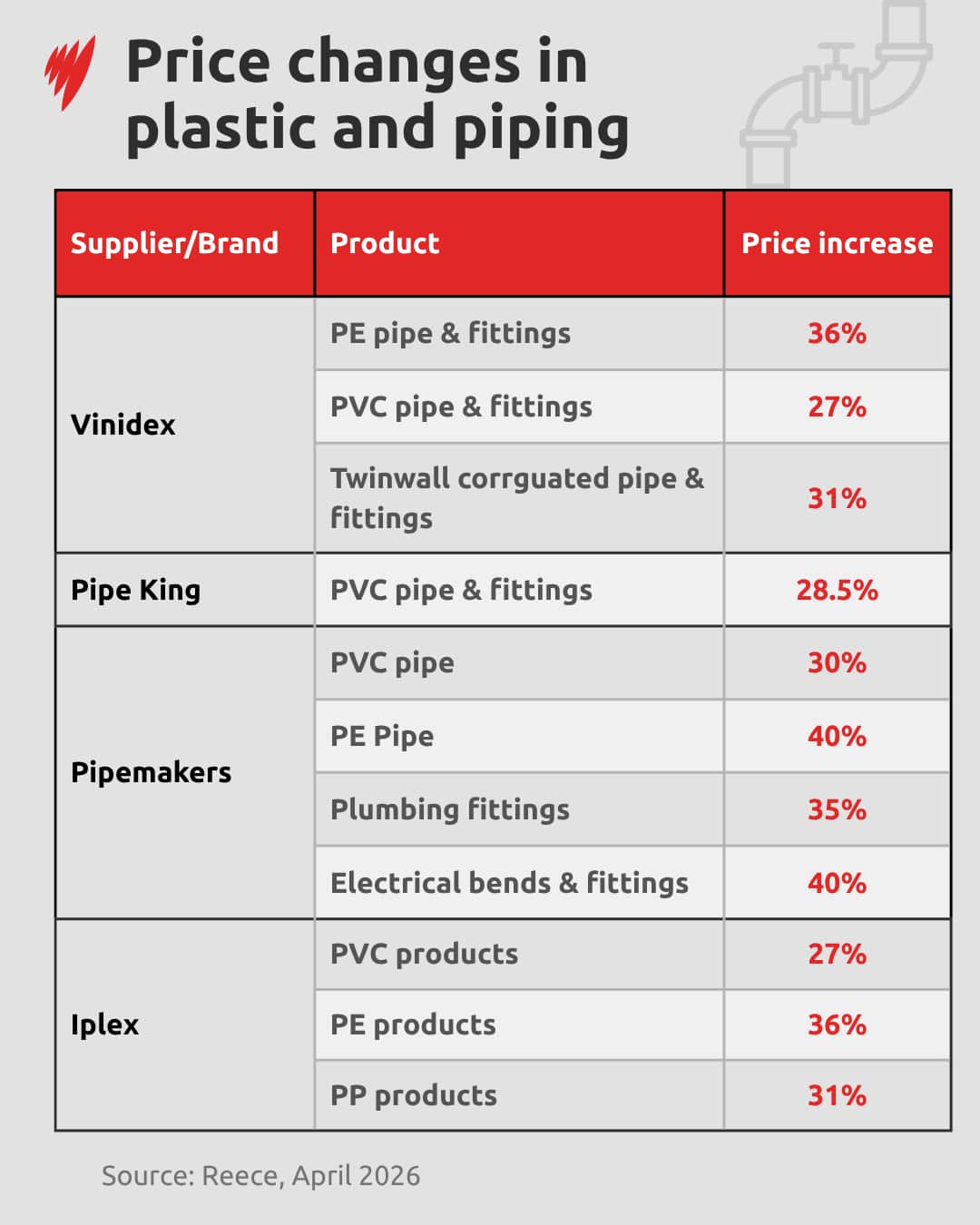
Data from wholesaler Reece estimates that products made from the three most common forms of plastic have risen to up to 40 per cent in cost.
This includes Polyvinyl Chloride (PVC), commonly used for piping, and Polyethylene and Polypropylene.
Australia does not currently have the manufacturing facilities required to meet this demand, Leaney said, meaning the country will likely remain reliant on imports to support fuel and petrochemical demand.
Calls for reform
Global conflicts and disruptions to international supply chains are seen as largely out of the government's control, but it is seeking to reduce costs to builders through reforming the National Construction Code.
Both the HIA and Master Builders Australia are calling for the code, which sets out requirements for the design and construction of new buildings, to be streamlined.
Wawn said the current state of the code, most recently updated in 2025, leads to poorer building outcomes and higher costs.
"As the building and construction industry knows all too well, the NCC’s sheer size, poor drafting, complexity and scope have made it unwieldy and impractical," she said.
"According to the Productivity Commission, the estimated regulatory cost burden on housing is as high as $47.5 billion per year, which is up to $320,000 per new house."
Martin said one way to simplify the code while retaining safety standards is to digitise its contents and make it AI-searchable.
In its current state, she said, it's not practical for builders to navigate it efficiently or to understand it in its entirety.
"As the code has expanded to include issues such as livability, sustainability, and soon climate resilience, it has led to an exponential growth where the code is now sort of eight times its original length, and it's got three hundred more defined terms and a hundred additional reference documents. It's now thousands of pages," she said.
The Alliance of Industry Associations has called for the code to be reduced by at least 25 per cent.
For the latest from SBS News, download our app and subscribe to our newsletter.







