IN BRIEF
- Research by financial comparison platform Finder has found that 55 per cent of borrowers experience mortgage stress.
- Some experts believe the benchmark is a "simplified" way of measuring housing affordability.
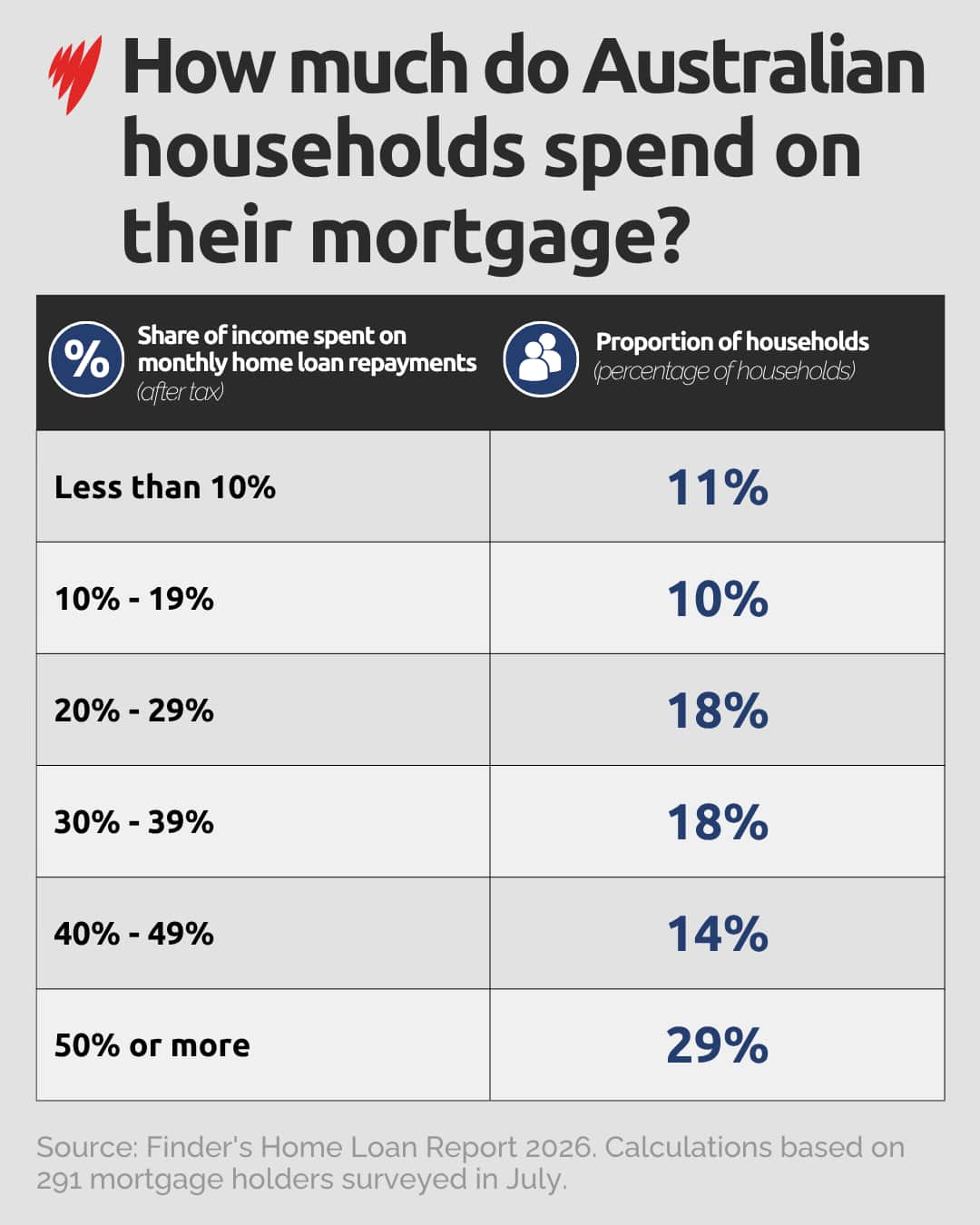
Many Australian borrowers are spending more than half of their take-home pay on home loan repayments, new research shows, with borrowers devoting an average of 38 per cent of their after-tax income to their mortgage each month.
That's according to the latest home loan report by financial comparison site Finder. The company surveyed approximately 1,000 Australians aged 16 and over in July this year, including 291 current mortgage borrowers.
It found that saving for a deposit is a "heavy burden" for many new home buyers, but once a property is secured, a new challenge begins.
"A great many Australians live with mortgage repayments so high they could be considered [in] mortgage stress. And ... the generational and gender disparities are incredibly revealing," the report said.
Around 55 per cent of borrowers surveyed experienced mortgage stress — a benchmark used to describe households that spend more than 30 per cent of their income on home loan repayments.
News that makes sense
Your trusted source for staying up-to-date with the world around you. Get free daily news updates and analysis, straight to your inbox.
But Richard Whitten, a home loans expert at Finder, cautioned that the mortgage stress metric is "more complicated" when applied to Australia's current housing market.
"I'd treat it as a benchmark figure rather than an absolute red line," Whitten told SBS News.
"It depends on factors like how much you earn, and what your household expenses look like. If you've got a lot of other big expenses like childcare or private school fees, you have less wiggle room."
What does mortgage stress mean?
The concept of mortgage stress is often linked to the United States' 1969 Housing and Urban Development Act, which set a benchmark on housing affordability. Under the Brooke Amendment, rent in public housing was capped to 25 per cent of family income.
By 1981, this rent cap was raised to 30 per cent. The 30 per cent threshold subsequently became a widely used metric for housing affordability for renters and homeowners.
The Reserve Bank of Australia says on its website the benchmark in Australia dates back to its 1991/92 National Housing Strategy.
Generally, mortgage stress is calculated by comparing home loan repayments to a household's gross (pre-tax) income.
Tom Alves, acting managing director of the Australian Housing and Urban Research Institute (AHURI), told SBS News that this proxy for housing unaffordability has also evolved into the '30:40 rule'.
"Usually, we look at the bottom 40 per cent of income distribution to see if anyone there is paying more than 30 per cent of their household income.
"So, the higher up the income distribution you are, I guess the more capacity you have to absorb a greater proportion of household income on housing costs."
Why the rule was never meant for everyone
Alves believes the 30:40 benchmark can be a "simplified" way of measuring mortgage stress but acknowledged it's "the standardised sort of rule of thumb ... fairly consistently [used] here and internationally as well".
He said it's important to recognise there's a "spectrum of income" which impacts how much Australian households can comfortably devote to mortgage repayments.
"If your household income is $1 million, for example, you could comfortably pay 50 per cent or more ... of that income on housing costs and not feel that as stress," he said.
"If you're only earning $50,000 as a household, for example, then even 25 per cent of your income is going to have a big impact on your capacity to pay for other things."
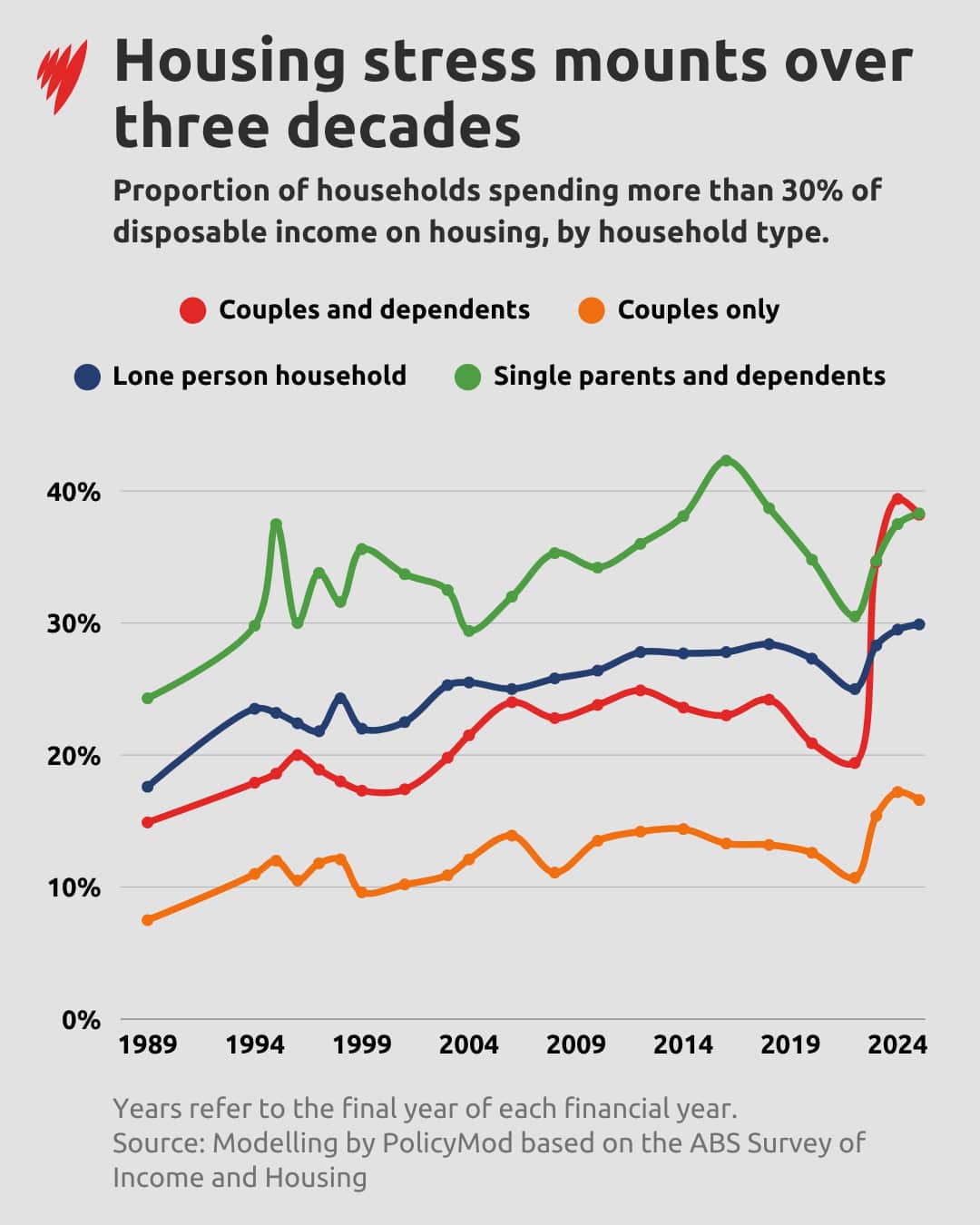
Alves said demographics including single-parent households and those with dependents are more likely to find housing costs "more difficult to accommodate within their budget".
The Australian National University's microsimulation model, PolicyMod, has tracked the proportion of households spending more than 30 per cent of disposable income on housing across three decades.
Using data derived from the Australian Bureau of Statistics (ABS) Survey of Income and Housing, it found that statistically, single parents and single-occupant households were more likely to experience mortgage stress.
Steven Rowley is a professor at Curtin University and director of AHURI's Curtin Research Centre.
In 2024, he co-authored a report examining housing affordability, which highlighted: "Normative housing affordability measures remain insensitive to factors such as household size, composition and formation, housing tenure, quality, and locational and neighbourhood characteristics."
Rowley told SBS News he does not believe mortgage stress is a "good metric" in the Australian context as many households will choose to spend more than 30 per cent of their income on housing.
"Considering it their most important expenditure item ... others may not wish to spend more than 30 per cent but have little choice because there is nothing affordable that would allow them to spend less," he said.
He also noted that the mortgage stress benchmark does not account for gaps in home equity and wealth.
Whitten said some households may choose to put themselves in mortgage stress and believes "going all in on property can set you up for long-term stability but not if it leaves you exposed in the short-term".
"You really need to be able to afford to pay your groceries and utilities, car repairs, any surprise expenses."
For the latest from SBS News, download our app and subscribe to our newsletter.







