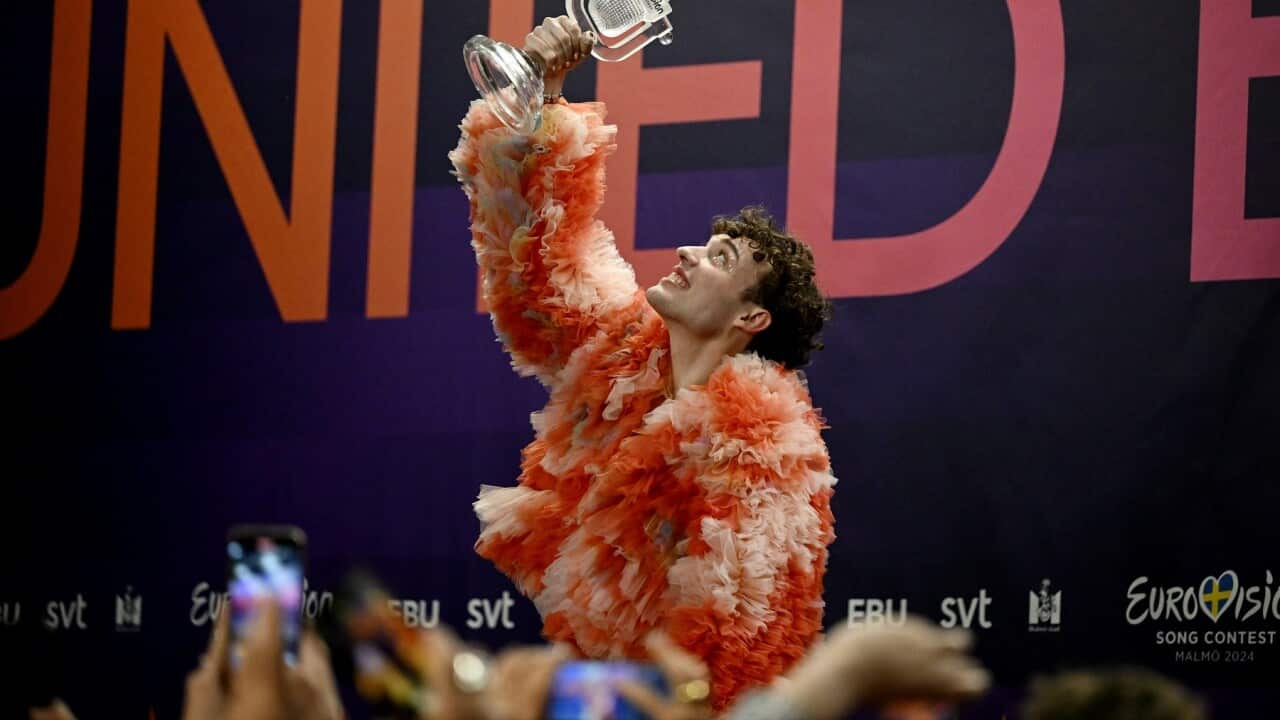

Europe’s largest cultural event is once again confronting the tension between entertainment and geopolitics. After the European Broadcasting Union formally confirmed Israel’s eligibility for the 2026 Eurovision Song Contest, four countries - Spain, the Netherlands, Ireland and Slovenia - immediately withdrew. Their walkout has triggered one of the most serious disputes in the contest’s modern history, raising questions about neutrality, artistic expression and how far Eurovision can distance itself from real-world conflicts.
Listen to Australian and world news, and follow trending topics with SBS News Podcasts.
TRANSCRIPT
Members of the European Broadcasting Union have elected not to hold a direct vote on Israel’s participation.
Instead, they introduced strengthened rules designed to prevent government interference, a response to concerns raised after previous contests.
Germany and Austria supported the outcome, describing it as a reaffirmation of Eurovision’s founding principles.
German Radio network ARD- ZDF representative Katja Wildermuth says the Union prioritised its values over immediate political pressure.
"We are very happy that in the end rules and values and impartiality of public service media has been stronger than emotional public debates of the day. We're talking about the biggest song contest in the world and it's a contest that stands for building bridges, for diversity, for tolerance. And we underlined these values today in the debate."
Austria’s Broadcasting Corporation director Roland Weissmann echoes that, noting that the vote reflected democratic process and that Israel’s broadcaster KAN therefore remains eligible to compete.
After the European Broadcasting Union formally confirmed Israel’s eligibility for the 2026 Eurovision Song Contest, four countries - Spain, the Netherlands, Ireland and Slovenia - immediately withdrew.
So, why did the EBU make this decision and why did many members accept it?
William Lee Adams, founder of Wiwiblogs and one of Eurovision’s most respected analysts, tells the B-B-C that the Union had already acknowledged political interference in earlier contests, and the reforms introduced this week were seen by most broadcasters as sufficient.
"What we do know is that the discussion of new rules was presented; the EBU recognised that there was political interference that occurred during the previous Eurovision, and they had these new rules, additional measures to prevent a recurrence. Apparently countries accepted, as a whole, that those rules were enough and that a vote on Israel's participation did not need to take place."
But he says there is a thin line between politics and the personal.
"Israel's most recent entry from Yuval Raphael, she was a survivor of October the 7th, some people said that carries a political message, others said no, her song is about perseverance, it's a personal message. This is the problem with art: they're not just kicking a ball on stage, they're being judged for lyrics, for words, for meaning and it all gets very convoluted, and things are misinterpreted, ideas are projected. It's complicated."
In Vienna, host of next year’s contest, many residents expressed acceptance of Israel’s participation, even if they regretted losing several competing countries.
Austrian resident Bernhard Kleemann says the public should not be punished for the actions of any government.
“As far as Israel is concerned, I distinguish between the government and the population. Why should the population, or a part of the population, not participate? That is my reasoning. If countries decide not to participate because they condemn the government and the prime minister, that is their decision. That is my bottom line. It's a shame because it means less choice, but it is politically understandable. Yes, that's how I see it.”
Others in Vienna stressed that Eurovision was devised to promote cultural exchange, not political exclusion.
Meanwhile, in Madrid, the tone was unequivocally different.
Many Spanish Eurovision fans said their country's withdrawal was necessary given the war in Gaza.
Drag performer Enigma Queen captured the sentiment among Spain’s most dedicated fans.
"Honestly, I think it’s great, because since Eurovision doesn’t take steps to remove a genocidal, violent country that causes wars from its festival, it’s very good that Spain withdraws as a form of protest, and hopefully more countries join so the festival can’t go ahead and they stop allowing these things.”
In Tel Aviv, the response was one of relief.
Eurovision fans there said they had spent days fearing exclusion.
Jurij Vlasov says he was stressed over whether the EBU would allow Israel to participate or not.
"I feel like our reaction is full of happiness and huge relief. Feel like there was a lot of stress in the last hour that they wanted to go into the voting. And I was Oh my God, I'm a guy who's going to be anonymous. I think that's a huge relief right now and a lot of happiness that the Eurovision going to keep the non-political song contest and let it'll be fun and joy for all of Europe."
With four nations withdrawing, affecting untold millions of viewers across Europe and around the world, some are speculating whether the contest will be able to go on.
EBU leadership have been quick to insist that the contest is not troubled.
Martin Green is Eurovision's director.
"It's in no ways a crisis. We've got 35 members or so going to join us next year. Now, I understand the four or five who might not come. That's their choice. I completely respect that. I very much hope they'll be back with us in 2027 and I also very much hope that they will still broadcast the show and allow those fans who want to watch the show to watch it. But again, that's their choice."
He also noted that Bulgaria, Romania and Moldova are returning to the contest.
SBS who has Australian broadcast rights for Eurovision 2026, has issued a statement saying that participation in, and coverage of Eurovision will continue in 2026.
It continued:
“Eurovision was created to bring people and cultures together through music, a purpose that continues to guide the contest and has shaped SBS’s broadcast for more than 40 years. Our position remains that, as a public broadcaster, making a decision to be involved based on the inclusion or exclusion of any country would undermine SBS’s editorial independence and impartiality. SBS recognises and respects the deeply held views and concerns about the war in the Middle East and its impact, both locally among our audiences and internationally as reflected by other broadcasters."