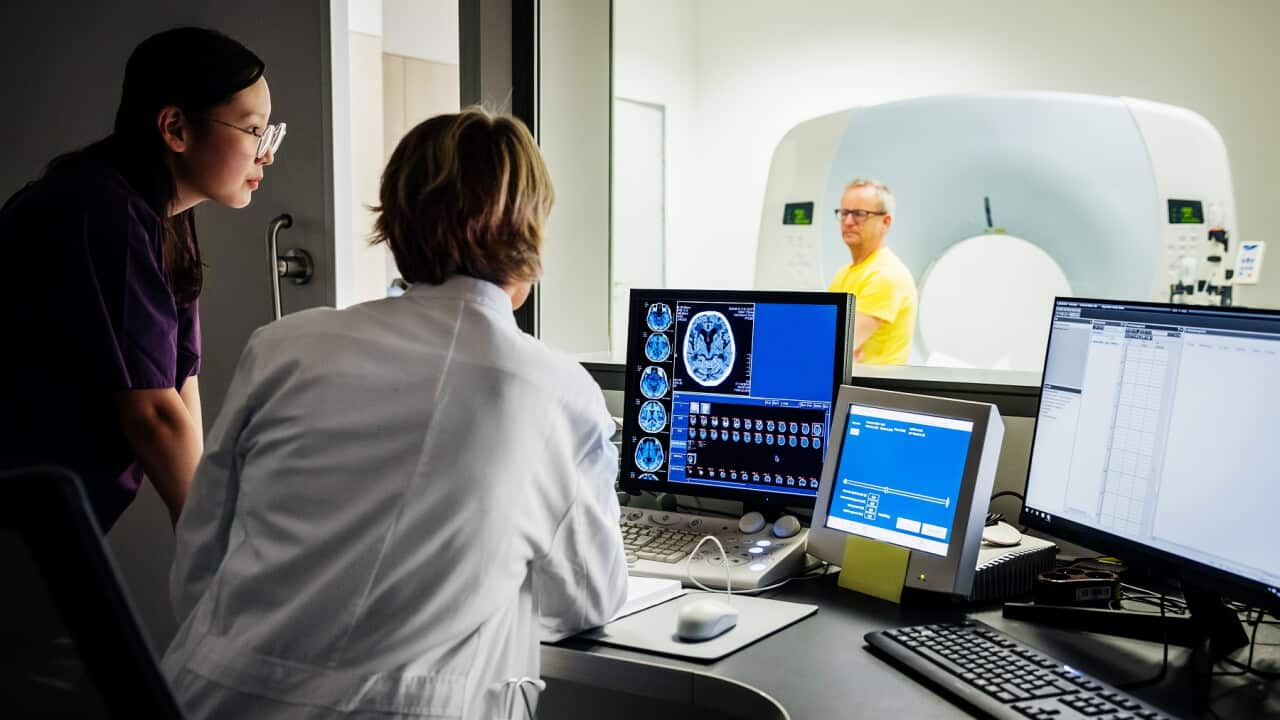


An Australian cancer research centre has been awarded a 2.5 million dollar grant to further their research into one of the country 's deadliest brain cancers. Researchers at the Walter and Eliza Hall Institute in Melbourne hope to fast-track diagnosis and treatment options.
Listen to Australian and world news, and follow trending topics with SBS News Podcasts.
TRANSCRIPT
Pippa Rae was nine years old when she was diagnosed with diffuse intrinsic pontine glioma, or DIPG.
Her mother, Virginia, says she was a remarkable child.
"Pippa was a really vibrant personality. She was everybody's friend. She had lots of friends. She was sporty, athletic. She just made the most of life. It was almost like she lived an entire life in 11 years."
It's a rare and aggressive type of deadly brain cancer that forms in the brain stem - it mainly affects children.
Virginia says Pippa's diagnosis was shattering.
"Your whole world comes crumbling down. At that point, I didn't realise that it was the worst possible tumour that anybody could be delivered, but I'd never had experience with brain tumours. You know that brain tumours are bad but to know the extent of that - I didn't know at the time."
The cancer is challenging to treat due to its location and infiltrative nature, making surgical removal impossible - so survival rates are so low.
Families are often told to spend their time making memories.
Pippa died 21 months after she was diagnosed.
She was just 11 years old.
"We were very fortunate that we had 21 months and the majority of that time Pippa was relatively well and she was able to travel with us, so one of the best memories was living out her dream and taking her to Paris, and that's just something that remains with our family forever. It was a very beautiful and special time and we spent two weeks there."
The Australian Cancer Research Foundation has awarded a $2.5 million grant to the Walter and Eliza Hall Institute of Medical Research in Melbourne.
It will fund a lab dedicated to research treatments for brain cancers like DIPG in children and glioblastoma - another aggressive type of brain cancer - in adults.
Kerry Strydom is the C-E-O of the Cancer Research Foundation.
"There really isn't a fantastic treatment option at the moment and what we are hoping is that this grant will provide hope to families with children with DIPG."
The ACRF Brainstorm Research Lab will use AI and other tools to test thousands of treatment options and determine the best course of action.
It will also fund a clean room to make personalised cell therapies for patients.
Professor Misty Jenkins, the head of the Walter and Eliza Hall Institute, admits it's a challenge.
"Prognosis for DIPG is the most dismal of any other cancer, and in fact, brain cancers kill more children than any other disease. And so the dial hasn't shifted for decades. And unfortunately oncologists are still having the same conversations with patients, which is telling them to go home and make memories with their families, and that there are no options available. And so we really need to start working together and collaborating better and really start to take more of a creative approach to tackling these really insidious, intractable diseases like brain cancer."
The Brainstorm project will test new drugs as well as therapies for brain cancers, which they hope will speed up the process from discovering treatment options right through to clinical trials.
"This is an end to end pipeline, so it's going from the drug discovery using AI approaches and liquid handling robots for drug screening all the way through to laboratory based testing all the way through to our patients that are in the operating room, having their tumours removed, and then being able to sequence some quickly and diagnose quickly, and then using that information to inform our drug design."
The lab is set to open next year, giving hope to families like Pippa's.