
India and the European Union say they have reached "the mother of all deals" in a trade agreement that has been in the works for nearly two decades. Subjected to steep tariffs and facing threats of further increases, the two major economies are working to diversify their trade partners.
Listen to Australian and world news and follow trending topics with SBS News Podcasts.
TRANSCRIPT:
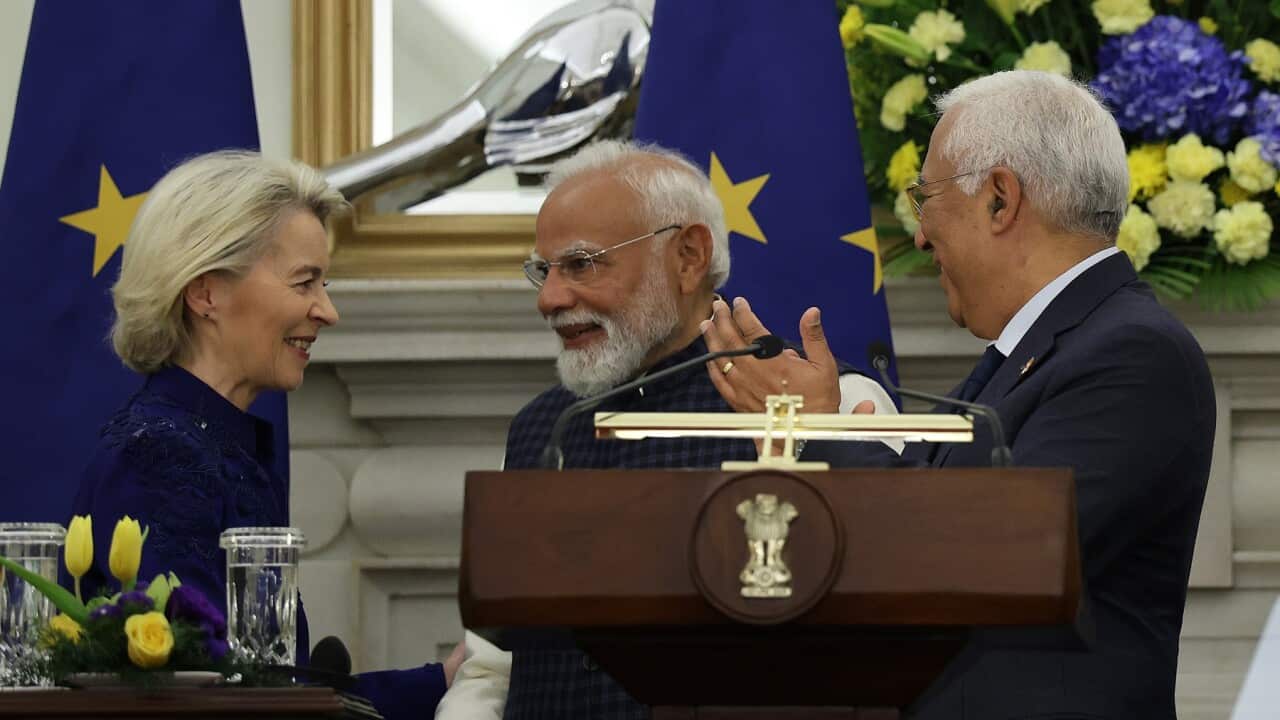
“Prime Minister (Modi), distinguished friend, we did it. We delivered the mother of all deals. We are creating a market of 2 billion people. And this is the tale of two giants, the world's second and fourth largest economies, two giants who choose partnership in a true win-win fashion.”
A new trade deal has been struck between the European Union and India, and European Commission President Ursula von der Leyen says it's bigger than ever.
Affecting over two billion people and accounting for around one-third of world trade, the deal comes after almost two decades of attempted trade talks between the two major economies.
The deal will open India's vast and highly guarded market, with Prime Minister Narendra Modi calling it a blueprint for shared prosperity.
“This free trade agreement will boost investment between India and the European Union. It will help forge new innovation partnerships and will strengthen supply chains at a global level, which means that this is not just a trade agreement, it is a new blueprint for shared prosperity.”
The European Union is already India's largest trade partner, with trade in goods reaching $A205.85 billion in 2024, while India is the European Union's ninth largest trade partner.
After trade talks between the two major economies were abandoned in 2013 because of disputes over cars, agriculture and dairy, they were once again revived in 2022.
Expected to deepen both economic and strategic ties, the deal may take months to ratify, with potential for issues around intellectual property, agriculture, and carbon emissions to arise.
European Council President Antonio Costa says it comes as the entire global order is facing major change.
“At a time when the global order is being fundamentally reshaped, the European Union and India stand together as a strategic and reliable partners. Today we are taking our partnership to the next level. As the two largest democracies in the world, we are working hand in hand to deliver concrete benefits for our citizens and to shape a resilient global order that underpins peace and stability, economic growth and sustainable development.”
In 2025, the United States imposed a 50 per cent tariff on India for refusing to stop buying Russian oil.
More recently, Donald Trump threatened more tariffs on European countries over his ambitions to annex Greenland, leaving European leaders wary of US reliability in the future.
While Europe and India hedge against the United States, US Treasury Secretary Scott Bessent says Europe is funding Russia's war.
"The Russian oil goes into India, the refined products come out, and the Europeans buy the refined product. They are financing the war against themselves. So President Trump's leadership, we will eventually end this Ukraine-Russia war."
India's Foreign Secretary, Vikram Misri, says those concerns have been discussed by the leaders involved.
"These are two things (India's relationship with Russia and EU) that stand alone on their own and that go forward on their own. And so far as Ukraine is concerned, yes, it was discussed between the leaders today. The European leaders shared their perspectives, their concerns with regard to the ongoing conflict and the prime minister (Narendra Modi) indicated to them that he had been in very close contact with leaders from both countries, from Russia, as well as from Ukraine."
The deal will see tariffs on 96.6 per cent of EU goods exports eliminated or reduced, with the EU to reciprocate for nearly 99 per cent of Indian shipments.
As well as the free trade agreement, it includes a framework for deeper defence and security cooperation.
They also signed a separate pact aimed at easing mobility for skilled workers and students, a move that could create a significant number of jobs in both economies.
President of Halle Institute for Economic Research in Germany, Reint Gropp, says it marks an important step for Europe.
“I think it's an important step in the right direction. We need to replace the problems in trade that we have with the US. India is an important market, it's 1.4 billion inhabitants. It may be an interesting and important source for rare earths and other raw materials. So, I think it is a very important step in the right direction, very welcome, particularly in the context of the problems we are having in other regions of the world.
As well as the obvious economic significance, the deal also carries geopolitical implications.
The deal sends a message to the United States that global leaders are looking to protect themselves from Donald Trump's trade policies.
While neither India nor the EU would benefit from antagonising the US President, their escalating efforts to diversify trade make clear their misgivings.
Senior fellow for India at the German Marshall Fund, Garima Mohan, says EU foreign policy is drifting further away from its historic alignment with the US.
“For a long time, Asia policy in Europe was just following the lead of the United States. Whether it was President Obama's pivot to Asia, President Biden's strategy of building a network of allies and partners, we saw Europe pretty much following suit and following the same approach. It's only now under President Trump that that bit of foreign policy also has seen more independence.”
Aiming to plug the economic holes created by US tariffs on Europe, the deal is also seen as a potential way for Europe to reduce reliance on trade from China.
Further signalling a possible pivot from US trade reliance, Canadian Prime Minister Mark Carney is also due to visit India soon, with trade high on the agenda.
For India, the EU pact marks only the latest in a string of trade agreements reached in recent years, including with the UK, Oman, Australia and New Zealand, as well as a major pact with the European Free Trade Association that came into effect last year.
Garima Mohan says the current geopolitical situation means middle powers are looking to each other for stability.
“Europe and India need each other today like never before. Even though we've seen these efforts and we've seen negotiations go for more than a decade on this free trade agreement, it only came to pass at this particular geopolitical juncture and that says something of the world we live in.”