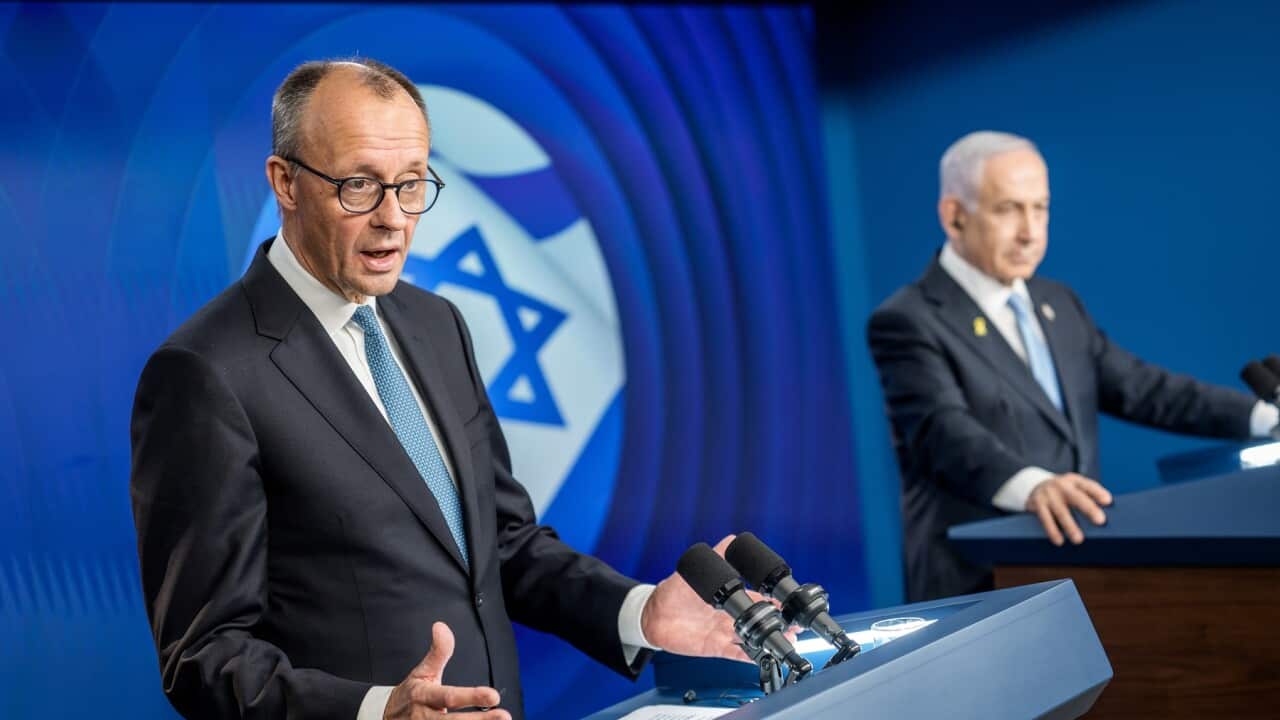

Israel is close to moving into the second phase of the Gaza ceasefire agreement, with Prime Minister Benjamin Netanyahu cautioning that the next steps will be “more difficult” as tensions continue over Hamas’s disarmament, Gaza’s future governance, and the stalled two-state solution. Speaking in Jerusalem with German Chancellor Friedrich Merz, Mr Netanyahu received strong backing for Israel’s security while also confronting growing international scrutiny over alleged human rights breaches during the Gaza war.
Listen to Australian and world news, and follow trending topics with SBS News Podcasts.
TRANSCRIPT
Israeli Prime Minister Benjamin Netanyahu says Israel is close to advancing to the second phase of the Gaza ceasefire agreement.
He warns this stage will be just as difficult as the first, which halted the two-year war and secured the return of all but one hostage in exchange for Palestinian detainees.
Speaking alongside German Chancellor Friedrich Merz in Jerusalem, Mr Netanyahu says dismantling Hamas remains essential, and credited Israel’s military campaign and US diplomacy for progress so far...
“We discuss, of course, how to bring an end to the Hamas rule in Gaza because that's an essential part of ensuring a different future for Gaza and a different future for us, facing Gaza. We finished the first part, as you know. Phase one, we're almost there. We have one more hostage, deceased, Ran Gvili, a hero of Israel, to return here. And then we very shortly expect to move into the second phase, which is more difficult.”
.. And on a two-state solution.
“On the question of two states, now we have a different point of view, obviously, because the purpose of a Palestinian state is to destroy the one and only Jewish state. They already had a state in Gaza, a de-facto state, and it was used to try to destroy the one and only Jewish state. We believe there's a path to advance a broader peace with the Arab states and a path also to establish a workable peace with our Palestinian neighbours. But we're not going to create a state that will be committed to our destruction at our doorstep.”
Phase two would bring in an international stabilisation force and a technocratic Palestinian administration, centred on Hamas’s disarmament.
Mr Netanyahu says he will outline the next steps with President Trump later this month in Washington.
Yet, while he focuses on security, Germany is stressing legal and humanitarian considerations.
Chancellor Friedrich Merz has reaffirmed Berlin’s historic commitment to Israel’s safety, even as Germany assesses Israel’s conduct in Gaza under international law.
“Germany will therefore always stand up for Israel's existence and security. This is part of the immutable core of our relationship. This applies today, it applies tomorrow, and it applies forever. And now, after the terrible terrorist attacks by Hamas on October 7, 2023, Germany has once again clearly and firmly stood by Israel's side.”
He acknowledged, however, concerns about Israel's actions in Gaza:
“However, in the course of this long war, the actions of the Israeli government have also presented us with a certain dilemma. Germany must stand up for Israel's security, and Germany must stand up for human dignity and justice, which are at the heart of our constitution, especially after the Shoah and the World War. As a country at war, as a democratic constitutional state, Israel must also be measured against international law in its military actions.”
Mr Merz also reiterated Germany’s backing for a negotiated two state solution, insisting any recognition of a Palestinian state can only come at the end of talks.
As partners debate Gaza’s future governance, Hamas senior official Bassem Naim says the group is willing to discuss freezing or storing its weapons, but only within a political process that leads to a Palestinian state.
“We are open to have a comprehensive approach in order to avoid further escalations or in order to avoid any further clashes or explosions. Therefore, we are talking about on one line to end fully the first phase, second to initiate a political process which has to end with an independent Palestinian state and during this time we can go for five, seven, 10 years of ceasefire or truce.”
He insists Hamas has complied with the ceasefire, while accusing Israel of falling short.
“When it comes to the resistance in general and Hamas in particular, we have fulfilled all our obligations toward this ceasefire deal. We have done all what has been requested from our side, but today most of the obligations of Israel are not fulfilled, they were not committed to the deal, they are still destroying and attacking most of the area eastern in the eastern part of the Gaza Strip.”
Mr Naim says Hamas would accept a U-N monitoring force on Gaza’s borders, but not foreign troops inside the territory.
He also frames the 7th of October 2023 attack as an act of defence, an indication of how far apart the sides remain in their core narratives.
As political arguments continue, daily life in Gaza is defined by food, shelter and survival.
Two months into the ceasefire, the World Food Programme says it has reached more than a million people, helped by expanded access at Kerem Shalom.
WFP spokesperson Maxime Le Lijour describes one recent aid convoy.
“I’m currently at the Kerem Shalom border crossing between Israel and Gaza, where today we picked up 47 trucks worth of life-saving humanitarian aid. Thirty of these trucks contain WFP food supplies, while 17 are for other humanitarian partners that we are supporting through the logistics.”
But the agency says rations remain limited, as residents, like Ahmad Al-Mamlouk, report widespread malnutrition, especially among children.
“This is the first aid box I've received in the last five to six months. It doesn't cover all my needs. It doesn't contain anything particularly important for me or others. We suffer from a lack of food, blankets, and other necessities. We live amidst the rubble, not in houses or tents. We don't even have a tent. I live in the rubble.”
Only half of the UN’s planned aid surge has entered the Strip so far, with scanning delays and import restrictions continuing to slow delivery.
Meanwhile, as Phase two may appear to be imminent, achieving a lasting settlement will demand political compromises that none of the parties appear fully ready to make.