
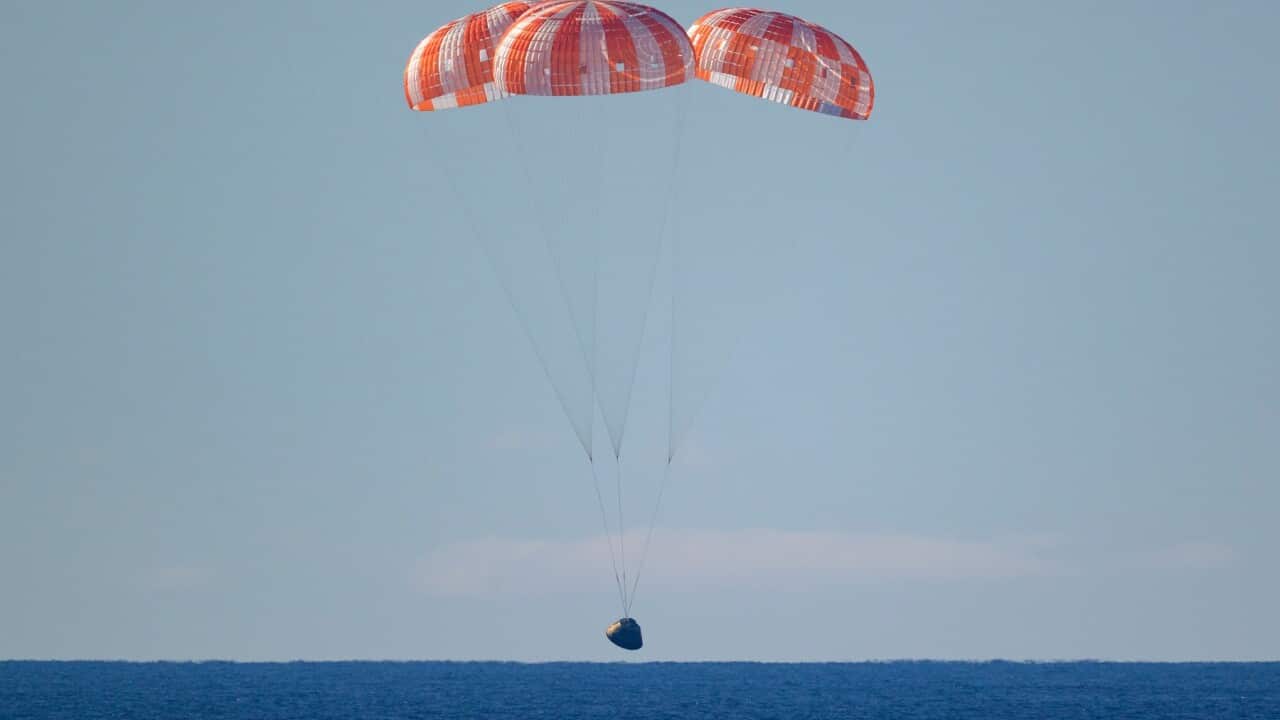

The crew of NASA's Artemis II mission have returned to Earth after creating history on their pass behind the moon. They splashed down in the Pacific this morning, after flying deeper into space than any humans before them.
Listen to Australian and world news, and follow trending topics with SBS News Podcasts.
TRANSCRIPT
NASA OFFICIAL: "Splashdown confirmed."
NASA GROUND CONTROL: "Copy splashdown. Waiting on ZLDR."
That was Ground Control at NASA's Mission Centre in Houston, confirming the comeback millions had been waiting for.
The astronauts of the Artemis II mission arriving back on Earth in the Pacific Ocean, miles off the coast of San Diego in California, after the first crewed lunar mission to the moon since Apollo ventured there in 1972.
"From the pages of Jules Verne to a modern day mission to the moon, a new chapter of the exploration of our celestial neighbour is complete. Integrity's astronauts: back on earth."
Pilot Victor Glover, commander Reid Wiseman and mission specialists Christina Koch and Jeremy Hansen spent almost 10 days flying by the moon, and going further from Earth than anyone has before.
Speaking on the deck of the USS John P. Murtha, NASA's administrator Jared Isaacman has said he's overjoyed the mission has been completed successfully.
"The years, the effort, the late nights, all the hard work from across the country that contributed to this incredible moment right now."
The Artemis II journey was the debut crewed test flight in a series of Artemis missions.
The program aims to put boot prints on the moon again by 2028, ahead of China's first landing, and to establish a long-term US lunar presence over the next decade, including a moon base.
So this spacecraft’s splashdown in the Pacific Ocean has been a test of the systems needed to safely bring astronauts back from deep space.
So says Aberystwyth University lecturer Tony Cook, who recalls that when the Artemis I Orion test module came back, NASA engineers found the heat shield was noticeably more damaged than what they expected.
"It's coming in at a pretty big speed of about 40,000 kilometres per hour and flying through space, that's not a problem, but as soon as it reaches the atmosphere, you get a lot of friction of the air molecules bouncing against the spaceship and that's why it's got a huge big heat shield on it to protect it because the friction from the air is going to heat the spacecraft up to about 3,000 degrees centigrade."
There are also things that NASA want to know about the moon to prepare for future missions.
NASA's Dr Lori Glaze says that is why this Artemis II crew went to observe the lunar south pole for the first time.
"And it's very different. The rocks and the environment at the South Pole are very different from the terrain that our Apollo astronauts saw near the equator. So we'll get new insights into the moon itself. We believe there are perhaps caches of frozen water beneath the regolith at the South Pole of the moon. So that's a place that, as we explore, we may be able to find resources like frozen water that could be used in place. We could turn that frozen ice into liquid water for drinking and then convert it and split it into oxygen and hydrogen for breathing and for fuel. So there's a variety of things that we can do. And then most importantly, as we build up this presence on the surface of the moon, we are going to learn how to live and work for long periods in this very challenging environment. And that's going to prepare us to send astronauts to Mars. So there are many, many reasons that we need to get back to the moon."
But it goes even further than science.
The record-breaking lunar flyby has come at a time of heightened international tension over US strikes on Iran, tariffs, and disruptions to global institutions.
Retired astronaut Chris Hadfield flew two missions into space and was the commander of the international space station.
He says the Artemis II experience offers a moment of positive attention amid the despair.
"We are at war with each other in multiple places simultaneously. The worst of human behavior, reverting to our most base and unforgivable nature. We need, at times like this, something better than that, something inspirational... It's so needed right now for us to have something tremendous to look up to."