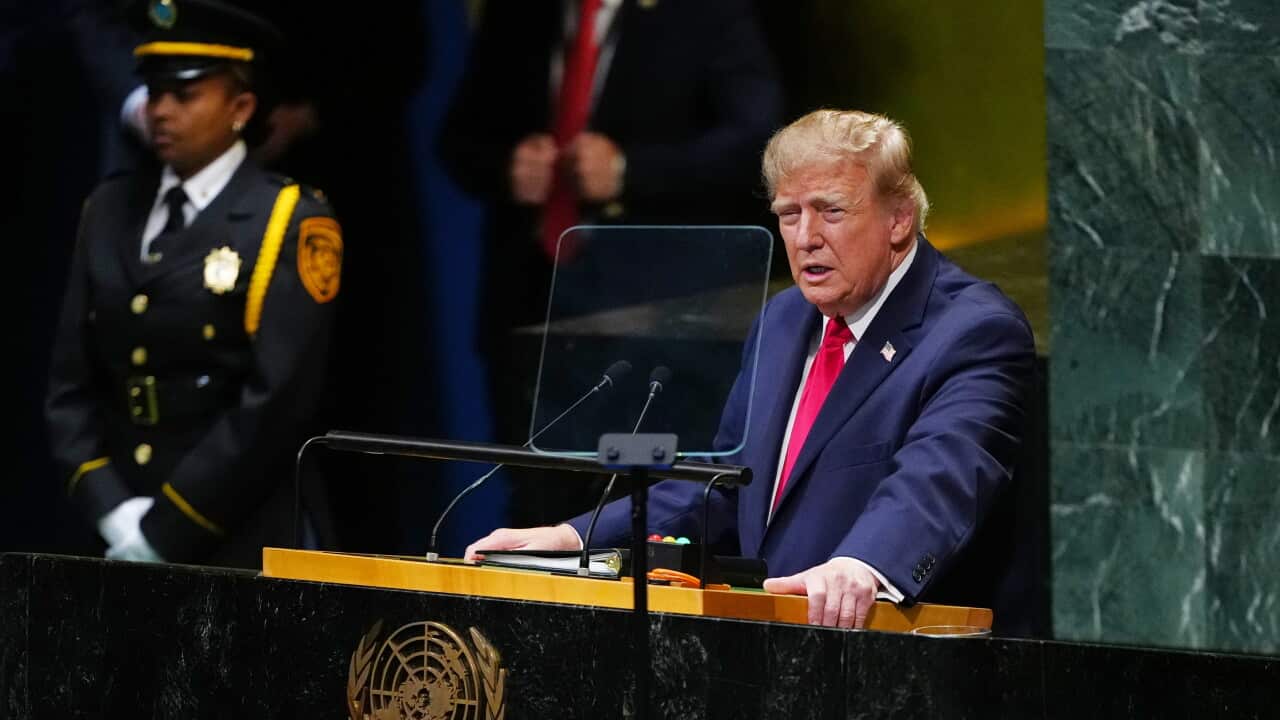
President Donald Trump says the United States has launched a 'powerful and deadly' strike against IS in north-western Nigeria. Mr Trump described those killed as 'terrorist scum' who had been targeting and killing primarily innocent Christians.
Listen to Australian and world news and follow trending topics with SBS News Podcasts.
TRANSCRIPT:
A post on social media from President Donald Trump on Christmas Day:
"Merry Christmas to all, including the dead terrorists, of which there will be many more if their slaughter of Christians continues."
President Trump wrote the US military had launched a powerful and deadly strike against what he called 'ISIS terrorist scum' in northwest Nigeria.
The US Africa Command later reported the strike was carried out in coordination with the Nigerian government in Sokoto state.
Last month, President Trump had threatened unilateral action in Nigeria.
"We're going to do things to Nigeria that Nigeria is not going to be happy about and may very well go into that disgraced country guns a-blazing."
Nigerian Human Rights lawyer Bulama Bukarti says he's relieved President Trump did not make good on that threat.
"We are very happy to see that the US government backtracked and sought the consent and cooperation of the Nigerian government which is key to legitimacy and efficiency of these kinds of actions and I'm very happy to hear that the Nigerian government cooperated because the Nigerian security forces have been deployed and have been fighting this crisis for over a decade and a half now but the terrorists' leadership and logistics capacity is still in place and these kind of strikes can help in taking out the leadership and the logistical capacity of terrorist groups and can help the Nigerian government - if it is a part of a broader strategy against violence and terrorism in our country."
Mr Bukarti says there's a huge problem with terrorism and criminal gangs in Nigeria, but he says the Nigerian government made it clear to the US that framing the problem as Christian persecution or genocide is wrong.
He says the data shows terrorist groups have overwhelmingly targeted Muslims.
"If you looked at the data, you would see from every single credible data source, terrorist groups in Nigeria have killed overwhelmingly Muslims, but it is not about competition over victimhood. It is about acknowledging that this is a security crisis that affects the whole of Nigeria and that any support for the Nigerian government, for it to be welcomed and be accepted on the ground, has to be framed as an assistance for the whole of Nigeria. Framing it as just affecting Christians risks oversimplifying a very complex situation and risks creating divisions and distrust on the ground and also feeding terrorist propaganda."
The news of the US strikes came on the same day at least five worshippers were killed and 35 others injured when a suspected suicide bomber detonated an explosive inside a mosque in Nigeria's Borno state.
Local trader Mustapha Modu says the community is fearful.
Hausa then VO: "Honestly there is fear due to this explosion, we are very scared, still we have fear. I appeal to the government to provide additional security at mosques places, we pray to God that such (an) incident does not reoccur."
No group has claimed responsibility for the attack, which comes amid heightened security concerns in Nigeria’s northeast.
Islamist insurgents Boko Haram and its ISWAP faction have waged a 15-year campaign of violence in the region targeting civilians, mosques, and markets.
Lawyer Bulama Bukarti says with IS operating in the country's northeast he suspects the US strikes in the northwest targeted a newly identified terrorist group known as Lakurawa.
He says the group is composed of jihadists from neighbouring Sahel countries, including Mali, Burkina Faso, and Chad.
Mr Bukarti says some analysts say the group is affiliated with IS while others say it's linked to Al Qaeda.
"The Lakurawa group has over the past 18 months or so has become very deadly and they have become audacious in northwestern Nigeria, especially in Sokoto state. What they are trying to do is to stretch even further the theatre of crisis in Nigeria by introducing a new actor, a new warfront, and I think if it was this group that was targeted, that is going to help Nigeria focus its resources elsewhere - if the airstrikes have succeeded."