

Australia’s sun can be harsh. And sunscreen is one key measure protecting us against harmful sun exposure. We asked three scientists about sunscreen facts, myths and choosing the right products.
Key Points
- Using sunscreen in combination with other sun safety steps is non-negotiable in Australia.
- Sunscreens are proven to protect against harmful effects of UV radiation.
- It is never too late to start using sunscreen, but how you apply it matters.
- Experts recommend using an SPF 30+ or SPF 50+ broad-spectrum, water-resistant sunscreen that’s TGA-approved.
- How common is skin cancer and melanoma in Australia?
- What can I do to prevent skin cancer?
- Can sunscreen protect me from skin cancer?
- What is SPF?
- How do I use sunscreen correctly?
- What should I look for when choosing sunscreen?
- Should I worry about Vitamin D deficiency when using sunscreen?
- What are the facts about sunscreen ingredients and DIY sunscreens?
Australia holds the unenviable title of the world’s ‘skin cancer capital’ for having the highest skin cancer rates.
Almost all skin cancers in Australia are caused by excessive exposure to UV (or ultraviolet) radiation, the part of sunlight responsible for sunburns and skin damage over time.
How common is skin cancer and melanoma in Australia?
“Two out of three Australians will develop skin cancer in their lifetime,” Linda Martin says. She is a paediatric dermatologist at Sydney Children's Hospital, Board Advisor at Melanoma Institute Australia and Head of Dermatology at UNSW.
For melanoma, the lifetime risk is one in 15 overall for boys and girls.
“That means that in every class of children starting kindergarten this year, two thirds will get skin cancer as they grow up, and one or two per class will get a melanoma.”
What can I do to prevent skin cancer?
The good news is that we can control our level of sun protection through our behaviour.
And it starts by limiting how long we spend outdoors, and at what UV rating we choose to go outside, Dr Martin says.
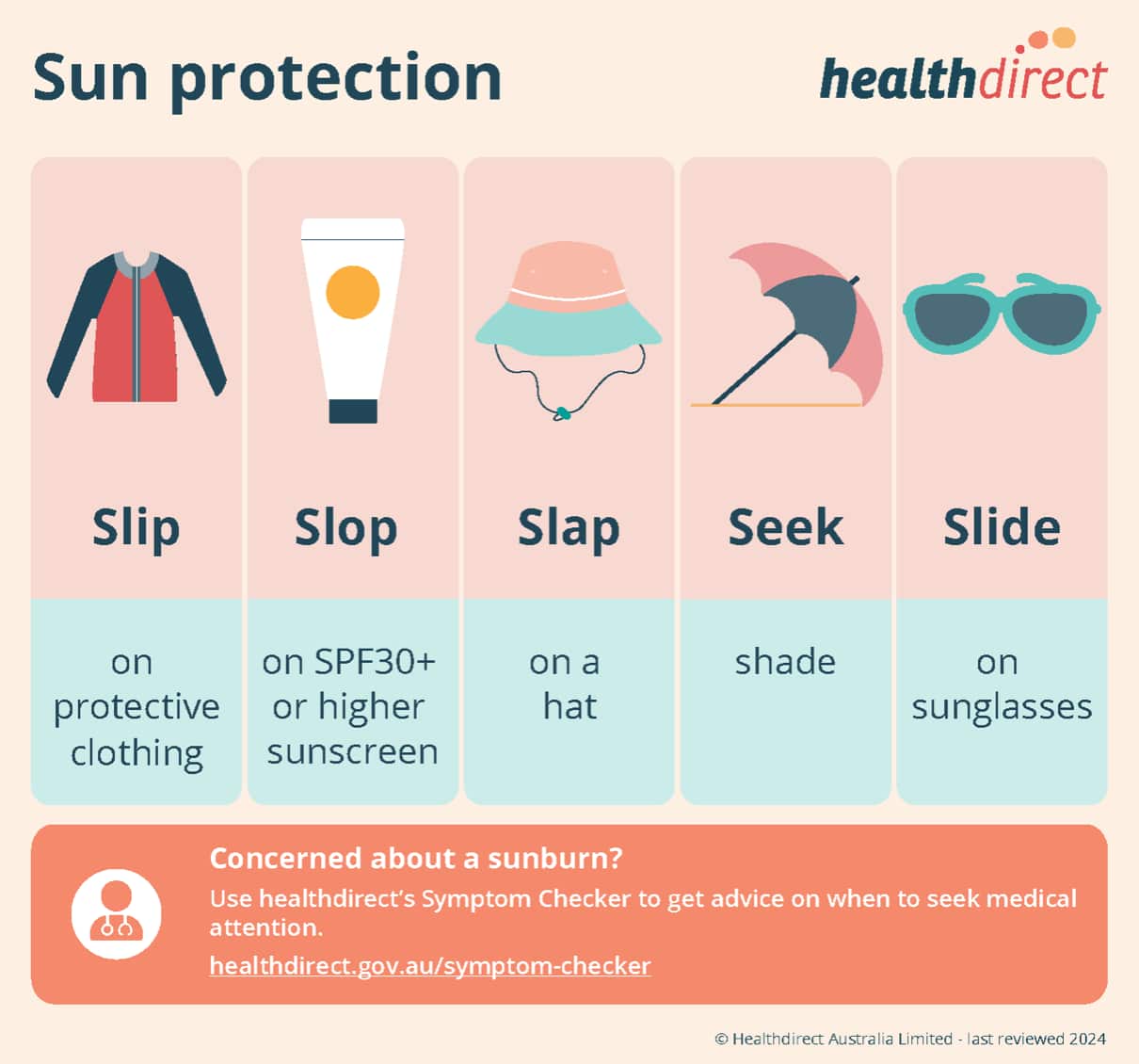
Many who grew up in Australia in the ‘80s are familiar with the slogan ‘Slip, Slop, Slap’, which has evolved today into a five-step evidence-based approach to sun safety:
- Slip on sun-protective clothing
- Slop on SPF 30 or above, broad-spectrum, water-resistant sunscreen
- Slap on a broad-brimmed hat
- Seek shade
- Slide on sunglasses
Can sunscreen protect me from skin cancer?
Sunscreen is only one part of our sun protection toolbox.
But using it is important, as Australian scientists have long established its effectiveness in preventing skin cancer.
Dr Martin points to the notable ‘Nambour Trial’, a randomised controlled trial confirming that daily sunscreen use decreases skin cancer incidence.
“After a 10-year follow up period, the melanoma rate in the daily sunscreen group was half.
“It shows that sunscreen does work, it does prevent melanoma, and that even if you start your daily sunscreen use at 50, it's never too late,” Dr Martin says.
What is SPF?
Every sunscreen has a Sun Protection Factor (SPF) number stated on the package.
The higher the SPF, the longer the sunscreen protection lasts.
Australia’s sunscreen regulator, the Therapeutic Goods Administration (TGA), considers any sunscreen above SPF 30 to provide ‘effective protection’.
As of 1 August 2024, prominent health body Cancer Council recommends SPF 50+ as the highest available on the market.
How do I use sunscreen correctly?
For sunscreen to be effective, you need to use it the right way, physical chemist Anna Wang, a UNSW Scientia associate professor, explains.
Reapplying every two hours and applying enough, applying it and waiting 20 minutes before you go out, they all matter.Dr Anna Wang
Even with water-resistant sunscreen, reapplication is needed every two hours, as well as after swimming, sweating or using a towel.
Aim for about 5 millilitres (approximately one teaspoon) of sunscreen for each part of your body exposed to the sun.
What should I look for when choosing sunscreen?
There are two forms of UV radiation we get exposed to when out in the sun: UVA and UVB.
They are both linked to skin cancer, so make sure your sunscreen offers broad-spectrum protection, Dr Wang says.
“When sunscreens are listed as broad-spectrum, it means they protect against both UVA and UVB.
“UVB is the one that causes sunburn while UVA […] damages the DNA, which can lead to cancer.”
Your sunscreen should also have a TGA-approval mark on it.
“If you pick up a sunscreen in a supermarket or a chemist, you'll see down the bottom they'll have something that says AUST-L and a long number,” Ian Musgrave, a molecular pharmacologist and toxicologist at the University of Adelaide, explains.
Should I worry about Vitamin D deficiency when using sunscreen?
Dr Musgrave says in Australia, there is no concern that sunscreen prevents you from generating sufficient vitamin D.
“Because we've got so much UV, we can generate enough vitamin D just from casual exposure to sunlight.
The amount of sunscreen we need to stop us developing sunburn and cancer is not going to stop us getting enough UV to generate vitamin D.Dr Ian Musgrave
What are the facts about sunscreen ingredients and DIY sunscreens?
TGA-approved sunscreens contain ingredients in quantities with long-proven history of safe use.
All sunscreens are made from chemicals, including those marketed as ‘mineral-only’.
Both ‘mineral’ and ‘chemical’ sunscreens are safe and effective; they just work in different ways.
“If applied correctly, they will both do the same job,” Dr Musgrave explains.
“Physical/mineral sunscreens have minerals like zinc oxide that basically reflect UV, and chemical sunscreens have organic chemicals that absorb UV.”

Sunscreen technology is impossible to replicate in homemade recipes, so stick to commercially available products.
“People underestimate just how high-tech sunscreen is,” UNSW’s Dr Wang says.
“Sunscreen formulators have spent decades to make these formulations that feel good and protect us.”
Finally, an expensive sunscreen doesn’t mean it’s better than a cheaper one.
It’s best to choose a sunscreen you are more likely to use frequently and correctly, Dr Wang concludes.
This article contains general information only. For advice relating to your personal situation, see a qualified medical practitioner.
Subscribe to or follow the Australia Explained podcast for more valuable information and tips about settling into your new life in Australia.
Do you have any questions or topic ideas? Send us an email to australiaexplained@sbs.com.au