
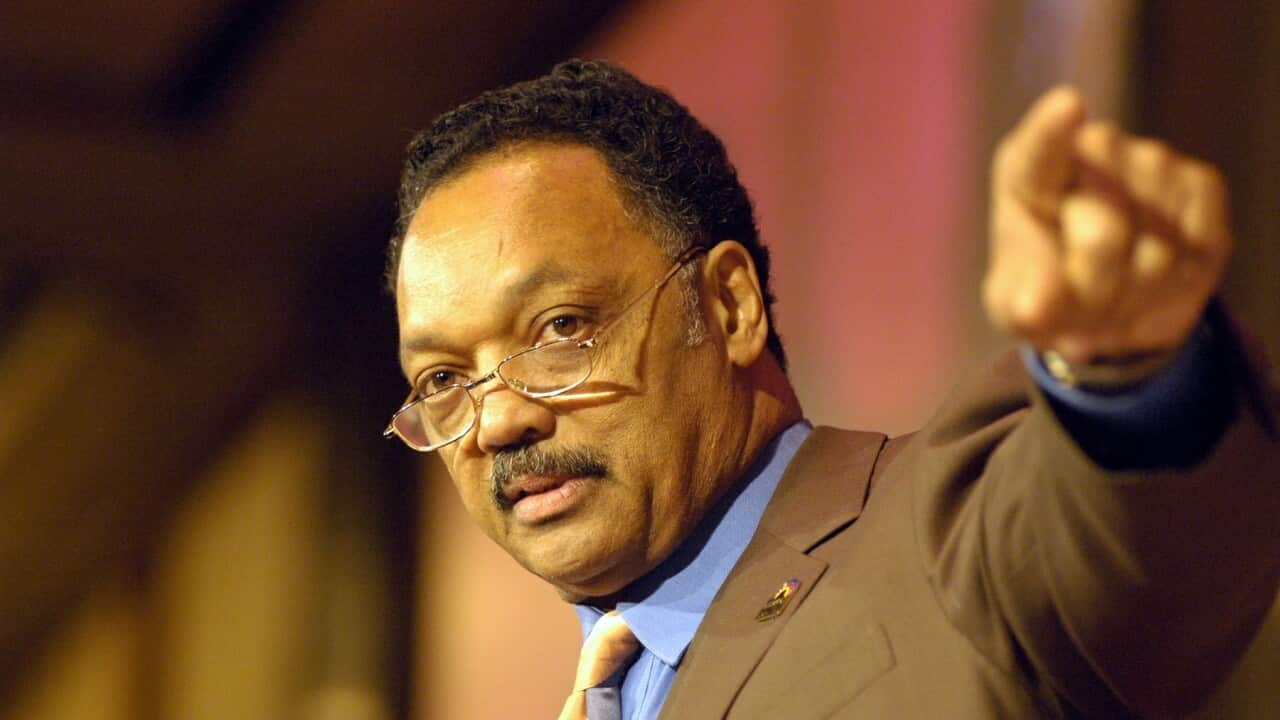

Influential civil rights leader Reverend Jesse Jackson has died at the age of 84. Devoting six decades of his life to political and civil rights activism, Jesse Jackson is being remembered for his charisma and conviction till the very end.
Listen to Australian and world news and follow trending topics with SBS News Podcasts.
TRANSCRIPT
“This campaign has taught me much that leaders must be tough enough to fight, tender enough to cry, human enough to make mistakes. Humble enough to admit them. Strong enough to absorb the pain and resilient enough to bounce back and keep on moving.”
Reverend Jesse Jackson, one of the most influential leaders in the United States' civil rights movement, has died at the age of 84.
The impassioned orator and Baptist minister was a trailblazer in the civil rights movement, marching alongside Martin Luther King Junior in the push for racial equality in America.
His family did not announce the cause of his death, but he was known to have had progressive supranuclear palsy for more than a decade.
Reverend Al Sharpton, a fellow Baptist minister and renowned civil rights activist, says his friend kept fighting till the day he died.
“I once said to him, you're already in history, you've gotten all the honours, why do you keep going? He said, I never learned how to retire. He said you got to remember Al, Dr. King was killed at 39 years old, Medgar Evers was killed at 39 years old, Malcolm X was killed at 39. We were never raised to be 40 years old. He said, I woke up one day at 55, there's no retirement plan for us. And he kept going until this morning.”
Born in South Carolina in 1941, Jesse Jackson spent his early life in the segregated South under Jim Crow laws.
Forced to attend separate schools, denied access to local libraries and segregated from white neighbours, Mr Jackson went on to become a voice for the oppressed in America.
After excelling in his segregated high school and earning a football scholarship to the University of Illinois, he later transferred to the predominantly Black Agricultural and Technical College of North Carolina, where he received a degree in sociology.
Once he graduated, Mr Jackson commenced a masters degree at the Chicago Theological Seminary, stopping three classes short of completion to focus on civil rights activism full time.
Participating in his first sit-in in 1960, he then joined the Selma to Montgomery civil rights marches in 1965, where he drew the attention of Martin Luther King Jr.
After bearing witness to Dr King's assassination, Reverend Sharpton says Jesse Jackson wanted to keep his dream alive.
“When Dr. King died, he was killed in '68, he was talking to Jesse Jackson and Ben Branch over the rail at the Lorraine Motel in Memphis. And Reverend Jackson was literally one of the two last people to speak to him. I always wondered how much trauma that must have been for him to witness Reverend King's assassination. He never would talk about it too much, but it drove him. He kept saying we got to keep Dr. King's dream alive.”
In 1984, with his entry into the Democratic primary race, Mr Jackson became the first Black candidate to seek a major party's nomination since Shirley Chisholm a decade prior.
He then ran for a second time in 1988, but lost to Michael Dukakis, the Massachusetts governor who went on to lose against George H.W Bush.
Undeterred by the losses, Mr Jackson said at the time that anger over the results would do nothing to serve the movement.
“I am too controlled, I'm too clear, I'm too mature to be angry. I am focused on what we must do to keep hope alive. Anger reflects crisis in emotion and therefore irrational behaviour. I simply have been in this struggle long enough to keep my eyes on the prize and keep doing what I've done through this campaign.”
In 1971, after the assassination of Dr King, Jesse Jackson created his own organisation to improve economic conditions for Black people, called People United to Save Humanity, or PUSH.
After his unsuccessful first presidential run, he then created the National Rainbow Coalition to continue the push for voting rights and social programs.
In the mid-1990s, he merged his two organisations to form the Rainbow PUSH Coalition, focusing on educational and economic equality.
Ziff Sistrunk, who runs an organisation that helps felons get jobs, came to pay his respects to Mr Jackson in front of the Rainbow PUSH Coalition headquarters in Chicago.
“What I am somebody means is that all you have to do is just keep pushing. Pushing, keep pushing, and that's what Jesse taught us. And that's why I'm here, and I'm so happy. I'm sad, but I'm more happy than I'm sad because I met him. I can personally say, and all of us can personally say that we met the great Jesse Louis Jackson.”
Mr Jackson was also esteemed across Africa, particularly for his activism against the apartheid regime in South Africa.
Abroad, he also made several high-profile mediation efforts, using his charisma to help secure the release of hostages and prisoners of war.
In 2000, he was awarded the Presidential Medal of Freedom by Bill Clinton for his work in civil rights activism and international humanitarian diplomacy.
Even after he was diagnosed with Parkinson's disease in 2017, Mr Jackson remained active, issuing calls at the UN in 2018 for a ‘global coalition of conscience’ to cement human rights.
“So we're racially equal, but our education is not equal; access to capital is not equal; access to health care is not equal; access to development is not equal. And so, that's the next phase of our struggle beyond racial freedom, racial equality.”
Staying at the forefront of civil rights activism till the end, he stood with George Floyd's family in 2021 after a police officer was convicted of murdering the unarmed man during an arrest.
Reflecting on his work, Al Sharpton says Mr Jackson's legacy and impact lives on.
“So I'm not talking about somebody that just is some removed figure in history. He literally changed American politics, New York politics, and kept the civil rights movement going, and then raised some of us that have been in the forefront in the first part of the 21st century to do what we do, and he's been there with us. When we did George Floyd, he was right there at the church with us when I did the eulogy. He was there with Trayvon Martin. He never stopped.”
Tributes for Mr Jackson have been pouring out since the news of his death.
Survived by his wife and six children, his family wrote in a statement that he was a "servant leader" for the "oppressed, the voiceless and the overlooked around the world."
In Atlanta, local tour guide Paris Weeden was among mourners gathering at the Martin Luther King Jr National Historical Park.
“He was such a poignant activist in the civil rights movement and his legacy will forever, you know, live on. So I know he lived a full life. He was fighting and working for the cause till the very end. And I'm just so grateful. I think it is even, I think, ironic that it happened during Black History Month because he is such a huge figure in Black history as well. So honestly, I just felt gratitude for who he was, the man he was, and the work he did for us and our people.”
In a statement on X, Barack Obama wrote that Mr Jackson laid the foundation for his own victory, praising him as a 'true giant'.
Kamala Harris, the first Black vice president, hailed Mr Jackson as "one of America's greatest patriots."
Joe Biden wrote that Mr Jackson "believed in his bones" in the idea that all people are created equal and deserve to be treated as such.
At the United Nations, Spokesman for the Secretary General Stephane Dujarric gave his condolences.
“The Reverend Jackson lent his powerful voice to the UN's work against racism, against apartheid, and for human rights including taking part in a number of events here at UN headquarters. The Secretary-General extends his deepest condolences. To his families, his loved ones, his friends, as well as the government and the people of the United States.”
President Donald Trump wrote on social media that Jesse Jackson was a good man, claiming credit for helping him in the fight to empower Black Americans.
Last month, Mr Trump told the New York Times that civil rights era protections led to the poor treatment of white people.
As the Trump administration works to roll back and narrow the scope of key civil rights protections, Reverend Sharpton says the fight is far from over.
“We've got to keep fighting. We cannot make a mockery with just mourning him and letting it go. And DEI - diversity, equity and inclusion - which has now been wiped out by this present administration, that was Jesse Jackson saying, 'We've got to diversify our boardrooms, diversify employment for Blacks, for women, for Browns or for LGBTQ.' So we are seeing at a stage where everything he fought for is at risk. And if we want to mourn him, we've got to preserve what he fought for.”